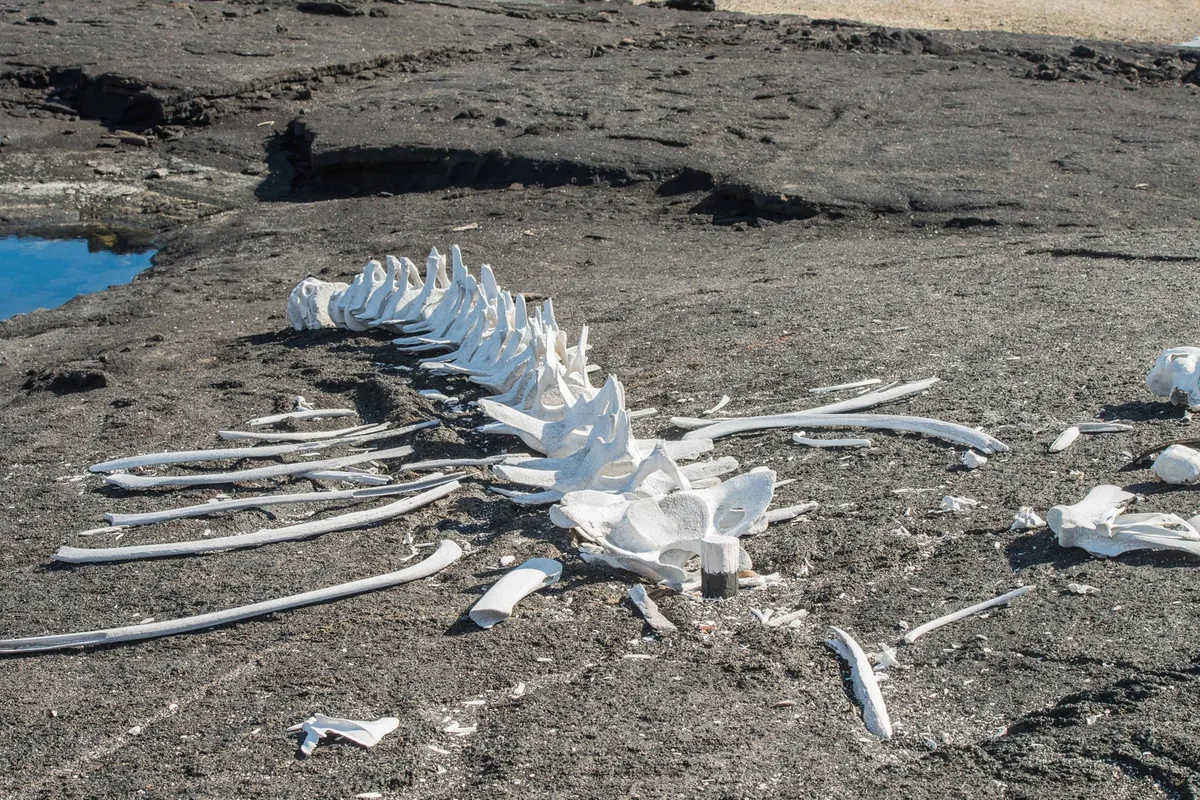
Deep in the Indian Ocean, scientists have found an ancient whale graveyard. This site is filled with fossils and active ecosystems. It offers new clues about how whales evolved and how life forms around their remains.
When a whale dies, its body can create a whole new ecosystem in the deep ocean. First, the carcass might float, attracting sharks. Then, it sinks to the seafloor. There, scavengers and other deep-sea creatures feed on it.
These events are called "whale falls." They are hard to study because they are rare and happen in deep, remote areas. The scientific information about them is still incomplete.
We're a new kind of news feed.
Regular news is designed to drain you. We're a non-profit built to restore you. Every story we publish is scored for impact, progress, and hope.
Start Your News DetoxDiscovering an Ancient Necropolis
A team led by Xiaotong Peng from the Chinese Academy of Sciences found a huge ancient whale graveyard. It is in the Diamantina Zone of the southeastern Indian Ocean.
The site is over five million years old. It is one of the deepest whale fall ecosystems ever found. The discovery was made in February 2023 during a special dive mission. Scientists used the submersible Fendouzhe to explore the seafloor.
They found many whale skeletons and fossils partly buried in the sediment. This showed that whale carcasses had supported life there long after death.
After the first discovery, the team made 32 more dives over the next month. They mapped the graveyard, which stretched about 1,200 kilometers along the seafloor. It was at depths between 4,200 and 7,000 meters. The site contained 476 whale fossils and five active whale falls.
These active whale falls were full of unusual creatures. These included jellyfish, brittle stars, and bone-boring worms. Many of these might be new to science.
The team recovered 43 fossils. They identified five beaked-whale species, like the Andrews’ beaked whale (Mesoplodon bowdoini) and the strap-toothed whale (Mesoplodon layardii). These are known to live in the region. They also found one baleen whale species, the sei whale (Balaenoptera borealis).
The largest find was a five-meter-long Antarctic minke whale. The team identified it by its ear bone shape and genetic analysis. They also found a new, now-extinct whale species called Pterocetus diamantinae.
Scientists used isotopic dating to find the age of the fossils. This method uses the decay of radioactive isotopes. It showed that the oldest fossils are about 5.3 million years old.
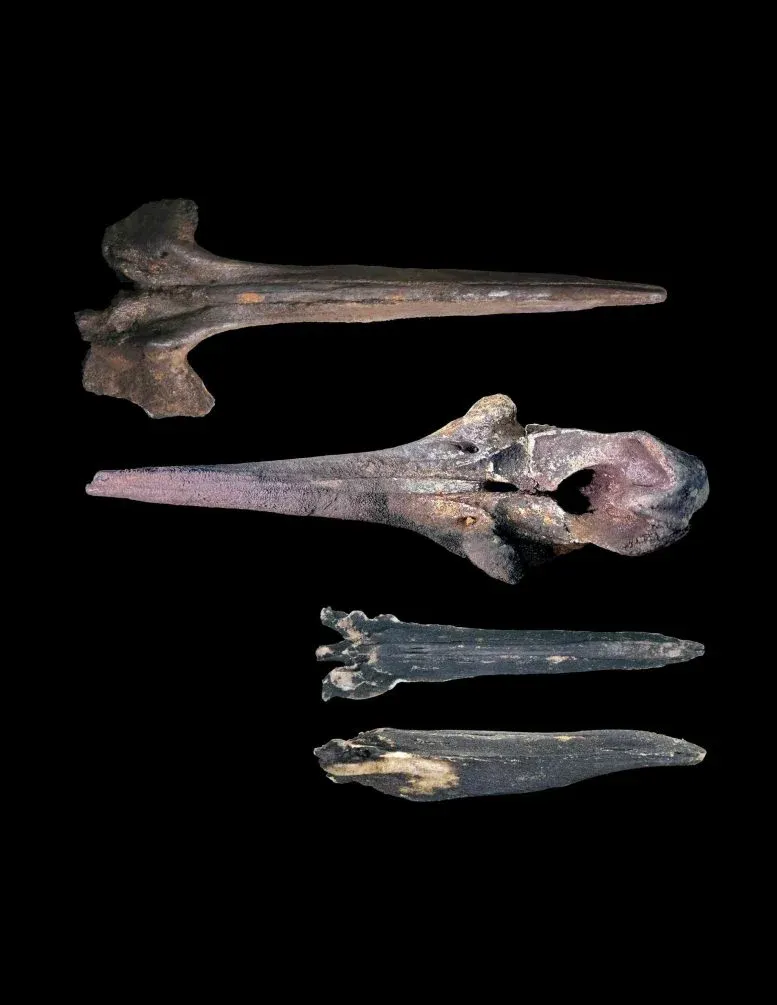 Fossil skulls of three beaked whales recovered from the seafloor of the Diamantina Zone. Credit: Global TREnD
The high number of whale remains in this area is unusual. Researchers think it's because of the V-shaped landscape of the Diamantina Zone. This shape funnels carcasses to the seafloor. Also, many deep-diving beaked whale species live in this part of the ocean.
New Insights into Deep-Sea Life
This research helps us understand whale falls and the amazing ecosystems they support. It also teaches us more about beaked whales. These offshore species often dive up to one kilometer deep and can hold their breath for over an hour.
Finding five-million-year-old fossils gives us a look into the history of beaked whales. It shows their evolution from the Pliocene epoch to today.
This discovery reminds us how little we know about the deep sea. It shows that when we explore, we can find incredible things.
Deep Dive & References
A 5.3-million-year-old deep-sea whale necropolis in the Diamantina Zone - Nature, 2026