Scientists are challenging a long-held idea about how the human brain evolved. For about 70 years, many believed the brain grew in layers. This theory suggested that rational thinking developed on top of older, more primitive emotional parts.
New research, published in Science Advances, suggests a different story. It's not about stacking new parts on old ones. Instead, brain evolution seems to involve a balancing act of wiring and space.
Rethinking Brain Evolution
Nabil Imam, a professor at Georgia Tech, explained that the old theory from the 1950s doesn't fit with how evolutionary biologists think. His team studied both biological and artificial brains. They wanted to see how different brain systems change across species.
We're a new kind of news feed.
Regular news is designed to drain you. We're a non-profit built to restore you. Every story we publish is scored for impact, progress, and hope.
Start Your News DetoxThe brain has limited space and energy. This means it can't make every system bigger at once. Evolution seems to shift resources between two main wiring strategies. These strategies are already set up before birth.
This new idea helps solve a long-standing mystery in brain evolution. It might also help create more efficient artificial intelligence systems.
Beyond the "Lizard Brain"
When people talk about a "logical" brain, they usually mean the neocortex. This outer layer handles vision, reasoning, and other complex tasks. The "lizard brain" is often linked to the limbic system, which controls emotions. However, Imam noted that the limbic system also handles memory, smell, and navigation.
Imam's team looked at how the limbic system and neocortex grow across many species. They found that when one part of the limbic system was larger, other limbic parts also tended to be larger. At the same time, the neocortex tended to be smaller. This suggests a coordinated expansion of these regions, not random growth.
This finding reframes the limbic system. It appears to be a network that expands or shrinks together over evolutionary time.
Wiring Strategies and Tradeoffs
Imam's explanation starts with how brain circuits are organized before birth. The neocortex is like a map. Nearby body parts are represented in nearby brain areas. This wiring works well for information with a clear spatial structure, like vision or hearing.
The limbic system works differently. Its wiring isn't mainly based on physical location. Instead, it uses distinct patterns spread across networks to represent things like smells or complex memories.
To test these wiring styles, Imam's team used artificial intelligence. AI models with localized spatial connections worked well for vision, sound, and touch. Models with distributed, "bar code" style connections were better for smell and memory. This showed that different wiring patterns are better for different kinds of information.
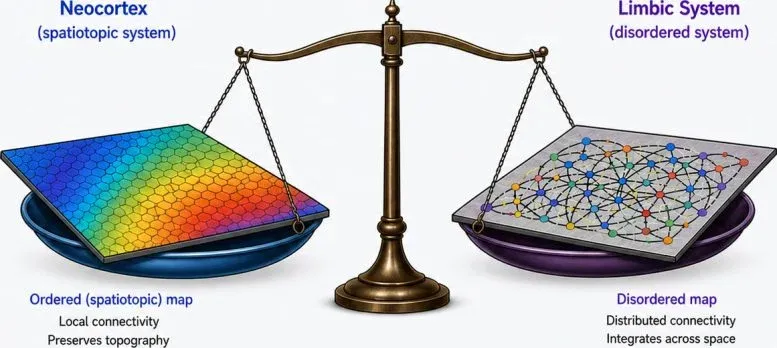 This image shows the two wiring strategies found in the study. Spatially organized circuits in the neocortex (left) keep map-like relationships. Distributed networks in the limbic system (right) connect information across different locations. This creates a tradeoff that might influence how the brain evolves. Credit: Georgia Institute of Technology
Since brain tissue is costly, evolution has to make choices. A species that relies heavily on smell might benefit from larger distributed limbic networks. A species that uses vision more might benefit from a larger neocortex.
The team simulated this tradeoff. When the model rewarded smell, the distributed system grew, and the neocortex shrank. When vision was more important, the neocortex grew, and the distributed system contracted.
This pattern explains differences in real species. The nine-banded armadillo, which relies on scent, has a large limbic system. The squirrel monkey, which is very visual, has a brain dominated by its neocortex. Across 182 species, evolution wasn't stacking reason on instinct. It was reallocating space between different wiring systems to help an animal survive.
Lessons for AI
This research could also help artificial intelligence. Today's AI often needs huge amounts of data to learn. But biological brains start with built-in architecture that guides learning.
Imam noted that the brain isn't a blank slate. It's a mix of nature (pre-wired architecture) and nurture (experience). Translating this architecture to AI systems could make them more brain-like and help them learn more efficiently.
Deep Dive & References
Dual computational systems in the development and evolution of mammalian brains - Science Advances, 2026