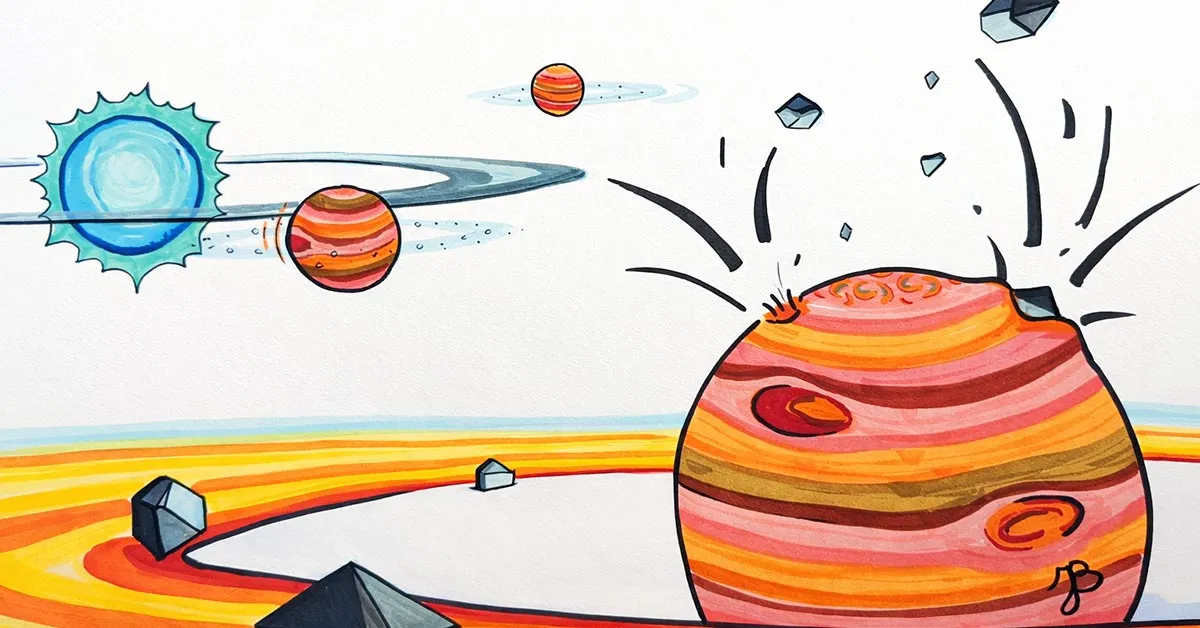
For decades, astronomers have been staring at giant planets and asking, "How exactly did you get so… large?" Now, thanks to the James Webb Space Telescope (JWST), we’re starting to get some answers. And they’re making the line between a planet and a "failed star" blurrier than ever.
Gas giants are basically the universe's biggest hydrogen balloons, likely with dense cores and no solid surface to speak of. Think Jupiter, but on an intergalactic steroid regimen. Scientists have found plenty of these behemoths outside our solar system, some so huge they practically rub shoulders with brown dwarfs — those celestial objects that couldn't quite ignite into proper stars.
How these cosmic heavyweights actually form has been a two-sided debate. One camp championed "core accretion," where rocky bits and ice slowly glom together in a star's gas disk until they're big enough to suck in a whole lot of gas. The other side argued for "gravitational instability," a more dramatic scenario where a chunk of the gas disk just… collapses on itself, star-style. Turns out, the truth might be a little more complicated, and a lot more interesting.
We're a new kind of news feed.
Regular news is designed to drain you. We're a non-profit built to restore you. Every story we publish is scored for impact, progress, and hope.
Start Your News DetoxThe HR 8799 System: An Oversized Family Portrait
Researchers from the University of California San Diego decided to point JWST at the HR 8799 system, a cosmic family portrait about 133 light-years away. This system is basically our solar system's bigger, bolder cousin, boasting four massive outer planets, each weighing five to ten times Jupiter’s mass. They orbit their star at distances that would make Neptune feel cramped, with even the closest planet a whopping 15 times farther out than Earth is from our Sun.
These colossal planets, with their wide, leisurely orbits, threw a wrench into older theories. Traditional core accretion models just couldn't explain how such massive worlds could form before their star had hoovered up all the surrounding gas and dust. It was like trying to bake a giant cake before you had enough flour, and the oven was about to turn off.
JWST Sniffs Out Sulfur in Alien Skies
Enter the JWST. To figure out how these distant worlds came to be, astronomers used spectroscopy, a fancy term for analyzing light to decipher what stuff in space is made of. Previous efforts with ground telescopes could detect water and carbon monoxide, but those weren't ideal for formation clues.
The team, however, went for the good stuff: refractory elements, like sulfur. Sulfur is key because it only exists as a solid in the disk where planets form. So, finding it in a gas giant's atmosphere is like finding a receipt for a construction site in a finished skyscraper — a strong hint that the planet grew through core accretion.
Jean-Baptiste Ruffio, a research scientist at UC San Diego, noted that JWST's incredible sensitivity allowed them to dive deep into these atmospheres. Detecting sulfur, he explained, suggests the HR 8799 planets likely formed like our own Jupiter, despite being far more massive. Which, if you think about it, is both impressive and slightly terrifying.
It also helps that HR 8799 is a cosmic youngster, only about 30 million years old (our solar system is a venerable 4.6 billion). Young planets are hotter and brighter, making them easier to snoop on. And JWST, floating above Earth's atmosphere, delivered observations so clear they allowed astronomers to find detailed signs of several rare molecules, including hydrogen sulfide, hidden until now in the atmospheres of the system's three inner gas giants.
The Planet-or-Not-a-Planet Conundrum
Jerry Xuan, a fellow at UCLA, refined the atmospheric models to confirm sulfur's presence. He described the JWST data quality as "revolutionary." The clearest sulfur signal was on planet HR 8799 c, and researchers believe it's present on all three inner planets. Plus, these planets have more heavy elements like carbon and oxygen than their star, further cementing their "planet" status.
This discovery is prompting a serious rethink of how big a planet can actually get. Quinn Konopacky, a UC San Diego professor, believes it shows that older core accretion models are officially outdated. Newer models, she says, suggest gas giants can form solid cores far from their star. So much for those old limits.
Ruffio, for his part, is still pondering the big questions: "How big can a planet be? Is a planet 15, 20, or 30 times Jupiter's mass still forming like a planet? Where is the line between planet formation and brown dwarf formation?" It seems the universe is still full of surprises, and the JWST is just getting started in blurring the cosmic lines. The search for answers, naturally, continues.