Ancient DNA is helping solve mysteries at Shimao, a huge stone-walled settlement in northern China. This genetic evidence shows where the people came from, how their families were structured, and who was chosen for ritual sacrifices.
A study published in Nature looked at human remains from Shimao, a key late Neolithic site in China. The findings link Shimao's people genetically to southern populations. They also confirm that mass burials of males at the site were part of human sacrifice rituals.
Professor Qiaomei Fu from the Institute of Vertebrate Paleontology and Paleoanthropology (IVPP) led this research. Her team worked with the Shaanxi Provincial Academy of Archaeology and others. Over 13 years, they analyzed 169 ancient human samples from Shimao and nearby areas.
We're a new kind of news feed.
Regular news is designed to drain you. We're a non-profit built to restore you. Every story we publish is scored for impact, progress, and hope.
Start Your News DetoxShimao's Society Revealed
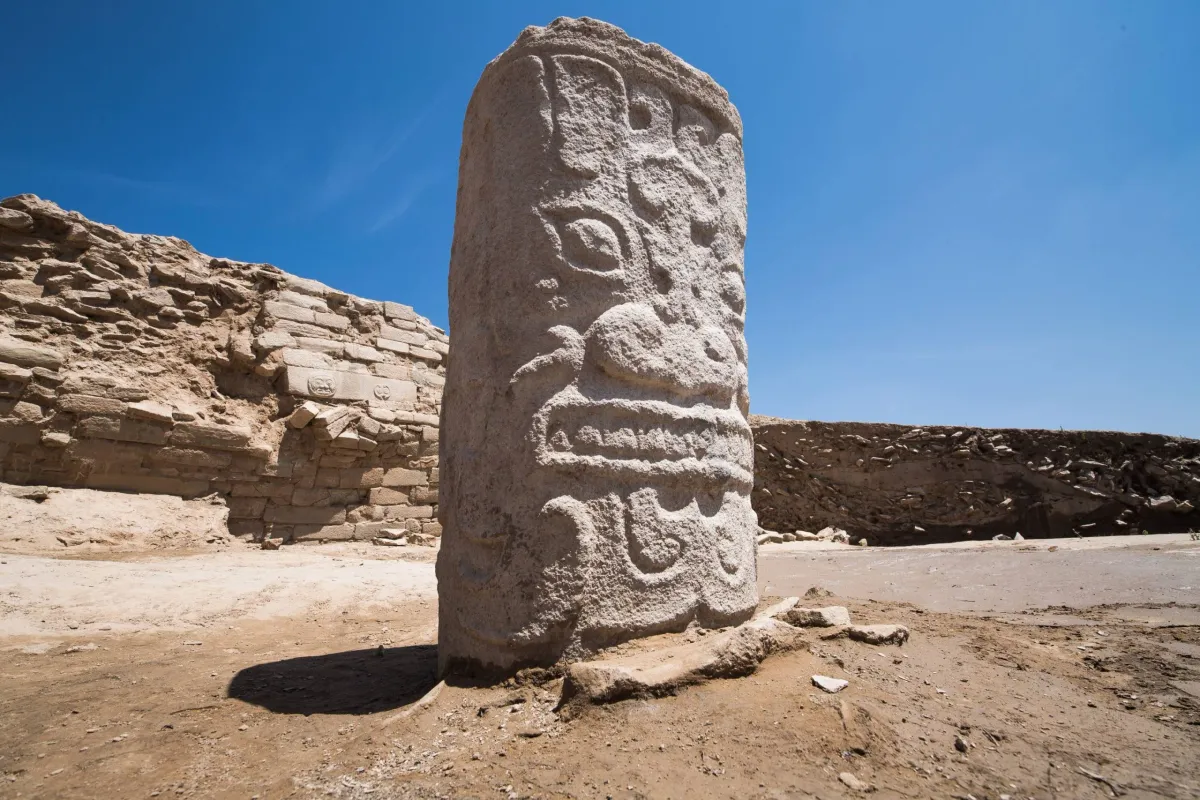
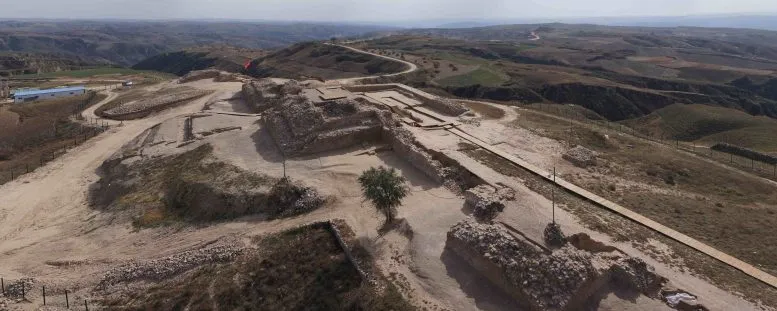
Shimao existed about 4,200 to 3,700 years ago. It was a large, complex late Neolithic settlement in northern Shaanxi Province, China. The stone-walled city covered about four square kilometers. It had different areas for various functions, showing a complex social structure and evidence of human sacrifice.
By comparing these new genomes with older DNA from other Chinese groups, researchers found that Shimao's people mostly came from local groups. These groups lived in the area about 1,000 years earlier. The analysis also showed cultural and genetic links to the Yangshao Culture, a major Neolithic civilization near the Yellow River. This helps explain where the Shimao population originated.
Sacrifice Patterns by Gender
One striking discovery at Shimao was about 80 human skulls found near the East Gate. No other Chinese site before the late Shang period had so many skulls. Genetic analysis also helped reconstruct family trees up to four generations. This showed a society based on male lineage and where wives lived with their husband's family.
The results changed earlier ideas about who was sacrificed at Shimao's East Gate. It was thought that mostly females were sacrificed there. However, the genetic data showed that nine out of ten burials were male.
This pattern was specific to gender. Male sacrifices were mainly at the East Gate. Female sacrificial remains were found in elite burial sites like Huangchengtai and Hanjiagedan. This suggests highly organized rituals with different roles for genders, linked to specific locations and ceremonial purposes.
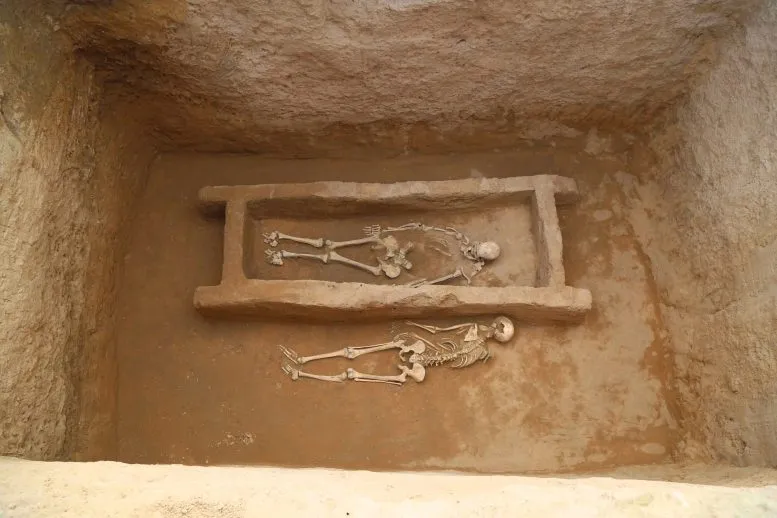 High-level burial (tomb 2020M4) at Zhaishan site (a tomb owner and a sacrificed victim). Credit: IVPP, CAS
Ancient Networks Shaped Power
The study provides genetic proof that Shimao's people largely came from local Yangshao-related ancestors in northern Shaanxi. This shows cultural and genetic continuity in the region for at least 1,000 years. It also found close genetic and cultural ties between Shimao and the Taosi Culture (southern Shanxi), steppe Yumin-related groups, and southern rice farming communities. This points to wide interactions among prehistoric farming and herding groups.
This research also offers the first direct genetic evidence. It helps understand how power might have been passed down, how ruling families were formed, and how social ranks developed during the rise of early East Asian states.
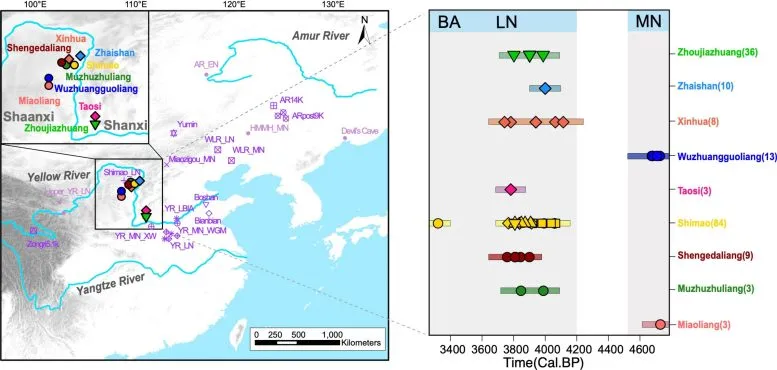 Geographic locations and Temporal distribution of newly sampled archaeological sites. Credit: FU Qiaomei’s team
Deep Dive & References
Ancient DNA from Shimao city records kinship practices in Neolithic China - Nature, 2025