China just launched its Shenzhou-23 mission, and it's not just another rocket ride. This flight is a pretty big deal in Beijing's race to get humans to the moon by 2030. For the first time, one of its astronauts will be spending a full year in orbit. Because apparently, six months just isn't enough anymore.
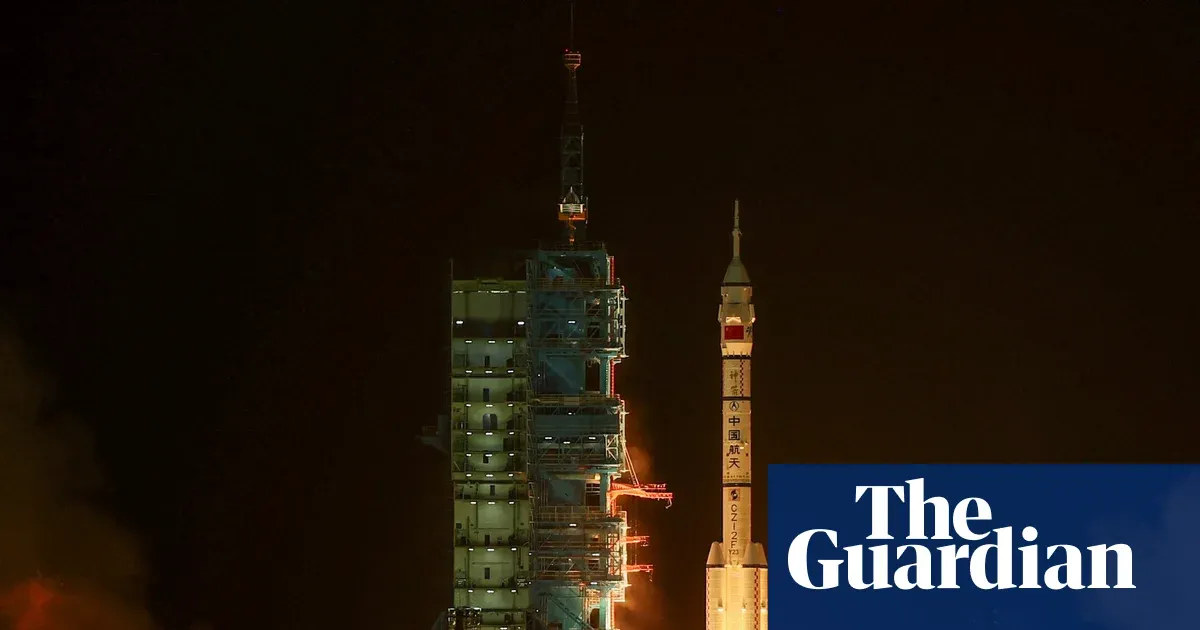
The Long March 2-F rocket, a familiar sight for China's space ambitions, blasted off from the Jiuquan launch center, carrying three astronauts toward the Tiangong space station.
The Year-Long Commute
Among the crew is Lai Ka-ying, 43, from Hong Kong. She's making history as the first astronaut from the territory to go to space. Her previous gig? The Hong Kong police force. From patrolling the streets to orbiting the Earth – quite the career pivot.
We're a new kind of news feed.
Regular news is designed to drain you. We're a non-profit built to restore you. Every story we publish is scored for impact, progress, and hope.
Start Your News DetoxThe other two crew members are space engineer Zhu Yangzhu, 39, and former air force pilot Zhang Zhiyuan, also 39, on his inaugural trip to the stars.
This trio isn't just up there for the view. They'll be tackling a range of science projects, from life sciences and materials science to fluid physics and medicine. But the real headline-grabber is that year-long stay. One astronaut, whose name will be announced later, will essentially become a very high-altitude guinea pig, helping scientists understand the long-term effects of microgravity on the human body.
Because, as Macquarie University astrophysicist Richard de Grijs points out, extended space stays are no walk in the park. We're talking bone density loss, muscle wasting, radiation exposure, sleep problems, and good old psychological fatigue. Plus, you need reliable water and air-recycling systems. And managing a medical emergency when you're light-years from the nearest ER? Crucial. De Grijs notes that China is rapidly racking up experience in keeping its Tiangong space station continuously occupied. Year-long missions are a vital step for future lunar and deep-space goals, pushing both equipment and people to new operational limits compared to those quaint, shorter six-month missions.
The Great Space Race
The Shenzhou-23 mission isn't just about science; it's a strategic move in China's very public race to plant its flag on the moon before 2030, putting it squarely in competition with NASA's Artemis program.
China is also busy prepping its next-gen ride. An orbital test flight for its Mengzhou spacecraft is slated for 2026. This new vehicle is set to replace the current Shenzhou line and will be the designated moon taxi for future astronauts. By 2035, the plan is to start building the International Lunar Research Station, a manned scientific base on the moon.
And for a touch of international flair, China expects to welcome its first foreign astronaut to the Tiangong station by the end of this year – hailing from Pakistan. Over the past three decades, Beijing has poured billions into its space programs, rapidly closing the gap with established space powers like the US, Russia, and Europe. Remember 2019, when China landed the Chang'e-4 probe on the far side of the moon? A world first. Then, in 2021, a rover on Mars. Not bad for a country that was effectively locked out of the International Space Station by the US in 2011, forcing it to build its own orbital home. Sometimes, a little exclusion can be a powerful motivator.