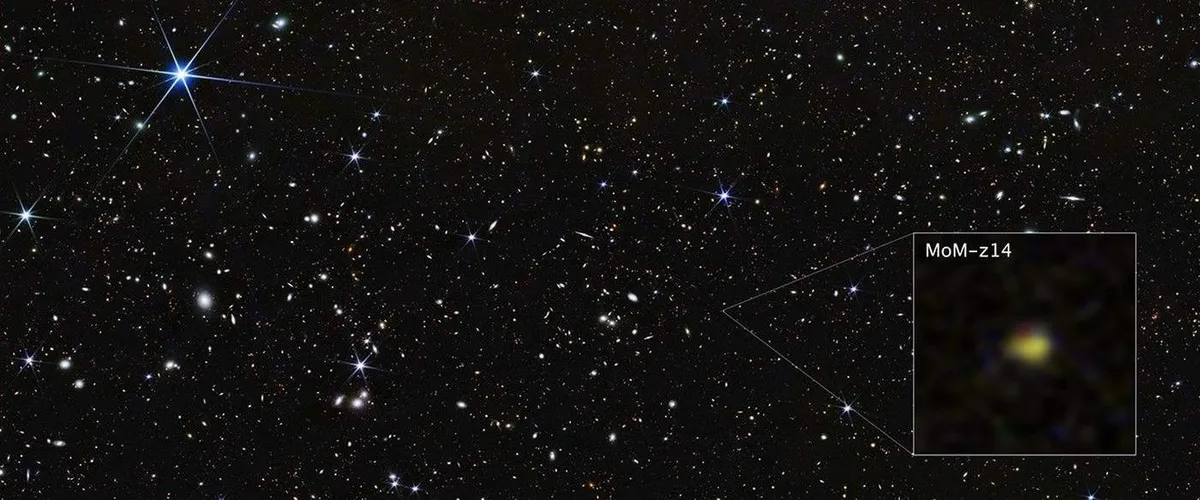
NASA's James Webb Space Telescope just spotted something that shouldn't exist — at least not according to what we thought we knew. A galaxy called MoM-z14 formed just 280 million years after the Big Bang, and it's roughly 100 times brighter than our best theories predicted it should be.
This isn't a small discrepancy. It's the kind of gap that makes astronomers simultaneously excited and slightly unsettled. "We are able to see farther than humans ever have before, and it looks nothing like what we predicted, which is both challenging and exciting," said Rohan Naidu, lead researcher at MIT's Kavli Institute for Astrophysics and Space Research.
What Webb actually found
Using its Near-Infrared Spectrograph, Webb's team measured MoM-z14's light signature and determined it's been traveling through expanding space for about 13.5 billion years — nearly the entire age of the universe. The galaxy's light shows a cosmological redshift of 14.44, a number that essentially acts as a cosmic timestamp.
We're a new kind of news feed.
Regular news is designed to drain you. We're a non-profit built to restore you. Every story we publish is scored for impact, progress, and hope.
Start Your News DetoxBut MoM-z14 isn't alone. It's part of a growing cluster of surprisingly luminous early galaxies that Webb keeps uncovering. Each one challenges the assumption that the young universe should have been dimmer, smaller, and less chemically complex than what we're actually seeing.
One possible explanation comes from an unexpected place: the oldest stars in our own Milky Way. These ancient survivors contain unusually high amounts of nitrogen — the same signature appearing in Webb's observations of early galaxies like MoM-z14. This suggests the dense, turbulent environment of the early universe may have created supermassive stars capable of forging heavier elements much faster than we thought possible.
MoM-z14 also shows signs of actively clearing away the thick primordial hydrogen fog that filled the early universe. This "reionization" period — when the first stars produced enough high-energy light to punch through the cosmic fog — is exactly the era Webb was designed to illuminate. Watching it happen in real time (well, in ancient light) fundamentally reshapes how we understand the universe's first few hundred million years.
The real excitement lies ahead. NASA's upcoming Nancy Grace Roman Space Telescope will extend Webb's reach, potentially cataloging thousands of these bright, compact, chemically-enriched early galaxies rather than just a handful. That shift from a few puzzling exceptions to a large sample could either confirm a major gap in our models or reveal something entirely new about how galaxies form.
"It's an incredibly exciting time," said Yijia Li, a graduate student at Pennsylvania State University, "with Webb revealing the early universe like never before and showing us how much there still is to discover."