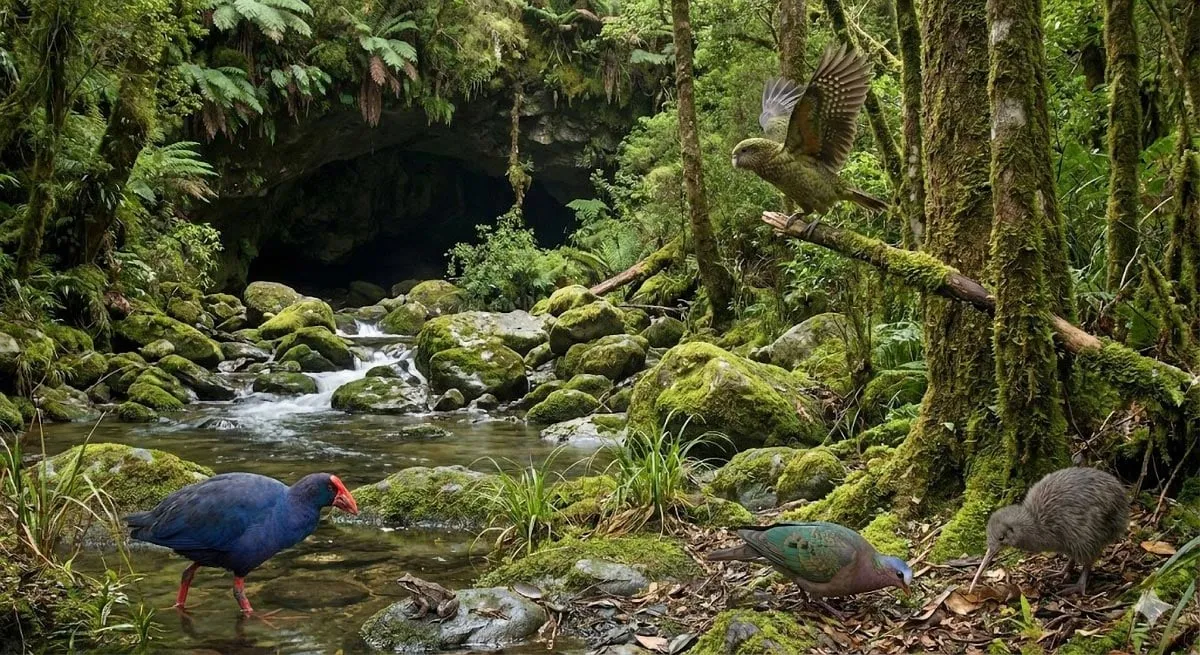
Deep in a cave system near Waitomo on New Zealand's North Island, paleontologists have uncovered something rare: a snapshot of life from a million years ago, preserved between two layers of volcanic ash like pages pressed in a book.
The discovery includes thousands of ancient bones—the largest collection of fossils from this period ever found in New Zealand. Among them is an early relative of the kākāpō, the heavy, flightless parrot that lives in New Zealand today. But its ancient ancestor, Strigops insulaborealis, may have been built differently. Fossil analysis suggests it had weaker legs than the modern kākāpō, which means it might have been capable of flight—a detail researchers will need to investigate further.
The cave also held remains of an extinct takahē ancestor and a now-lost pigeon species related to Australian bronzewings. For paleontologists, these bones fill a gap that's been missing from New Zealand's fossil record for decades.
We're a new kind of news feed.
Regular news is designed to drain you. We're a non-profit built to restore you. Every story we publish is scored for impact, progress, and hope.
Start Your News DetoxA Landscape in Flux
Dr. Paul Scofield, Senior Curator of Natural History at Canterbury Museum, describes the find as solving a puzzle. "From our excavations at St Bathans in Central Otago, we have a snapshot of life in Aotearoa between 20 and 16 million years ago," he explains. "These new findings cast light on the 15 million-year period from then to 1 million years ago, which is largely absent from New Zealand's fossil record. This wasn't a missing chapter in New Zealand's ancient history, it was a missing volume."
What emerges from these bones is a world in constant upheaval. Between one million years ago and human arrival 750 years ago, roughly 33–50% of bird species disappeared. The culprits weren't people—they were supervolcanoes and dramatic climate shifts. The cave itself sits between two volcanic ash layers: one from an eruption 1.55 million years ago, the other from a massive eruption roughly a million years ago that blanketed much of the North Island in meters of ash.
These environmental pressures reshaped New Zealand's wildlife. "The shifting forest and shrubland habitats forced a reset of the bird populations," Scofield says. "We believe this was a major driver for the evolutionary diversification of birds and other fauna in the North Island."
This reframes how scientists think about New Zealand's extinctions. For decades, the loss of the country's unique birds was viewed almost entirely through the lens of human arrival. But this discovery shows that natural forces were already sculpting the islands' identity long before people arrived. The kākāpō, the takahē, and other iconic birds we know today are survivors of a much older story—one written by volcanoes and climate, not just by human hands.