Gravity is the enemy of precision in bioprinting. When researchers try to print living tissue, cells don't cooperate—they sink to the bottom of the syringe like sediment, clogging the nozzle and ruining the carefully designed structure. For years, this has been the invisible problem holding back the entire field.
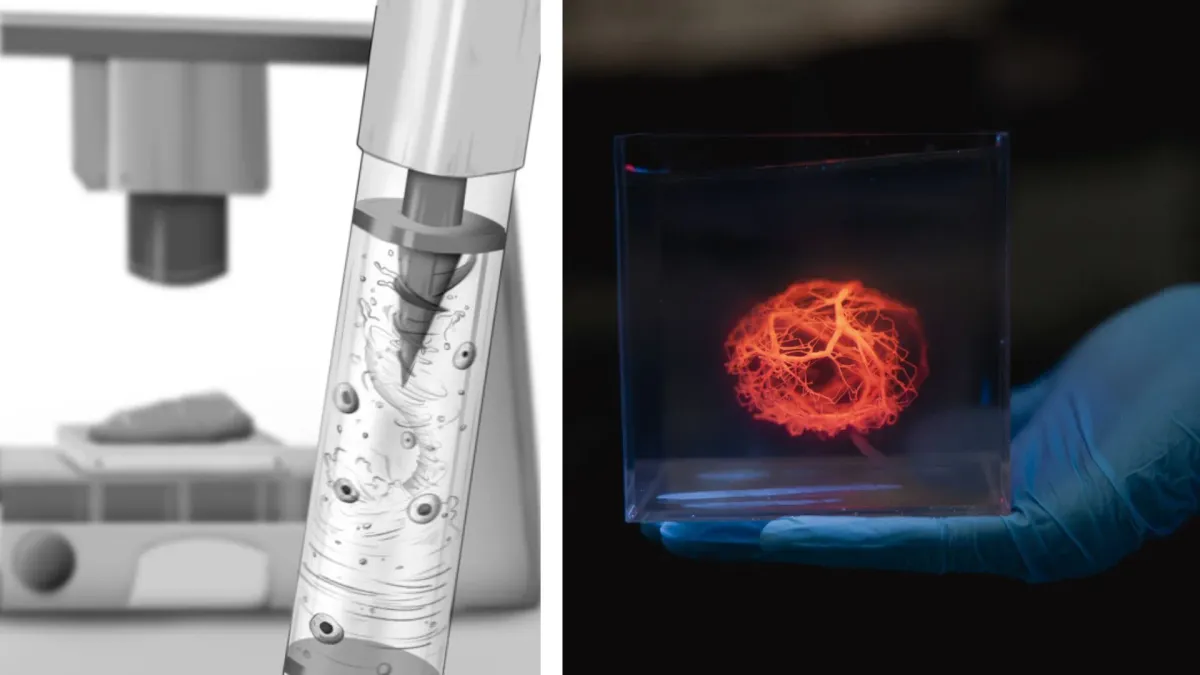
MIT researchers just found a way around it. They've built a device called MagMix—a magnetic mixer so small it fits inside a standard bioprinter syringe—that keeps cells evenly suspended throughout the printing process. In tests, it prevented cell settling for over 45 minutes of continuous printing, which is long enough to print complex tissues without losing consistency.
How a Tiny Magnet Solves a Big Problem
The design is elegantly simple. A magnetic propeller sits inside the syringe, invisible to the bio-ink flowing around it. Outside, a permanent magnet moves up and down, controlling the internal propeller without ever touching the material being printed. No contamination, no interference—just gentle, constant mixing.
We're a new kind of news feed.
Regular news is designed to drain you. We're a non-profit built to restore you. Every story we publish is scored for impact, progress, and hope.
Start Your News DetoxThe MIT team ran computer simulations to find the perfect propeller shape, then tested it with different types of bio-ink. The results were consistent: cells stayed suspended, printing stayed clean, and the cells themselves survived the process with high viability. The researchers can even adjust mixing speeds to find the sweet spot between keeping cells distributed and not stressing them out.
This matters more than it sounds. Right now, when bioprinting fails because of settling cells, researchers waste time, materials, and the biological samples themselves. A reliable mixing system removes that friction. It means more experiments can actually work.
Why This Opens Doors Beyond the Lab
The real significance sits downstream. If researchers can print tissues that actually match what's inside human bodies, they can test drugs on those tissues instead of on animals. The FDA has already started paying attention to these alternatives—there's genuine momentum toward replacing animal testing where possible.
Ritu Raman, the MIT professor leading the work, puts it plainly: "If we can print tissues that more closely mimic those in our bodies, we can use them as models to understand more about human diseases, or to test the safety and efficacy of new therapeutic drugs."
That's not hype. That's the practical path from better printing to faster drug development to fewer animal tests. It's a chain where each link depends on the one before it.
The team's next move is ambitious: they want to print muscle tissue with MagMix and use it to power biohybrid machines—living tissue driving mechanical systems. It's a test of whether the technology can scale beyond printing a single tissue sample. If it works, it proves the reliability and precision required for regenerative medicine to move from concept to clinic.