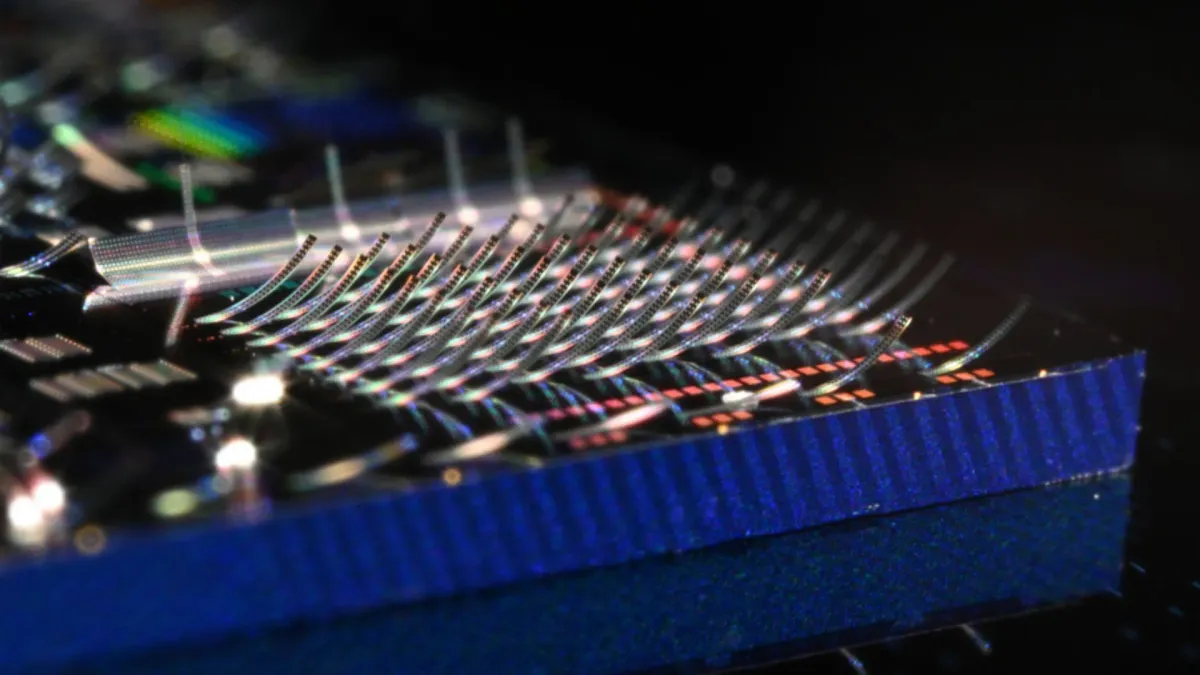
Researchers at MIT and partner institutions have created a new photonic chip. This chip can shoot thousands of controlled laser beams directly into open space.
This technology solves a long-standing problem in photonics. It helps light leave a chip efficiently instead of staying trapped in tiny optical wires. Photonic chips use light, not electricity, to process information. This means faster communication and more data can be sent.
Most photonic systems keep light inside small optical guides on the chip. Engineers have struggled to send this light out into the world efficiently. If light could be projected outward quickly and precisely, it could lead to better displays, smaller lidar systems, faster 3D printing, and larger quantum computers.
We're a new kind of news feed.
Regular news is designed to drain you. We're a non-profit built to restore you. Every story we publish is scored for impact, progress, and hope.
Start Your News DetoxThe findings were published in the journal Nature. Scientists from MIT, MITRE, Sandia National Laboratories, and the University of Arizona worked together on this project.
Tiny Ski Jumps for Light
The new system uses microscopic structures that curve up from the chip's surface. These tiny emitters look like miniature ski jumps that launch light beams into open space.
Each photonic chip has thousands of these structures. Engineers guide light through pathways on the chip toward these emitters. Then, special devices control when each beam turns on and off.
To make these structures, researchers layered two materials. These materials expand differently when they cool after being made. This difference in tension makes the structures naturally curl upward.
Henry Wen, a visiting research scientist at MIT and co-lead author, explained that light travels in wires on a chip. But in our world, light travels freely. Connecting these two worlds has been a challenge. Now, this new platform can create thousands of individually controlled laser beams that can interact with the outside world all at once.
The design is similar to old thermostats. These thermostats use two metals that expand at different rates, causing them to curl as temperature changes. Wen noted that silicon nitride and aluminum nitride were separate technologies. Finding a way to combine them was the key manufacturing breakthrough that made the "ski jumps" possible.
This project came from the Quantum Moonshot Program. This program is a partnership between MIT, the University of Colorado Boulder, MITRE, and Sandia National Laboratories. It aims to build a quantum computing platform using diamond qubits. These qubits need very precise laser beams. Future quantum computers might have millions of qubits, making beam control a big engineering challenge.
Painting Images with Light
Researchers also showed that the system could project detailed, full-color images into open space. These images are about half the size of a grain of table salt.
Each laser beam acts like a pixel. Because the emitters are tiny, the platform can create very dense displays. Wen said the system is so stable that it doesn't need error correction. The pattern stays perfectly still on its own. They just calculate what color lasers need to be on and then turn them on.
This technology could be used for lightweight augmented reality glasses, compact lidar sensors, and faster laser-based 3D printing systems.