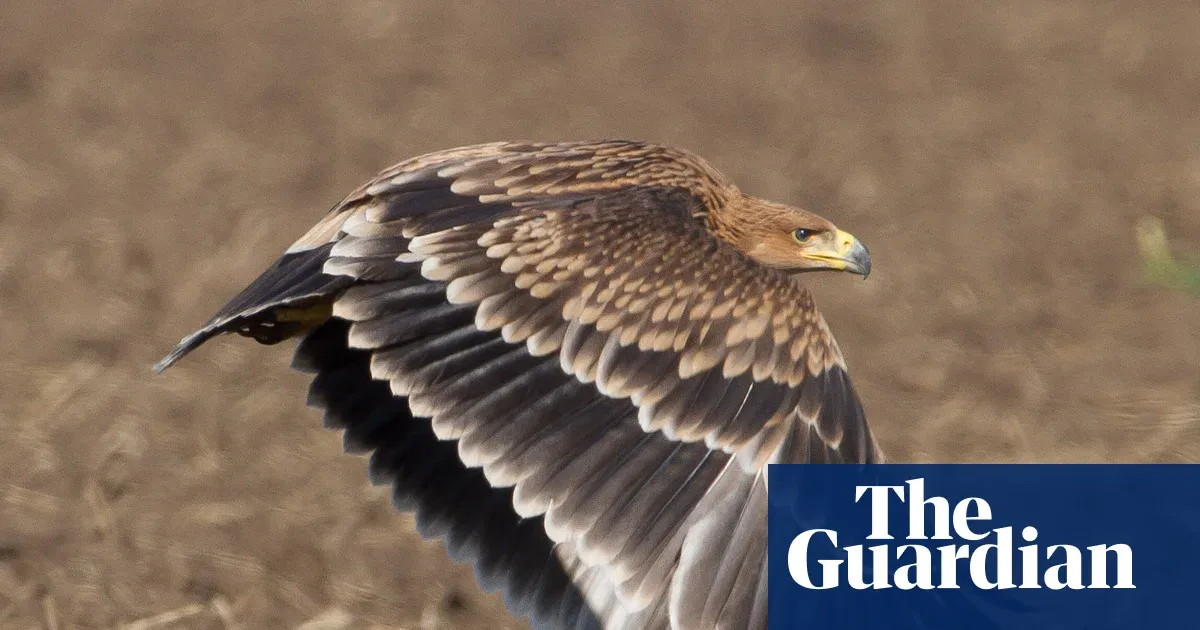
In 2017, Serbia had one breeding pair of imperial eagles left. Last year, ornithologists counted 19 pairs, with 10 successfully raising young. It's a comeback that seemed impossible just a few years ago.
The eastern imperial eagle (Aquila heliaca) nearly vanished from Serbia for reasons that read like a catalog of human carelessness. During the region's decades of conflict, guns were everywhere—and people shot birds of prey for sport or to protect livestock. After World War II, the Yugoslav state ran poison campaigns targeting large predators, which decimated raptors as collateral damage. Then came industrial agriculture: fields expanded, trees were cleared, and the ground squirrels that eagles hunted disappeared along with the grasslands. By the late 1980s, only two small populations remained. One was lost in the 1990s. The other held on until 2015, when intensive fruit farming in the area likely delivered the final blow.
A Population Spills Over
The turnaround came from an unexpected direction. Across the border in Hungary, conservation work had been quietly succeeding for decades. The Hungarian imperial eagle population grew from 20 pairs in the 1980s to 550 today. As those territories filled up, young eagles began dispersing southward. The first one arrived in Serbia in 2011.
We're a new kind of news feed.
Regular news is designed to drain you. We're a non-profit built to restore you. Every story we publish is scored for impact, progress, and hope.
Start Your News DetoxWhen Serbia's last breeding pair faced a critical moment—a storm destroyed their nest during breeding season—the Bird Protection and Study Society of Serbia (BPSSS) made a calculated decision. Volunteers guarded the site around the clock. When the nest collapsed, conservationists carefully removed the chicks, rebuilt the structure, and returned them. The pair fledged successfully.
That single act of intervention, backed by EU funding through the PannonEagle Life project, shifted the entire trajectory. The BPSSS began systematic monitoring, rehabilitating injured eagles, and working with local communities. The fact that the imperial eagle appears on Serbia's national coat of arms helped: people rallied behind a symbol of their own heritage.
The Fragile Edge
But recovery remains precarious. Trees are still scarce in much of Serbia, and eagles don't readily adapt to artificial nesting platforms. Poison—both intentional and accidental—still kills raptors. Power lines electrocute them. Satellite tracking, which would help researchers understand migration patterns, has become complicated by bureaucratic barriers.
Conservationists now find themselves negotiating with farmers, investors, and businesses over land use. It's not a conflict that resolves neatly.
Yet the population is expanding southward along river corridors at 15–20 kilometers per year. Unless something dramatic reverses course, the imperial eagles will keep coming back. What was nearly lost is being reclaimed—slowly, carefully, and against considerable odds.