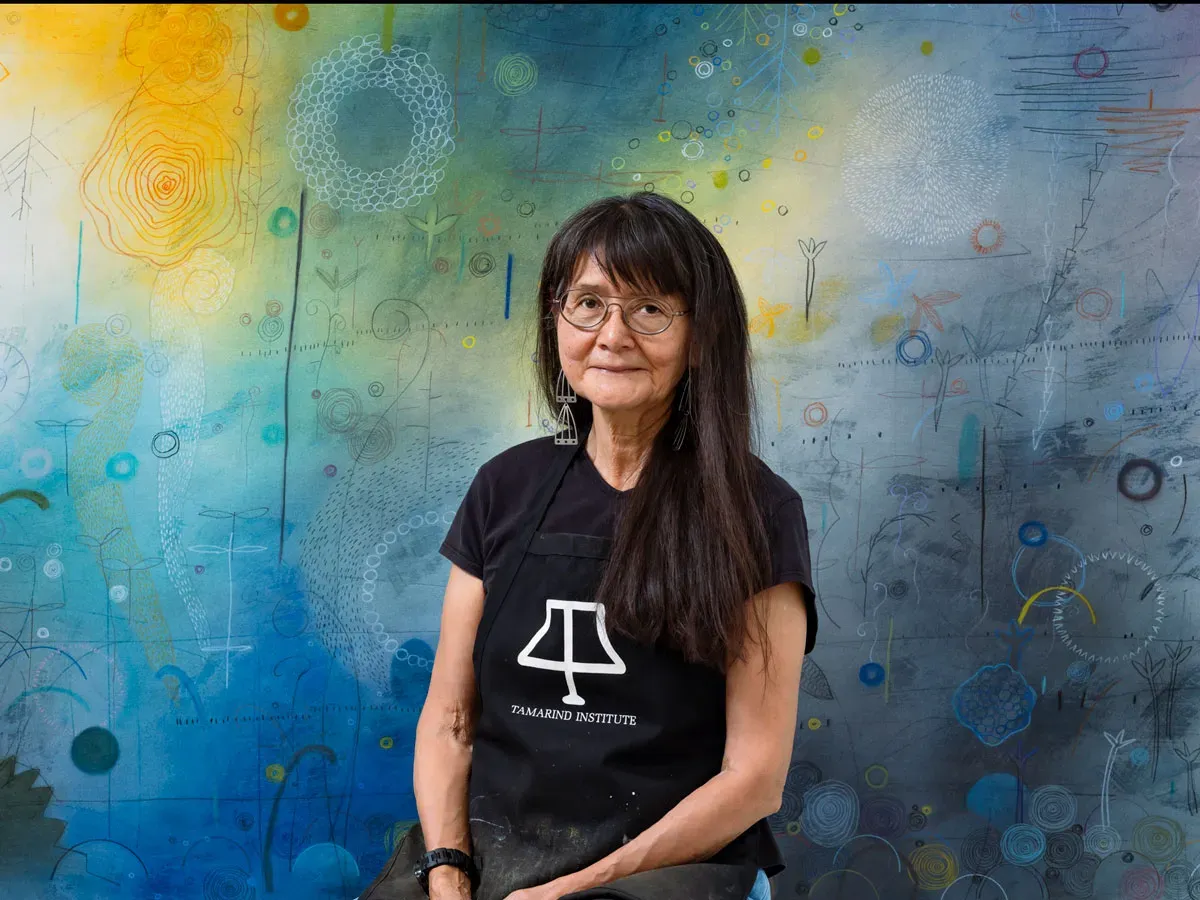
Emmi Whitehorse's paintings exist in a state of quiet luminescence—layered oil washes in blues and greens and burnt oranges, threaded with marks of plants and animals that seem to emerge from memory rather than observation. At 67, after nearly five decades of consistent exhibition presence, she has just joined White Cube, one of the world's most influential contemporary galleries, marking a rare milestone for Indigenous artists in the international art market.
The partnership pairs Whitehorse with White Cube's global roster while maintaining her existing representation with New York's Garth Greenan Gallery. Her debut with White Cube comes this month at Art Basel Hong Kong, where the gallery will present her 2025 painting Father Sky meets Mother Earth. This follows a solo exhibition at White Cube's Paris location last September—a sign the relationship has been building momentum.
Whitehorse's work draws explicitly from Hózhó, a Navajo philosophy centered on harmonious balance between humanity, beauty, and nature. It's not decoration inspired by Indigenous thought; it's art rooted in it. Born in Crown Point, New Mexico in 1957, she studied painting at the University of New Mexico, earning both a bachelor's degree in painting (1980) and a master's in printing (1982). During those years, she cofounded the Grey Canyon Group with Jaune Quick-to-See Smith, a collective of Native American artists determined to challenge stereotypes through their work—a deliberate act of intellectual resistance at a moment when Indigenous artists had few platforms for such visibility.
We're a new kind of news feed.
Regular news is designed to drain you. We're a non-profit built to restore you. Every story we publish is scored for impact, progress, and hope.
Start Your News DetoxThe Long Road to Recognition
Whitehorse's institutional presence has been substantial but fragmented. Her paintings live in major collections—the Whitney, the Brooklyn Museum, Crystal Bridges, the National Gallery of Art in Washington. She was included in the 2024 Venice Biennale's main exhibition and major traveling shows like "The Land Carries Our Ancestors" (2023–24) at the National Gallery of Art. Yet her last solo museum exhibition was in 2006 at the Boulder Museum of Contemporary Art. This gap reveals a structural problem in the art world: Indigenous artists can be collected, exhibited in group shows, and held in prestigious institutions while remaining largely invisible in the solo exhibition circuit that builds sustained career momentum and market presence.
White Cube's move addresses that gap. The gallery's global artistic director, Susan May, noted that Whitehorse's work encourages viewers to "reconsider our relationship with nature," pointing to both the beauty of the natural world and humanity's interdependency with it. It's a reading that takes the paintings seriously as philosophical statements, not as decorative expressions of cultural identity.
The broader context matters: major international galleries have historically underrepresented Indigenous artists, particularly those working in abstraction rather than figurative or traditional forms. Whitehorse's representation is significant precisely because it's still uncommon enough to merit noting. Her career trajectory—decades of work, institutional recognition, and then accelerated international visibility in her late sixties—reflects both her artistic merit and the art world's slow reckoning with its own exclusions.
Whitehorse's next major presentation will likely reshape how her work circulates globally. White Cube's network spans London, Paris, Hong Kong, and beyond. For an artist whose meditative, poetic vision has long deserved wider attention, the timing of this partnership suggests the art world is finally catching up.