Maia Chao starts with observation. She notices the landscape painting in a doctor's waiting room that no one actually looks at. She hears the "um" and "uh" that mark hesitation across 31 languages. She watches tourists in Times Square repeat the same small gesture over and over. Then she asks: Why is this here? What does this tell us about who we are?
These observations become art—the kind that makes you see something mundane and suddenly feel the weight of it. Chao, who trained as an anthropologist before becoming an artist, approaches her practice like fieldwork. She collects, she replicates, she stages. And in doing so, she exposes the strange logic underneath ordinary life.
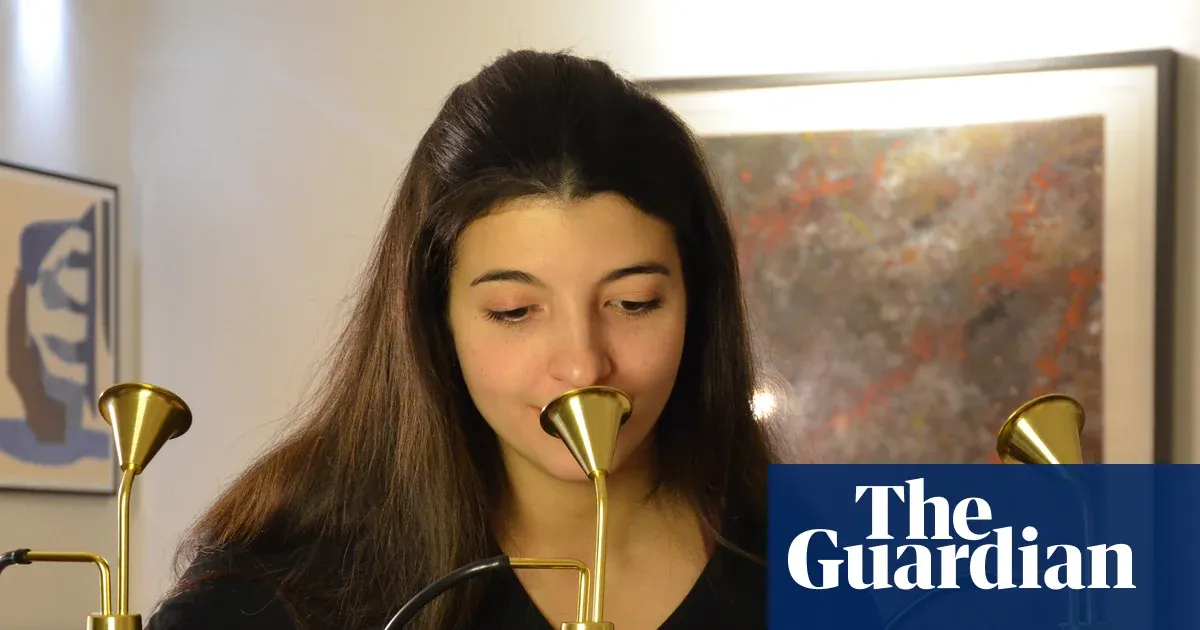
In 2016, she created Hesitation Particles, an audio composition built from interviews with native speakers of 31 languages. She asked them to produce the sounds they use to pause—the filler words that mark thinking in real time. What emerged was something oddly intimate: a crowd of strangers all caught mid-thought, their hesitations layered into something atmospheric and almost meditative. It's a work that transforms a linguistic quirk into a shared human moment.
We're a new kind of news feed.
Regular news is designed to drain you. We're a non-profit built to restore you. Every story we publish is scored for impact, progress, and hope.
Start Your News DetoxHer 2022 project "A Picture of Health" started with frustration. After spending three hours in a doctor's waiting room staring at a landscape painting—"arguably one of the longest times I've contemplated a single work of art," she noted—Chao borrowed paintings from 27 local healthcare providers and exhibited them at Vox Populi Gallery in Philadelphia. But here's where it gets clever: she replaced the originals in the doctors' offices with blank monochromatic canvases. Suddenly there were two simultaneous exhibitions happening across the city. What you saw depended on where you chose to look.
The Institution as Raw Material
Chao has trained her anthropological eye on the art world itself, exposing its contradictions. For "Look at Art. Get Paid" (2015–20), a project developed with collaborator Josephine Devanbu, she invited people who don't normally visit museums to become paid critics. The project, which started at the RISD Museum and has since expanded to other institutions, has engaged over 200 respondents and 41 paid guest critics. The premise is pointed: museums receive public funding, yet 90 percent of their visitors are still overwhelmingly wealthy and white. By paying people outside that demographic to critique art, Chao makes visible what's usually invisible—the gatekeeping that happens through access and belonging.
In her 2021 video The Performance of Making Art, Chao documents her own material conditions with wry honesty: the cost of the car, the education, the honorarium that allow her to make the video itself. She's not critiquing art-making; she's naming the economic structures that make certain kinds of art-making possible for certain kinds of people. This is her consistent throughline—labor, precarity, and the ways capitalism has colonized our time and bodies.
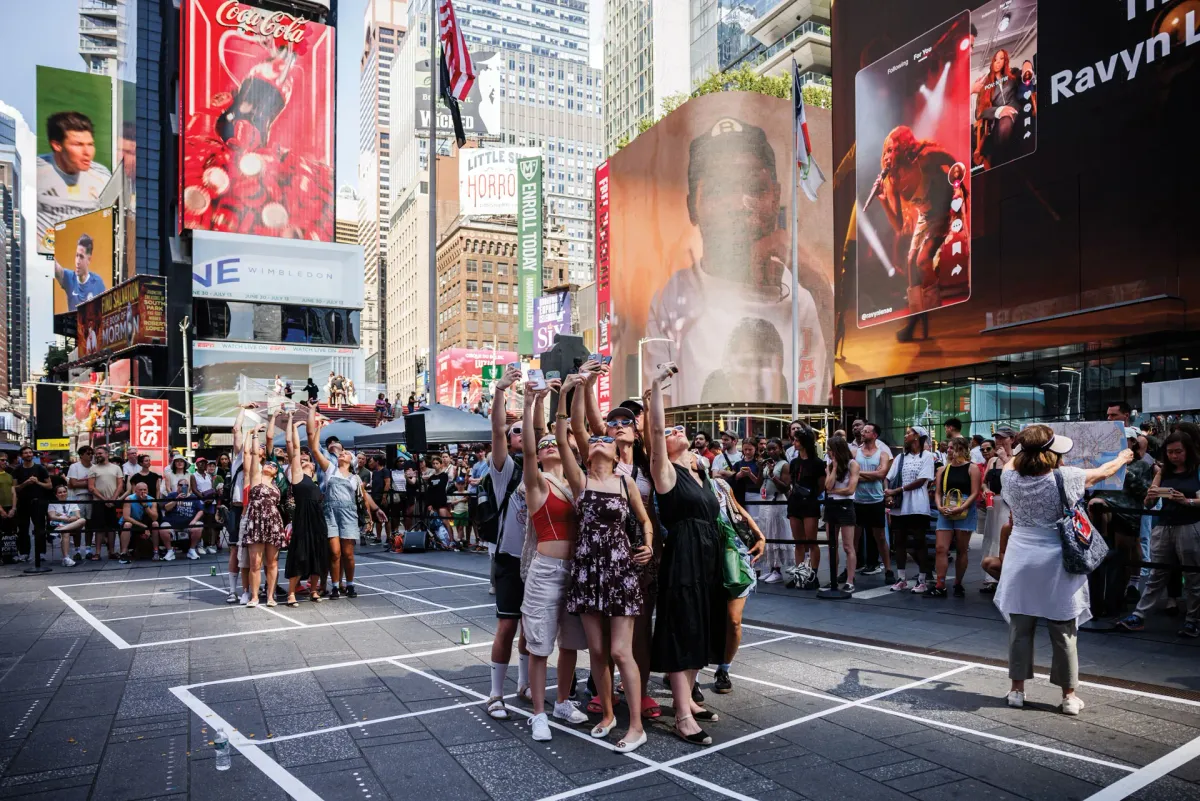
Her 2025 commission for Times Square Arts, American Idle, created with choreographer Lena Engelstein, takes this further. For an hour, performers surrounded by the relentless spectacle of Times Square advertisements repeat small, mundane gestures: cooling themselves with a shirt, taking a selfie, eating chips. Chao drew these movements from observation—tourists caught in loops—but also from crowd simulation software, those 3D figures designed to fill digital spaces. Each performer had an identically dressed doppelgänger, doubling the uncanniness. Near the end, the performers count down to a new year that never arrives. Some of the doubles kiss. Some cry. The piece turns waiting, idling, and repetition into something both comic and unsettling.
Now Chao is preparing for the 2026 Whitney Biennial, where she'll create a wandering live performance inside the museum itself. She's building a libretto from recordings of friends exploring the space—their actual conversations about needing the restroom, wanting to sit down, getting hungry. By focusing on the bodily, unglamorous aspects of being in a museum, she dresses down the institution. She even draws attention to the museum's "Replication Committee," a real administrative body whose name, under her gaze, becomes almost absurd.
What Chao does, consistently, is take the scripts we live by—the gestures, the words, the systems—and hold them up to the light. In doing so, she makes the familiar strange enough that we can actually see it. That's the anthropologist's gift: the ability to look at your own world as if seeing it for the first time, and to ask why we accept what we accept.