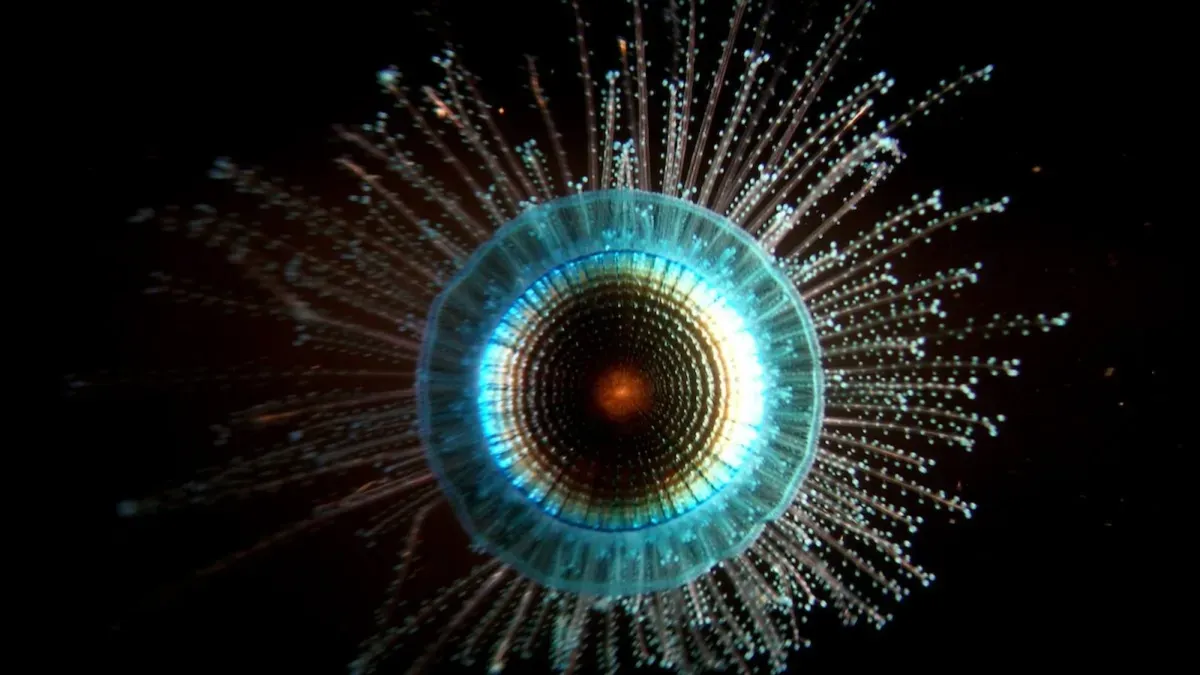
The blue button jelly looks like an eye that shouldn't exist in nature — a brilliant blue disc the size of a coin, ringed with delicate tentacles that radiate outward like sun rays. At its center sits a caramel-colored core. If you squint, it resembles the Eye of Sauron. But instead of surveying a dark realm, this creature is drifting on the ocean's surface, quietly hunting zooplankton.
What makes the blue button jelly truly strange isn't its appearance — it's what it actually is. Scientists still aren't entirely sure.
The puzzle of organization
The blue button (Porpita porpita) belongs to a group called cnidarians, which includes corals, jellyfish, and the notorious Portuguese man-of-war. It's small — rarely wider than an inch — and built from a float and multiple tentacles, some equipped with stinging cells for hunting and defense.
We're a new kind of news feed.
Regular news is designed to drain you. We're a non-profit built to restore you. Every story we publish is scored for impact, progress, and hope.
Start Your News DetoxBut here's where it gets interesting. Researchers classify the blue button as a "quasi colonial organism," which is a polite way of saying: we're not entirely sure if this is one animal or many working as one. Larry Madin, a jellyfish expert at the Woods Hole Oceanographic Institution, describes it this way: some tentacles catch food, others defend against threats, and still others handle reproduction — all suspended from the same float.
"People have been confused for a long time about whether it's really a colonial animal, like a coral is, or just a single animal with multiple parts," Madin explains. The distinction matters because it challenges how we understand what counts as a single organism.
Unlike the Portuguese man-of-war, which has specialized parts for different jobs, the blue button uses its many tentacles as a coordinated hunting team. They secure prey, then pass it to a central stomach for digestion.
Predator and prey
The blue button itself isn't alone in the food chain. It has a predator that sounds equally fantastical: the Glaucus, a swimming snail known as the blue dragon. This creature — which looks like it escaped from Avatar's Pandora — hunts blue buttons across tropical and subtropical oceans.
The exact nature of how the blue button organizes itself as a creature remains unresolved. But that uncertainty is part of what makes ocean biology so compelling. The surface waters are full of creatures that challenge our categories and remind us how much we still have to learn about the living world.