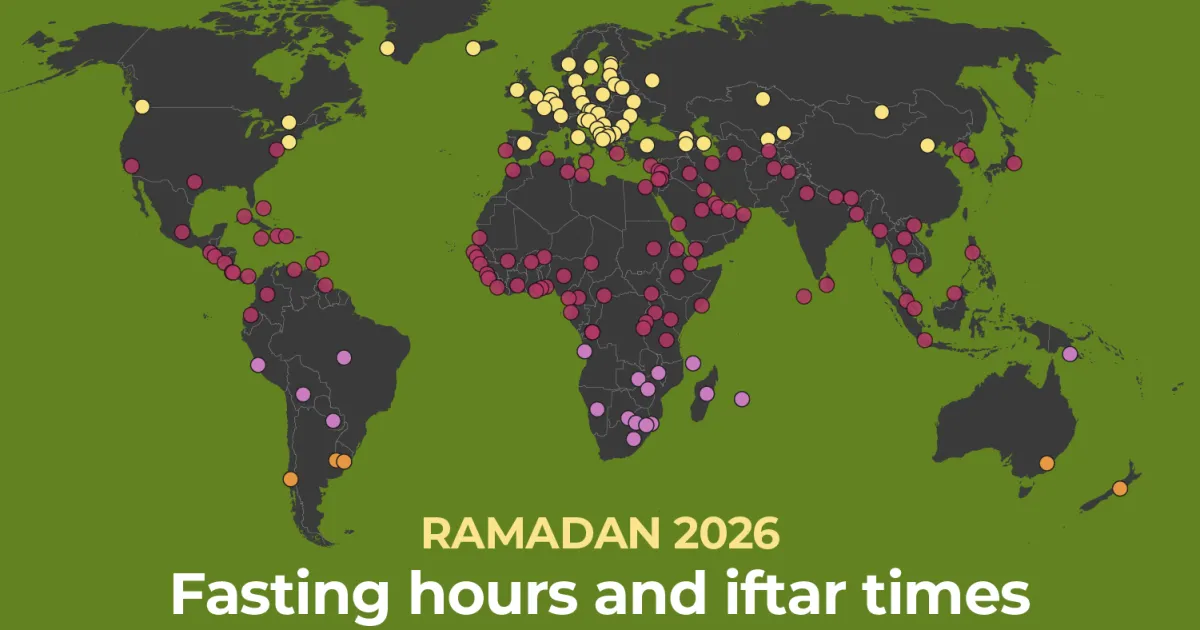
Ramadan 2026 starts on February 18 or 19 — the exact date depends on whether the crescent moon is sighted. For the roughly 1.8 billion Muslims observing the fast, this means 29 or 30 days of abstaining from food and water between dawn and dusk, a daily commitment that varies dramatically depending on where you live.
The reason Ramadan's calendar date keeps shifting is built into the Islamic lunar calendar itself. The Hijri calendar doesn't align with the solar year — it's about 11 days shorter. So each year, Ramadan arrives roughly 10 to 12 days earlier than the previous year. This creates a slow, decades-long cycle where Ramadan gradually moves through all four seasons.
Fasting hours depend on geography and season
In 2026, winter in the Northern Hemisphere means shorter days — and shorter fasts. Someone fasting in London or Cairo will spend roughly 12 to 13 hours without food or water on the first day of Ramadan. That's actually a relief for the roughly 90% of the world's Muslim population living north of the equator. The trade-off is built in: as the years progress, fasting hours will lengthen. By 2031, when Ramadan aligns with the winter solstice (the shortest day of the year), Northern Hemisphere fasters will have their easiest month in the cycle.
We're a new kind of news feed.
Regular news is designed to drain you. We're a non-profit built to restore you. Every story we publish is scored for impact, progress, and hope.
Start Your News Detox
The Southern Hemisphere experiences the opposite rhythm. Fasters in Chile, New Zealand, and South Africa will face their longest days — 14 to 15 hours without food or water on day one. But this too shifts over the cycle. The lunar calendar's rhythm means that the physical experience of Ramadan is never quite the same twice in a person's lifetime.
Beyond the mechanics, Ramadan carries cultural weight. The month is marked by communal iftars (the meal that breaks the fast at sunset), pre-dawn suhoor meals, and greetings exchanged across Muslim-majority countries. "Ramadan Mubarak" (blessed Ramadan) and "Ramadan Kareem" (generous Ramadan) are the most common wishes, each carrying a slightly different sentiment — one emphasizing blessing, the other generosity.

The practical details — exact suhoor and iftar times for your city — will matter most to those observing. The shifting calendar means that no two Ramadans feel identical, and that's by design. The spiritual practice meets the physical world in different ways each year.