A two-year-old male mountain lion spent 30 hours navigating the streets of San Francisco's Pacific Heights neighborhood before wildlife officials tranquilized and relocated him—a rare but increasingly familiar story in a city hemmed in by development.
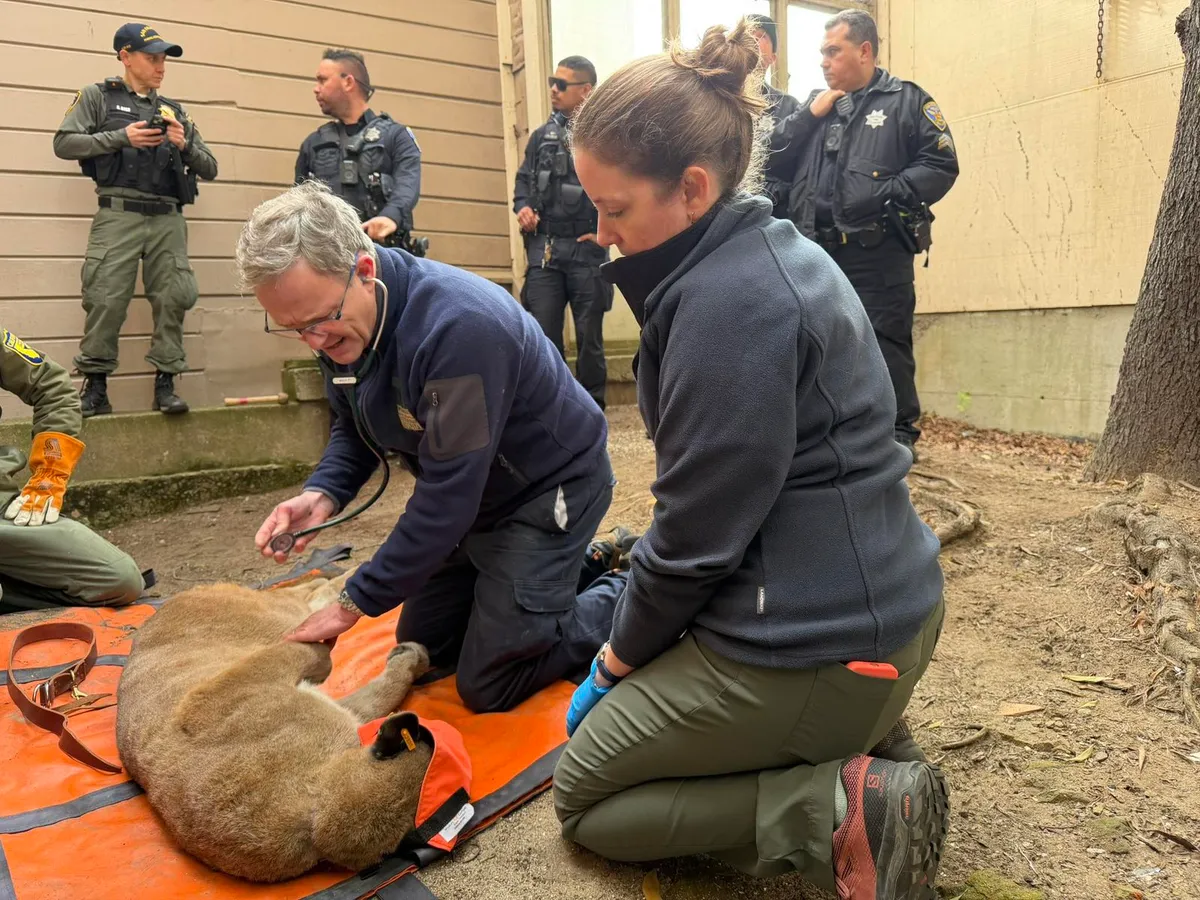
On January 26, residents spotted the 77-pound cat, known as 157M, prowling near an apartment complex. He'd wandered into one of the densest parts of the city, a place where mountain lions almost never venture. Parks and a private school closed while officials from the California Department of Fish and Wildlife, San Francisco Animal Care and Control, the Zoo, Police, and Fire Department coordinated the search. By the next evening, they'd cornered him in the narrow gap between two buildings, tranquilized him, and placed him in a cage.

Wildlife researchers already knew 157M. He was born in April 2024 near Rancho San Antonio County Park, about 30 miles south, and had been tracked by the Santa Cruz Puma Project—a collaboration between UC Santa Cruz and state wildlife officials running since 2008. His original tracking collar had fallen off as he grew, so researchers lost sight of his movements. Until he showed up in the city.
We're a new kind of news feed.
Regular news is designed to drain you. We're a non-profit built to restore you. Every story we publish is scored for impact, progress, and hope.
Start Your News DetoxWhy a young lion ends up in the city
At two years old, 157M is in what ecologists call a "dispersal phase." He's recently left his mother and is searching for territory—which is the problem. The Santa Cruz Mountains, where his kind naturally live, are increasingly surrounded by highways, suburbs, and sprawling development. "Males will often travel far out," explains Chris Wilmers, lead researcher of the puma project. "They're essentially trying to find a vacant territory, and the Santa Cruz Mountains are pretty trapped in by development on all sides. They wander, and they keep going, and they end up in one of those places—San Francisco, Silicon Valley, Highway 101."
This isn't entirely surprising. The last confirmed mountain lion sighting in San Francisco was in Bernal Heights in 2021. But the species is native to California and once roamed far more widely. They're remarkably adaptable predators—found from Canada to Chile, thriving in forests, grasslands, and deserts. In Argentina, they've recently started hunting penguins. The real constraint now is space and the human infrastructure that fragments it.
157M was lucky. Many mountain lions that wander into urban areas are hit by cars or killed by other hazards. This one survived long enough to be found and relocated. After his recapture, officials will fit him with a new tracking collar and release him in a more rural part of the Peninsula. The Santa Cruz Puma Project's public tracker will let San Franciscans follow his movements—delayed by eight weeks to protect his privacy, so to speak.
Whether he becomes a local celebrity like Claude the albino alligator or Sutro Sam the river otter remains uncertain. But as Cassandra Costello, interim co-CEO of the San Francisco Zoo, noted to the New York Times, San Franciscans have a soft spot for their wildlife. "Animals are a great distraction from everyday life," she said. "A mountain lion walking on city streets is something that really mesmerizes the public." In this case, that public fascination may have helped ensure the animal's safe passage home.