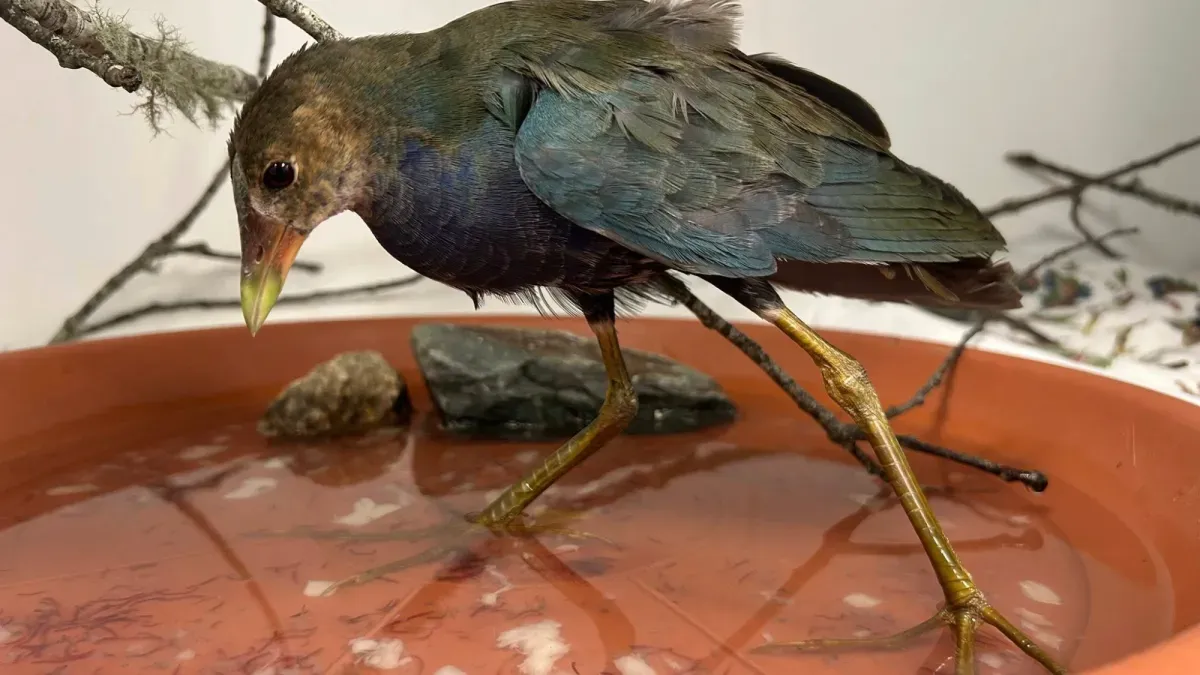
A purple gallinule—a jewel-toned marsh bird with improbably large feet—ended up in a New Bedford, Massachusetts backyard after a winter storm pushed it thousands of miles off course. The bird, built for wading across lily pads in southeastern swamps, had no business being in New England. But there it was, exhausted and starving.
When a local resident spotted the unexpected visitor and called the New England Wildlife Center, staff realized they were looking at something genuinely rare: the first purple gallinule the center had ever admitted. In the past decade, Massachusetts has documented only a handful of sightings. These birds belong in the marshes from the southeastern U.S. through South America, not shivering through a Massachusetts winter.
A detour that nearly cost everything
The gallinule arrived severely underweight and in poor condition. The wildlife team faced a delicate problem: the bird needed food and water urgently, but rushing refeeding could trigger a fatal metabolic crash called refeeding syndrome. They had to rehydrate slowly and introduce nutrients with careful precision—the kind of medical attention that separates survival from tragedy.
We're a new kind of news feed.
Regular news is designed to drain you. We're a non-profit built to restore you. Every story we publish is scored for impact, progress, and hope.
Start Your News DetoxStorm systems regularly push southern birds north along the Atlantic coast, a phenomenon wildlife staff see each winter. But displacement is one thing; recovery is another. This bird's survival depended on people who understood both the biology and the logistics.
As the gallinule's condition improved over the following weeks, the New England Wildlife Center coordinated with partners across state lines. On January 8th, volunteers piloted a small private plane carrying two purple gallinules—this one and another found in Vermont—south to South Carolina. The Carolina Wildlife Rehabilitation Center picked them up and prepared them for release further south, back into their actual range.
What's quietly remarkable here isn't the storm itself. It's that when a rare bird landed in the wrong place, a network of people moved to send it home. No fanfare, just the unglamorous work of rehabilitation: the X-rays, the feeding protocols, the volunteer pilots, the interstate coordination. The bird's resilience mattered, but so did the human infrastructure that met it halfway.