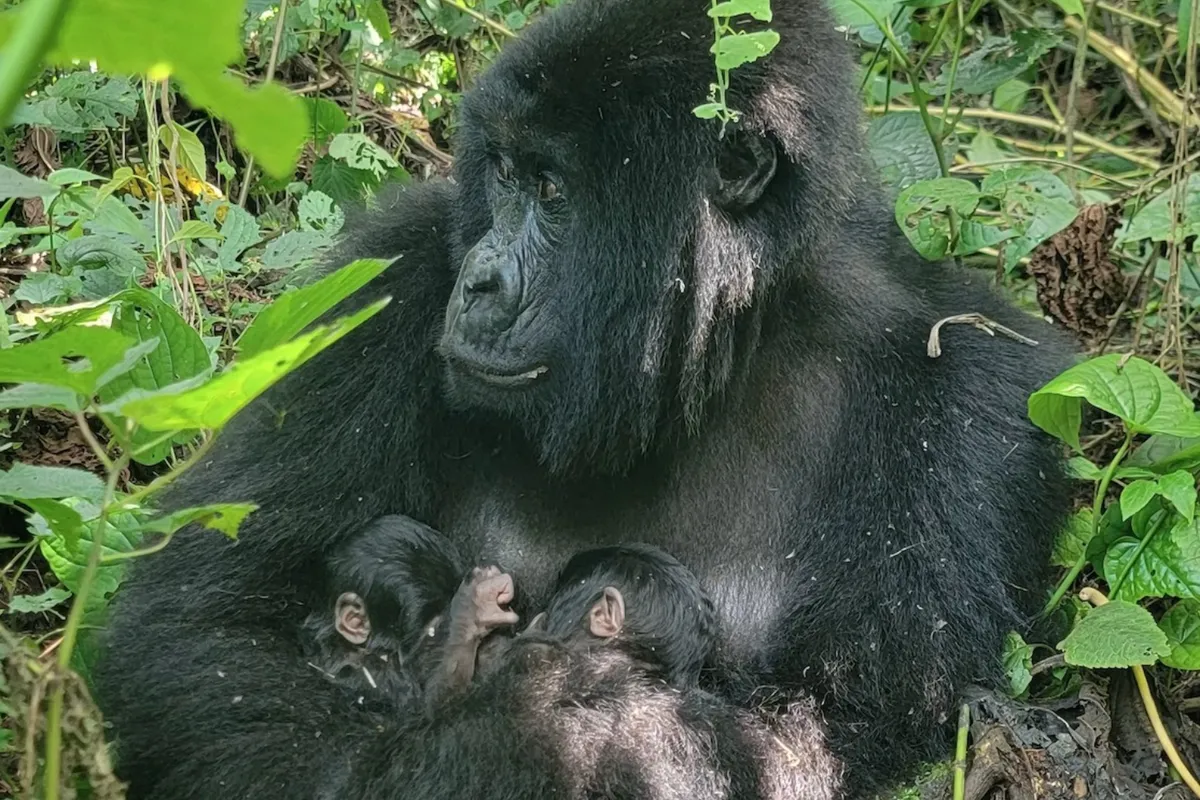
On January 3, community trackers in Virunga National Park spotted something that almost never happens: two healthy newborn male mountain gorillas. Their mother, 22-year-old Mafuko, had given birth to twins before—in 2016—but those infants didn't survive. This time feels different.
Twin births in mountain gorillas occur in less than 1% of all recorded births, compared to about 3% in humans. The rarity alone makes this moment significant. But what makes it genuinely striking is what it represents for a subspecies that was once headed toward extinction.
Why This Matters Now
Mountain gorillas live in the high-altitude forests of central Africa, at elevations between 8,000 and 13,000 feet. Their thick fur keeps them warm in that chilly climate. They're massive animals—up to 440 pounds, standing five and a half feet tall—and they live in tight family groups. Mafuko belongs to Virunga's Bageni family, which now numbers 59 individuals, the largest group of mountain gorillas in Africa's oldest national park.
We're a new kind of news feed.
Regular news is designed to drain you. We're a non-profit built to restore you. Every story we publish is scored for impact, progress, and hope.
Start Your News DetoxThere are roughly 1,075 wild mountain gorillas left on Earth, with about 350 living in Virunga. That number would have seemed impossible just decades ago. War, hunting, and habitat destruction nearly wiped them out entirely. Mafuko herself carries that history—her own mother was killed by armed individuals in 2007. Yet somehow the population has recovered.
But recovery is fragile. These animals reproduce slowly. Females don't start having babies until around age ten, and they give birth only once every four years. That means every birth—especially twins—carries enormous weight.
Raising two infants simultaneously pushes a mother to her biological limits. She's responsible for all their care. She must carry both babies—which makes movement difficult in those early weeks when they can't yet cling properly—while producing nearly double the milk. About 25% of mountain gorilla infants don't make it past infancy due to trauma, disease, or infanticide.
Mafuko's previous twins didn't survive. This time, Virunga's team is providing additional monitoring and protection during those critical first four weeks. Jacques Katutu, an ecological monitoring officer at the park, put it plainly: "Twin births in mountain gorillas are extremely rare and always present significant survival challenges. We are cautious and vigilant, while also maintaining hope."
That balance—caution and hope—captures what conservation looks like in practice. Not denial of the difficulties. Not naive cheerfulness. Just steady attention to the moment when a mother and her twins need it most.