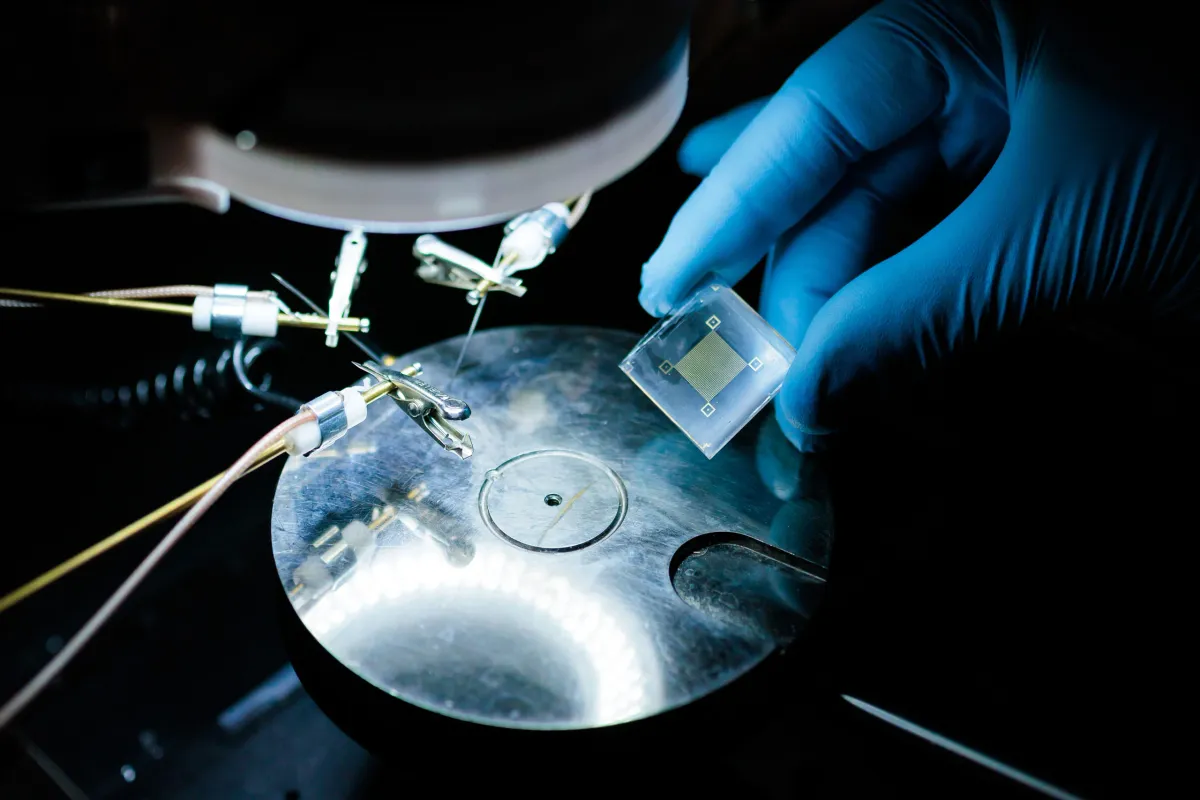
Scientists at the University of Chicago Pritzker School of Molecular Engineering (UChicago PME) have created a new skin-like computing patch. This patch can analyze health data using artificial intelligence directly on the body.
Unlike regular smartwatches, this device performs AI calculations in milliseconds. It does not need to send information wirelessly to external servers. This speed is crucial for detecting serious conditions like ventricular fibrillation, a dangerous heart rhythm disorder where every moment counts.
A New Kind of Wearable Technology
The new device was developed and tested with researchers at Argonne National Laboratory. Its creation was possible thanks to new manufacturing methods that allow organic electrochemical transistors to be printed onto flexible materials.
We're a new kind of news feed.
Regular news is designed to drain you. We're a non-profit built to restore you. Every story we publish is scored for impact, progress, and hope.
Start Your News DetoxSihong Wang, an associate professor at UChicago PME and co-senior author of the study, explained their goal. "The future that we’re trying to realize is to make wearable and implantable devices smarter," Wang said. "It’s helping people have a personal, instantaneous doctor integrated into their devices." The study was published in Nature Electronics.
Wang's lab has been working for years on electronic parts that can stretch and bend like human skin. Their aim is to create smart devices that can attach directly to the body. They have previously developed stretchable transistor arrays and a stretchable OLED display.
For this project, the team wanted to build a stretchable neuromorphic computing circuit. This is a large network of transistors that can analyze health information. Earlier studies showed this idea could work with a few transistors, but scaling it up for practical use was a challenge.
How the Patch Works
The team used organic electrochemical transistors. These work differently from transistors in standard computer chips. They process information using both electrical currents and the movement of ions within a gel-like layer. This gel can hold information over time, giving each transistor its own memory. This is similar to how brain synapses store learned patterns.
Building these devices was difficult because the flexible material is sensitive to heat and solvents. This made standard chip manufacturing methods unsuitable. Also, the gel electrolyte could flow, causing neighboring devices to merge and short circuit.
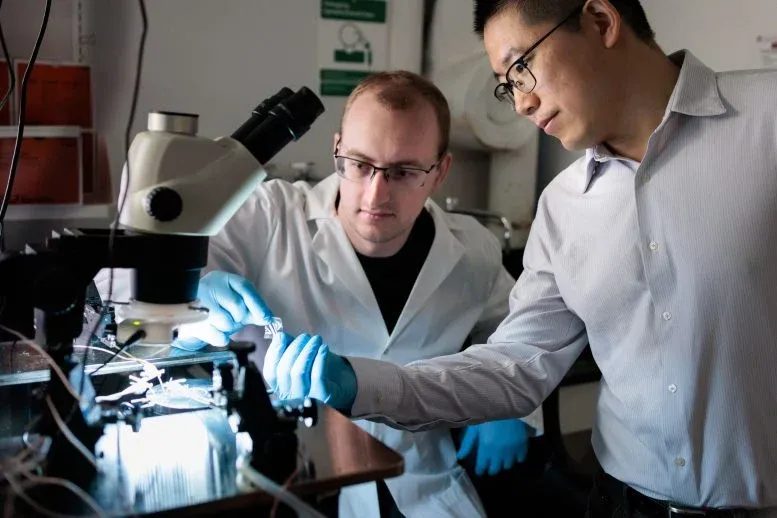
To solve these problems, the researchers created a polymer gel that hardens into precise shapes when exposed to ultraviolet light. This method allows them to make up to 10,000 organic electrochemical transistors in about one square centimeter.
Zixuan Zhao, a graduate student at UChicago CS and co-first author, noted the complexity. "In hardware, it’s a material—with variability, history, and physical limits," Zhao said. "The challenge was to hold those constraints in mind and still compute with enough precision to matter."
Real-Time Health Monitoring
The team tested the stretchable transistor array with an algorithm designed to help treat ventricular fibrillation. This condition causes chaotic electrical activity in the heart and can be deadly. Current treatments often involve a strong shock to the entire heart. However, researchers have suggested a more targeted approach: tracking abnormal electrical waves and applying small corrective pulses before they spread.
This requires extreme speed. Electrical wavefronts move through the heart very quickly, so analysis must happen within milliseconds. Remote processing is too slow.
"This is a situation where it’s not feasible to have remote computing. It just takes too long," Wang explained. "But if you have a computing device that can do the analysis within the body, it could be possible."
Using heart mapping data from a donated human heart, the researchers showed the array could find wavefront locations with 99.6% accuracy. This was true even when the patch was stretched to more than one and a half times its original size.
In another test, a neural network in the array analyzed vital signs and personal health data. This included cholesterol levels, blood sugar, maximum heart rate, and ECG measurements. It estimated heart attack risk with 83.5% accuracy.
Wang believes this computing array could become part of a complete health monitoring system. His team is now working to combine it with stretchable wireless communication and more advanced sensors. This would create devices that can collect, analyze, and respond to health data instantly.
Fangfang Xia, a computer scientist at Argonne National Laboratory and co-senior author, highlighted the benefit. "Instead of sending data away to a remote server, we can begin making sense of it right where life is happening," Xia said.
Deep Dive & References
- A large-scale stretchable neuromorphic circuit for on-body edge computing - Nature Electronics, 2026