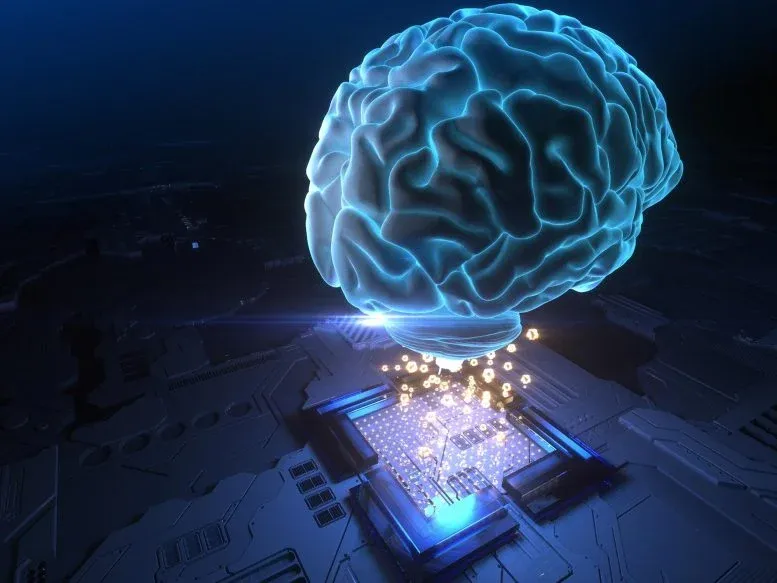
A new chip can reconstruct the brain's complex surface at nearly the speed of a human brain. This breakthrough could lead to faster medical imaging and brain-computer interfaces.
Researchers in China developed this chip. It performs complex brain modeling in under ten milliseconds. This speed is similar to how fast the human brain works.
Yuchao Yang of Peking University led the research. Scientists at the Shanghai Institute of Microsystem and Information Technology also collaborated. Their findings were published in Science.
We're a new kind of news feed.
Regular news is designed to drain you. We're a non-profit built to restore you. Every story we publish is scored for impact, progress, and hope.
Start Your News DetoxHow the Chip Works
The chip uses "neural dynamical systems." These combine neural networks with math equations. They track how complex systems change over time. This is useful for physical modeling and 3D brain reconstruction.
However, these systems need many calculations and constant adjustments. Traditional computers are slow because they constantly move data between memory and the processor. This uses a lot of energy.
The new chip solves this problem. It performs calculations directly where the data is stored. This reduces data transfers, making the system faster and more energy-efficient.
Performance and Future Impact
The chip was built using a 40-nanometer process. It has in-memory computing and conductance-drift arrays. These cover only 0.28 square millimeters. The chip runs at 50 MHz.
During tests, the chip was much faster than other specialized hardware. It was 3.82 to 36.27 times faster than ASICs (application-specific integrated circuits). It also used 11.75 to 24.73 times less power. For reconstructing the brain's surface, it was up to 478.18 times faster than an NVIDIA A100 GPU.
The researchers used the chip to reconstruct the boundaries of the brain's white and gray matter. It created smooth, closed 3D surface meshes. These preserved the brain's detailed folds. The chip also performed well on accuracy measurements. This shows it can combine fast processing with accurate brain modeling.
This technology could change how we interact with computers. It could support brain-computer interfaces and digital brain twins. It might also help with real-time surgical navigation and research into diseases like Alzheimer's and Parkinson's.
Deep Dive & References
A sub–10-millisecond neural dynamical system based on phase-change memristors - Science, 2026