Imagine fighting lung cancer and the devastating muscle loss that often comes with it, all at once, with a single, elegant solution. Scientists at Oregon State University have just unveiled a new method using microscopic, fat-based particles that might do exactly that.
Published in the Journal of Controlled Release, their study describes how these minuscule messengers deliver genetic instructions directly to cancer cells in the lungs. It's like a precision strike, but for your cells.
Double Duty: Tumors and Wasting Muscles
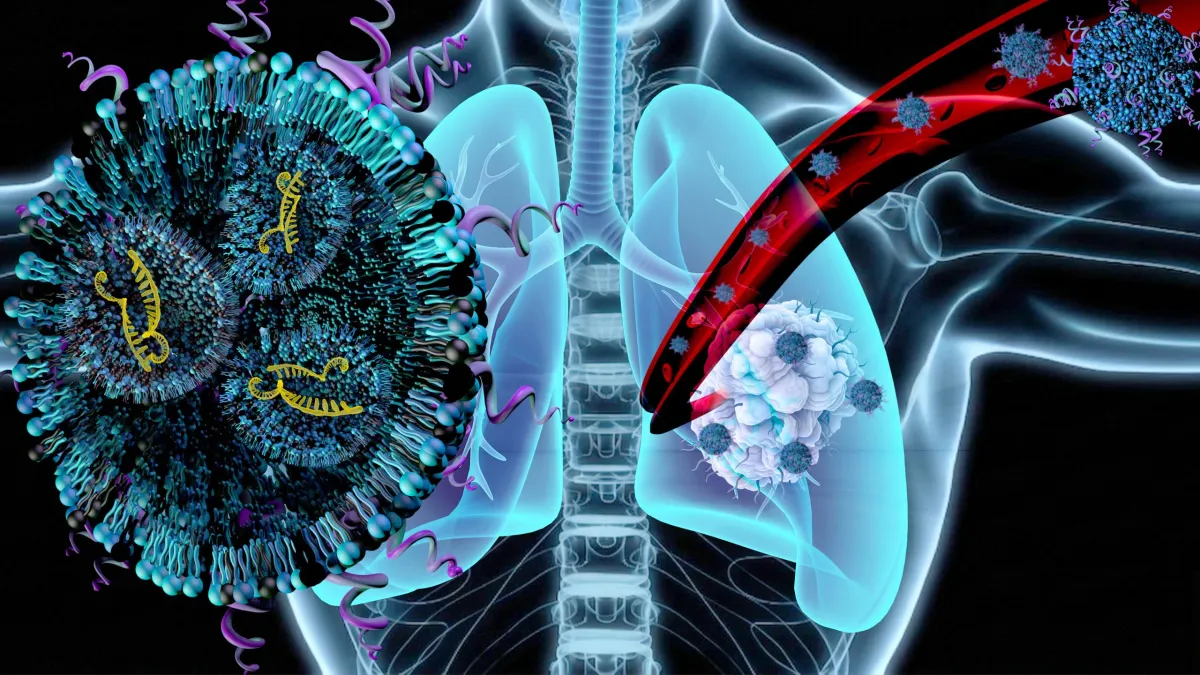
Led by Oleh Taratula and Yoon Tae Goo, the research team engineered what they call lipid nanoparticles (LNPs). These aren't just any LNPs; they’re loaded with messenger RNA (mRNA) for something called follistatin. Once inside a tumor, this genetic material essentially tells the cells, "Hey, start making follistatin!" The protein that gets produced then does a neat trick: it both helps slow tumor growth and supports muscle development. Talk about multitasking.
We're a new kind of news feed.
Regular news is designed to drain you. We're a non-profit built to restore you. Every story we publish is scored for impact, progress, and hope.
Start Your News DetoxThese clever LNPs travel through your bloodstream, making a beeline for the lungs. Their secret? They bind with vitronectin, a protein in your blood, which then guides them to lung cancer tumors. This happens because the LNPs connect with integrin receptors, which are, conveniently, abundant on tumor surfaces. As Taratula puts it, these receptors are how cells interact with their surroundings. And now, how we interact with them.
The Delivery Problem, Solved
Getting mRNA treatments directly to lung cancer tumors has been notoriously tricky. The body often has other plans for these tiny packages. But this new method seems to have cracked the code. Taratula notes their approach shrunk tumors roughly 2.5 times more effectively than traditional LNPs, which often just end up accumulating in the liver. Because apparently that’s where everything else goes.
Lung cancer, for context, is the third most common cancer in the U.S. and, grimly, the leading cause of cancer deaths. We're talking about an estimated 230,000 new cases and 125,000 deaths this year. Smokers, you guessed it, face a higher risk.
One of the most brutal complications of lung cancer is cachexia – a severe wasting condition that causes extreme muscle loss. It's a silent killer, contributing to up to 30% of cancer-related deaths in affected patients. People with cachexia lose weight, fat, and muscle, even if they're eating. It’s a relentless drain.
By packing follistatin mRNA into these LNPs, the team has created a therapy that tackles both the cancer itself and the muscle wasting, all without causing additional side effects. While more preclinical work is needed (because, science), the researchers are optimistic about future human trials. Which, if you think about it, is both impressive and slightly terrifying – the idea that tiny fat bubbles could be our next big weapon.