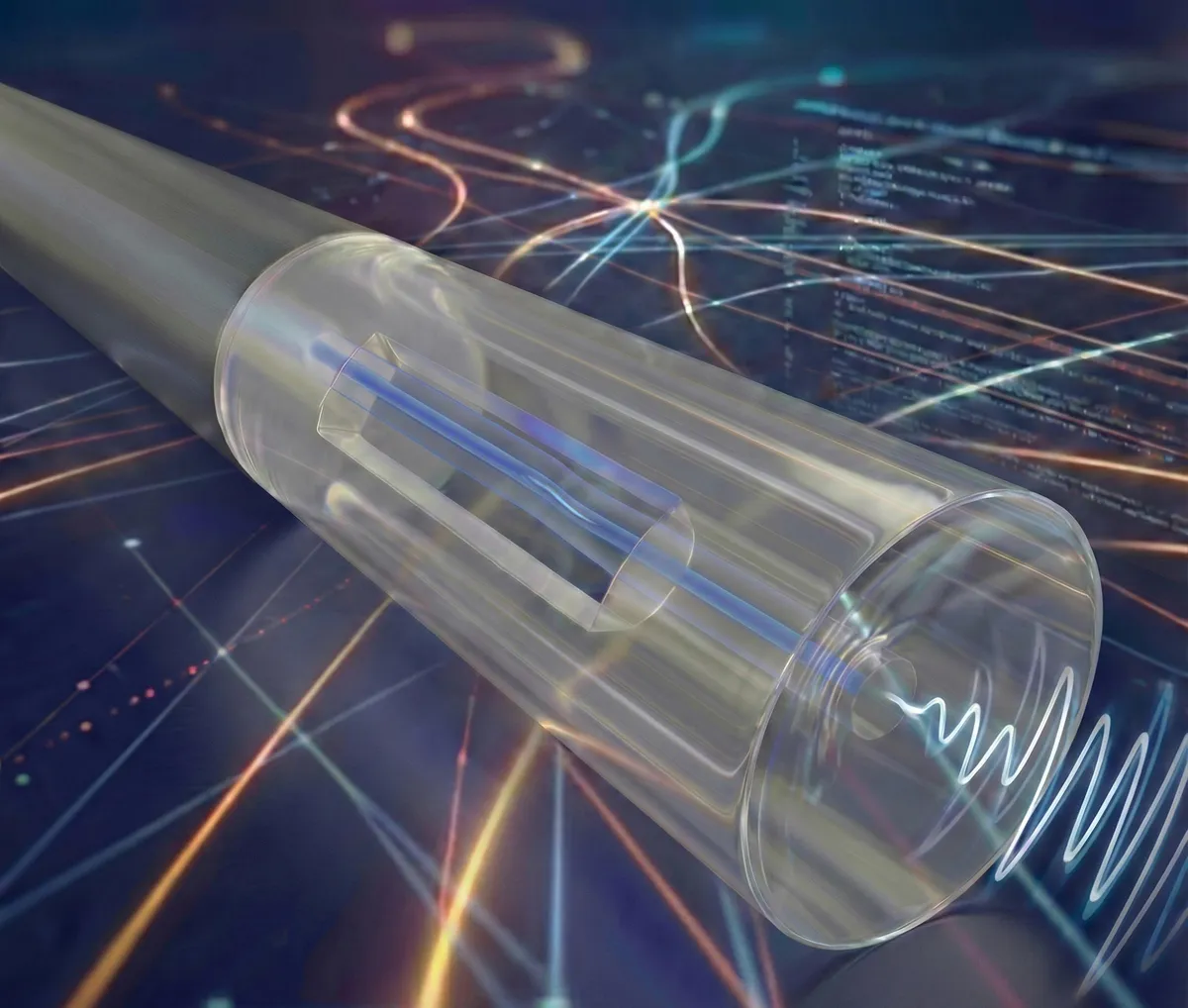
Engineers at Cornell University have built a neural implant so small it fits on a grain of salt—and it's been successfully recording brain activity in living mice for over a year without wires or surgery complications.
The device, called a MOTE (microscale optoelectronic tetherless electrode), works like a two-way conversation with light. Red and infrared lasers power it through brain tissue, and it sends data back by emitting pulses of infrared light that encode electrical signals from neurons. A semiconductor diode harvests the incoming light and produces the outgoing signal, all built from materials already standard in modern microchips.
"As far as we know, this is the smallest neural implant that will measure electrical activity in the brain and then report it out wirelessly," said Alyosha Molnar, a professor in Cornell's School of Electrical and Computer Engineering. The team uses the same pulse-position modulation code that satellites use for optical communication—a technique that lets them send data with minimal power draw.
We're a new kind of news feed.
Regular news is designed to drain you. We're a non-profit built to restore you. Every story we publish is scored for impact, progress, and hope.
Start Your News DetoxWhy this matters for brain research
When researchers implant traditional electrodes in the brain, the surrounding tissue shifts and can trigger immune responses that eventually degrade the signal. The MOTE's tiny footprint minimizes that disruption while still capturing electrical spikes from individual neurons faster than any imaging system could. The mice in the study remained healthy and active throughout the year-long recording period, suggesting the implants cause minimal biological stress.
Molnar's team tested the MOTE first in cell cultures, then implanted it into the barrel cortex of mice—the brain region that processes sensory information from whiskers. The implant reliably recorded both individual neuron spikes and broader patterns of synaptic activity, the kind of data neuroscientists need to understand how the brain processes information.
The implications ripple outward. Because the MOTE is made from materials compatible with MRI machines, it could eventually allow researchers to record brain activity during MRI scans—something nearly impossible with current implants. The technology could also be adapted for the spinal cord or paired with future innovations like opto-electronics embedded directly into artificial skull plates, opening possibilities for treating paralysis or monitoring neurological conditions.
This is the kind of progress that doesn't make headlines but quietly expands what's possible. The next phase will be scaling up from mice to larger animals, and eventually exploring human applications—but for now, the smallest implant in the world has already proven it can listen to the brain's electrical whispers for a year straight.