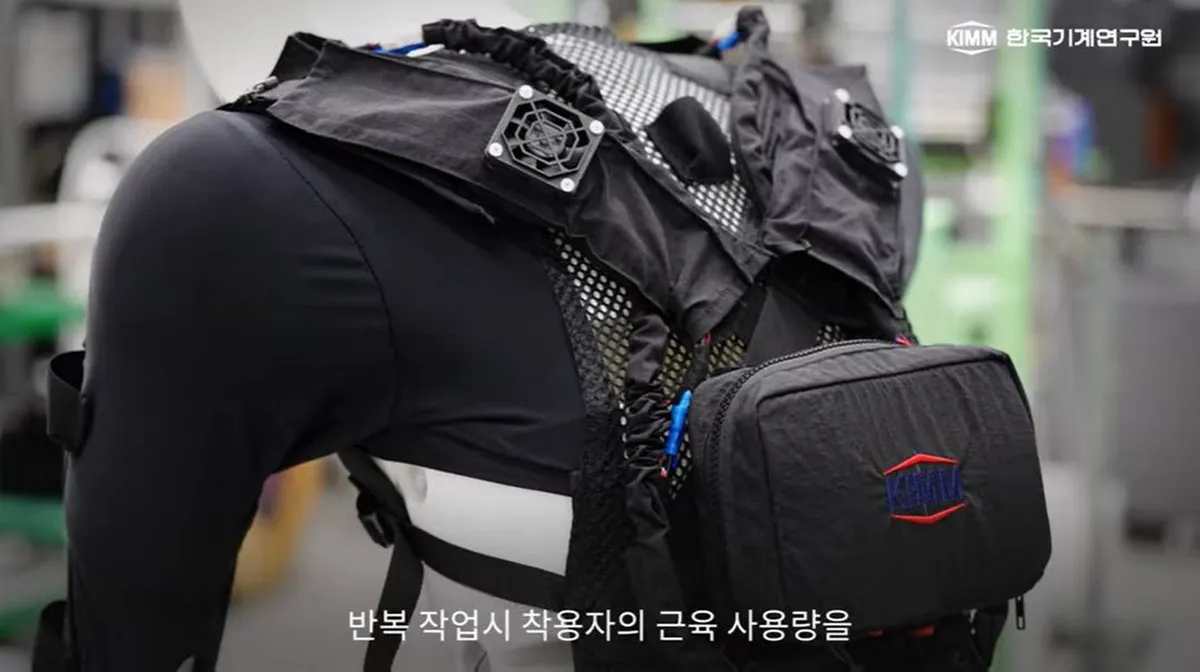
South Korean engineers have built something that looks like a regular shirt but works like a personal assistant for your arms. Woven from threads thinner than human hair, it's made of shape memory alloy—a material that contracts to a remembered shape when heated, mimicking the motion of lifting your arm at the shoulder.
The shirt, developed by the Korea Institute of Machinery and Materials, takes 40 to 57 percent of the strain off your muscles when you lift. On its own, the fabric can lift up to 34 pounds. Paired with your own arm strength, that means basic movements—reaching for a shelf, lifting a glass—become possible again for people whose muscles are failing them.
What makes this different
Unlike rigid exoskeletons that cost tens of thousands of dollars and require motors and batteries, this one weighs less than 2 pounds and costs thousands less. You put it on like a cotton shirt. You take it off the same way. There's a nylon harness for the electrical components, but that's it. No straps, no bulk, no learning curve.
We're a new kind of news feed.
Regular news is designed to drain you. We're a non-profit built to restore you. Every story we publish is scored for impact, progress, and hope.
Start Your News DetoxMyung Ha-yul, 15, has Duchenne muscular dystrophy. During trials at Seoul National University Hospital, he noticed something simple but profound: "It felt amazing because it was light and easy to wear, just like clothing. I could lift my arms with much less effort."
Lee Woo-hyung, a rehabilitation medicine professor at the hospital, put it plainly: "The biggest achievement is that patients can put it on and take it off like clothing, while receiving active muscle support that leads to real functional improvement."
The research was funded by the Child Cancer and Rare Disease Project, launched in 2021 with a $204 million donation from the family of late Samsung chairman Lee Kun-hee. That kind of backing matters—it means the technology isn't stuck in a lab. It's being tested with real patients, refined based on what actually works in their lives.
For people living with degenerative muscle conditions, independence often slips away gradually. A shirt that gives back even a fraction of that—that lets you dress yourself, feed yourself, move through your day with less help—changes what's possible.