Every year, the good people of Folly Beach, South Carolina, gather for something called Toby’s Earth Month Island-Wide Spring Litter Sweep. It’s exactly what it sounds like: a massive, communal effort to pick up all the garbage that mysteriously appears on their beautiful coastline.
This year, volunteers like Emerson Reece, who drove two and a half hours because "being part of the community means helping out," really earned their karma points.
The Day They Found the World's Rarest Turtle
On April 12, in less than two hours, this dedicated crew collected over 10,000 pieces of litter. Let that satisfying number sink in. Sarah Butler, executive director for Waves 4 Women, put it simply: their work is fueled by a profound love for the ocean. And, you know, a general understanding that we all breathe the same air and swim in the same sea.
We're a new kind of news feed.
Regular news is designed to drain you. We're a non-profit built to restore you. Every story we publish is scored for impact, progress, and hope.
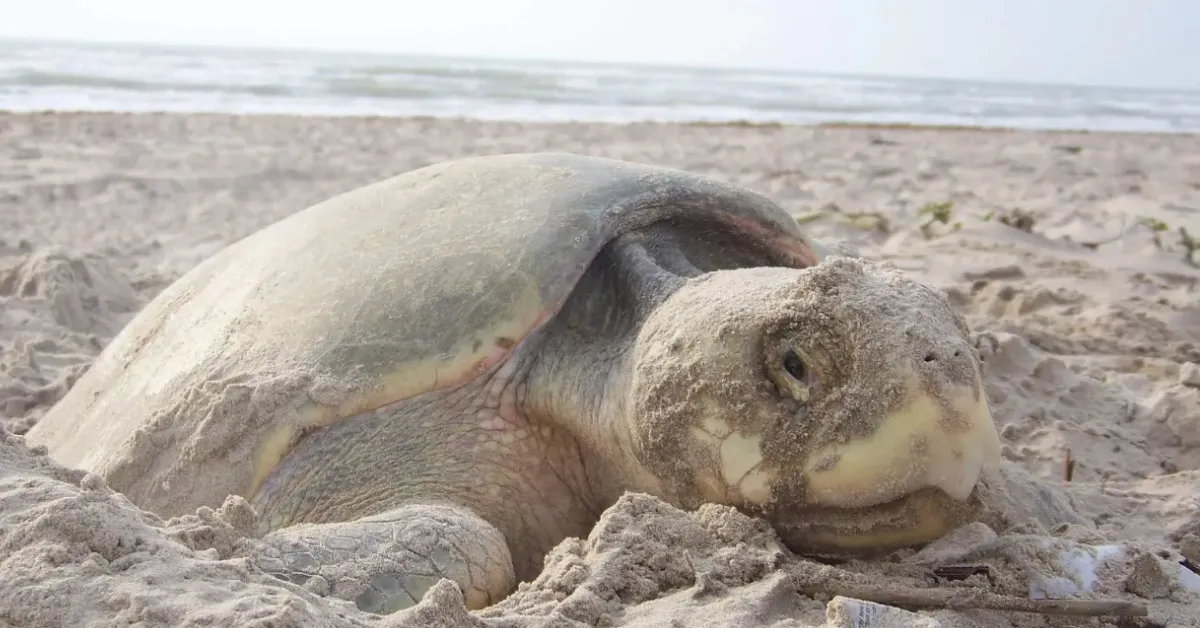
Start Your News DetoxBut then, something moved in the water. Something unusual. Something that made everyone stop sifting through plastic bags and discarded flip-flops. It was a young Kemp’s ridley sea turtle, thrashing around, clearly in distress. For those not up on their endangered species bingo, this is one of the rarest sea turtles on the planet.
Dave Miller from Folly Beach Turtle Watch, who probably thought he'd seen it all, confirmed this was the first stranding of the 2026 season for Folly Beach. (Yes, you read that right. The future is now, and apparently, so are distressed turtles.) Kemp's ridleys are the smallest, most endangered of the seven sea turtle species, and they usually prefer nesting in the Gulf of Mexico. They're also the only sea turtles that are brave enough to nest during the day, and in big groups, like they're going to a festival.
Turns out, this little guy had been hooked in the mouth by an angler from the Folly Beach fishing pier. Luckily, when the rescue team deployed a drop net to gently hoist the turtle, the hook decided it had enough drama for one day and simply fell out. A good day for the turtle, a good day for the rescuers, and probably a very good day for the angler's conscience.
Miller has some advice for anyone who accidentally hooks a sea turtle: do not try to play hero and remove the hook yourself. Cut the line, leave a few feet attached, and let the professionals (i.e., veterinarians) handle it. A swallowed hook means a trip to the Sea Turtle Care Center. Which, if you think about it, is a pretty fancy emergency room for a reptile.
The Unseen Dangers of "Ghost Gear"
This isn't an isolated incident. About a week earlier, another Kemp’s ridley was found struggling in Texas by lifeguard and marine biology student Nevaeh Vela. Specialists at the Amos Rehabilitation Keep (ARK) at the University of Texas at Austin discovered a fishing hook fragment in her trachea. They removed it with an endoscopy, because apparently, even turtles get high-tech medical procedures these days.
Andrew Orgill, ARK staff supervisor, noted that the turtle is now on antibiotics, pain meds, and anti-inflammatories. Basically, the full human recovery package. Orgill also highlighted the insidious problem of "ghost gear" — discarded fishing equipment that floats around causing deep cuts, amputating flippers, and making it impossible for turtles to swim. Not to mention the whole "swallowing hooks and lines" problem.
It’s a stark reminder, echoed by local volunteer Vanessa Oltman, that we only have one planet. And if we want to keep finding rare, adorable sea turtles instead of just, well, trash, maybe we should leave the beaches and oceans a little cleaner than we found them. And perhaps teach the kids to do the same. Because honestly, who doesn't want to tell their friends they helped save a unicorn of the sea?