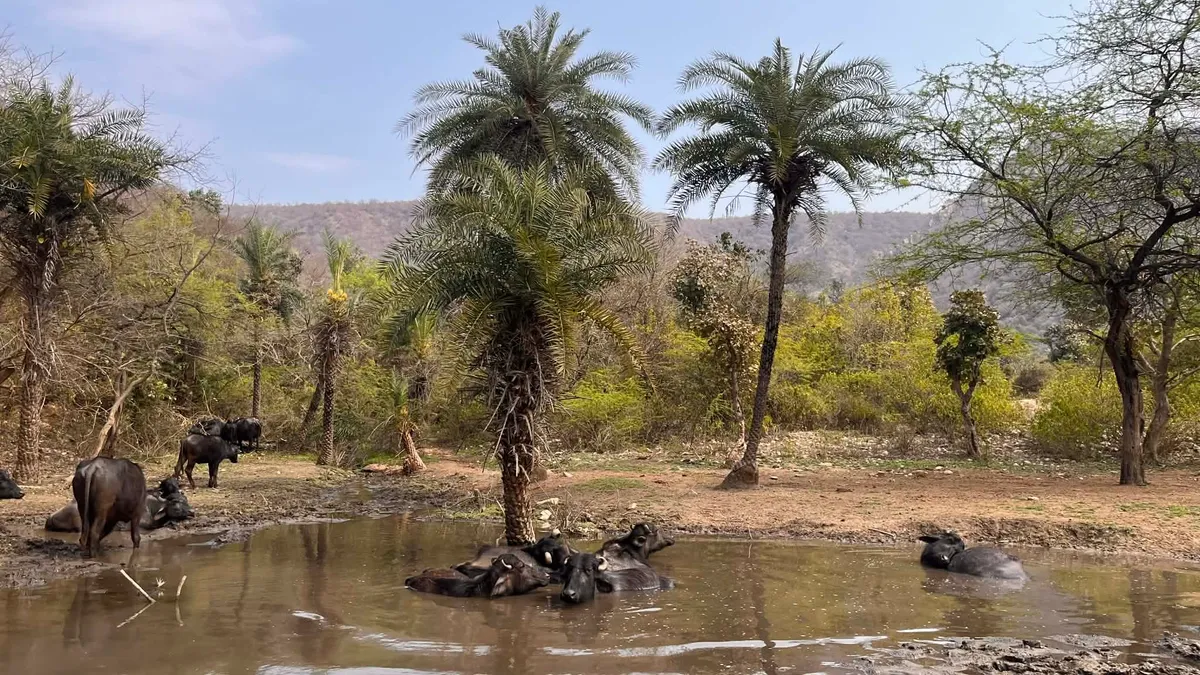
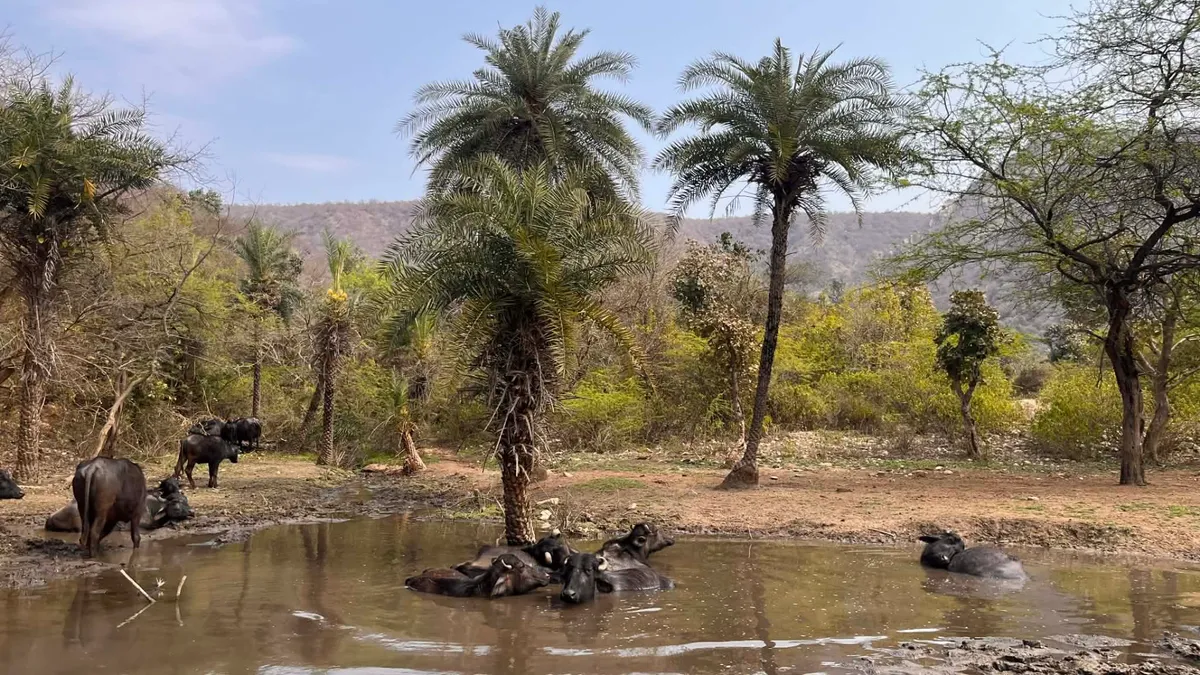
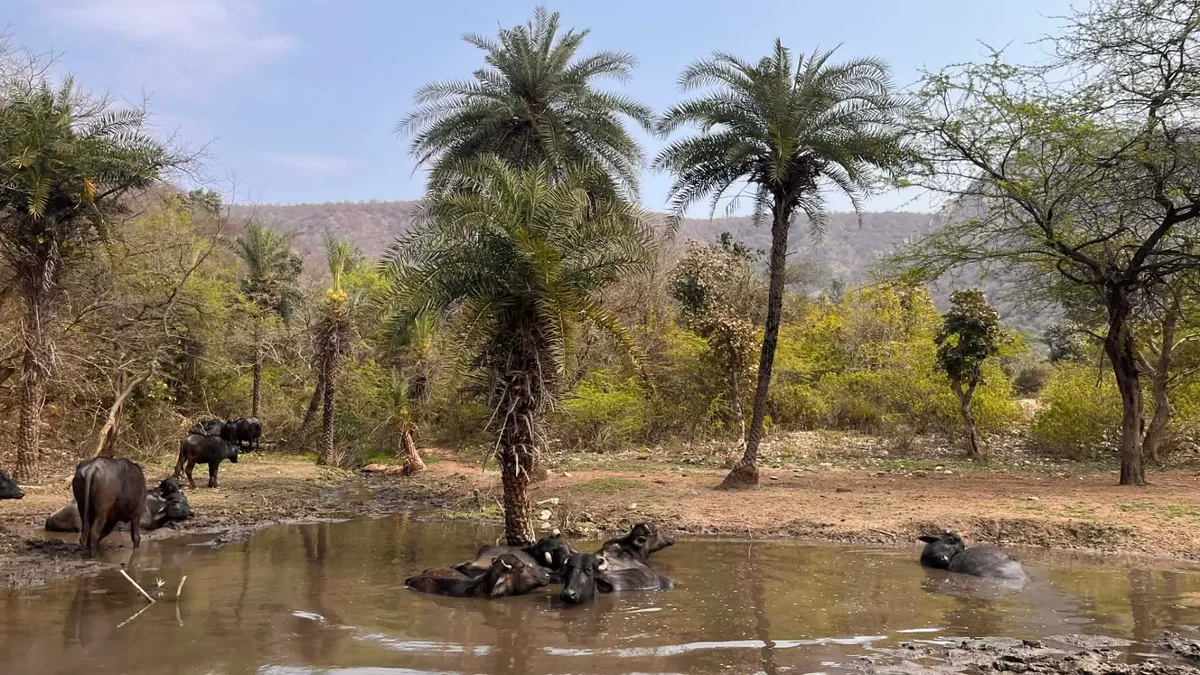
A herd of goats moves through dry grassland towards a hilly grove. The air cools, and the vegetation becomes denser and greener. Buffaloes wallow in a shallow pool. A forest path leads to a giant old ficus tree. A small stream emerges from its roots, its gurgling mixed with the sound of figs falling into the water.
Bhawani Shankar, the custodian of this forest and its shrine, says the forest and stream are looked after by "Baba." He believes the water is so life-giving that his hair has grown to his ankles. Shankar scatters seeds for peacocks. He warns that bad things happen to those who cut wood from the forest. He tells a story about a man who lost everything in a fire, except for a beam made from a tree he cut.
This forest is Adaval ki Devbani in Alwar, Rajasthan, India. "Devbani" means "sacred grove." Rajasthan has about 25,000 such groves, sometimes called orans. These are places where land, water, jungle, and people live together peacefully. For centuries, these groves have been common land for villages. People use them for grazing, collecting fallen wood, medicinal herbs, honey, and fruit. Strong spiritual beliefs protect the trees and animals, making these groves important for nature and a refuge for native species. In Rajasthan's desert, devbanis and orans also contain water sources for humans and animals.
We're a new kind of news feed.
Regular news is designed to drain you. We're a non-profit built to restore you. Every story we publish is scored for impact, progress, and hope.
Start Your News DetoxThe Decline and Revival of Sacred Groves
Over time, these pockets of biodiversity have declined due to changing lifestyles and land use. During British rule, many were labeled "ghair mumkin zameen" (uncultivable land) and not taxed. This made them vulnerable to encroachment, mining, and land grabs. After India's independence in 1947, they continued to face pressure from farming, construction, and mining.
In 1992, Aman Singh, who knew about water scarcity in Rajasthan, founded KRAPAVIS. This NGO, whose name means "organization for the development of ecology and agriculture/livestock," aimed to help.
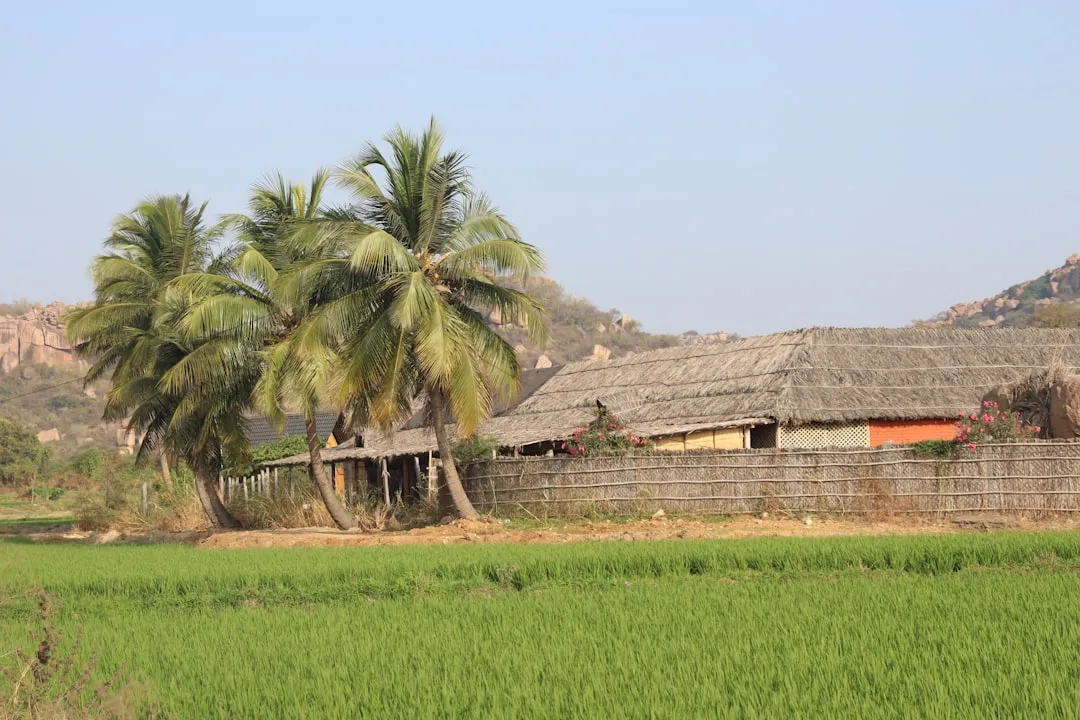
Singh believed that restoring water sources in village common lands could improve underground water levels. This, in turn, could revive nearby wells and dried-up water bodies. KRAPAVIS restored 15 orans and devbanis near Rajasthan's Sariska Tiger Reserve. As these groves and their water bodies recovered, Singh's theory proved correct. Wells revived, and water levels in Siliserh Lake rose. This showed that these water sources were connected underground.
This discovery gave KRAPAVIS a strong reason to restore more sacred and community forests across Rajasthan. They realized this could help desert communities become more resilient to harsh weather and climate change.
KRAPAVIS has now restored over 249 orans and devbanis and mapped 1,400 more in Rajasthan. When they identify a grove for restoration, they first check how willing local villages are to work together. Village residents are a key part of the restoration plan and share costs through money or labor. Their involvement is vital for success.
Community-Led Conservation Efforts
In Adaval ki Devbani, KRAPAVIS and local volunteers have planted native trees, cleaned the stream mouth, and desilted the pond. They also repaired an ancient temple in the grove and enlisted Shankar, its priest, to look after the forest. He patrols the forest and fines those who break community rules for using forest products. Villagers provide grain for his monthly food. The restoration cost about $10,000, which is typical for KRAPAVIS, funded by donors and the community.
About 25 miles away, on a hillock bordering Sariska National Park, is Bherunathji ki oran. This grove is lush and dense, a stark contrast to the park, where deforestation is visible.
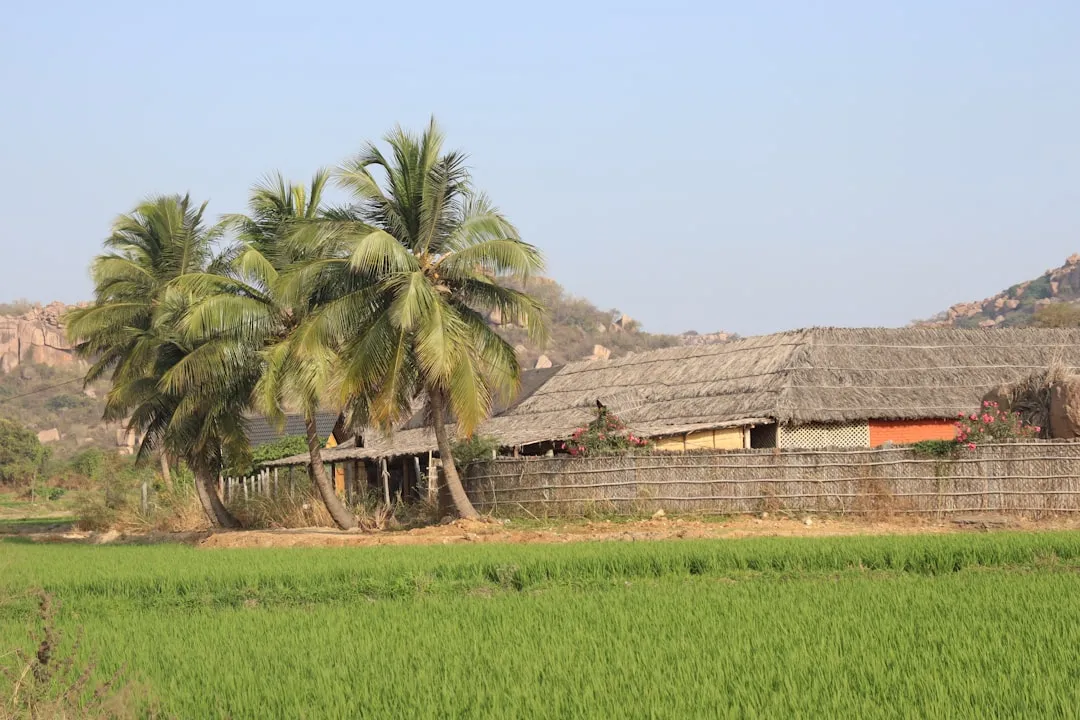
Singh believes community-led conservation is more effective than state-led efforts. State-led conservation often makes locals feel disconnected from the forest. People feel a sense of ownership for their oran because their economic, cultural, and religious lives are tied to it. Women collect fruits, honey, and firewood. Pastoralists follow strict community rules for grazing livestock. For example, devbanis with grasslands prohibit grazing from March to July to allow new grass to grow.
New Challenges and Legal Protections
Despite these efforts, sacred groves in India face a new challenge: they are losing relevance. Sunil Harsana, 37, from Manger village in Haryana, notes that most young people now seek urban jobs. Manger Bani, a 650-acre sacred grove, has survived Delhi's expansion so far.
Harsana and other ecologists have fought since the early 2000s to prevent Manger Bani from being converted to farmland. Peacocks call as Harsana hikes to a ridge in Manger Bani, pointing out dhau trees (Terminalia anogeissiana) that are rare elsewhere. In 2015, Haryana's chief minister declared Manger a forest with a 1,200-acre buffer zone, making it a no-construction area. However, legal issues still threaten the forest. Harsana says religious beliefs, like the belief that a holy man's spirit protects part of the forest, are now being misused.
Harsana, who walks with a limp due to polio, points out new shrines and roads, fearing they could lead to new land grabs. He runs a weekly Eco Club for local schoolchildren to teach them to love the forest. Two former students now volunteer with the club, and three others work on eco-restoration projects. Their parents also understand why they should protect the bani instead of selling it for real estate.
In Alwar, Singh is careful about using the word "sacred" for the groves. He advocates for a strong legal framework to conserve devbanis and orans as ecological heritage. He sees them as community-owned and community-led conservation areas, not national parks that separate communities from forests, or just religious sites.
In 2024, Singh petitioned the Supreme Court to recognize and preserve Rajasthan's devbanis and orans. The court acknowledged their vital role in conservation, groundwater recharge, grazing regulation, and supporting local livelihoods. It directed the state government to map them, prevent non-forest use, and ensure community involvement in their management. Singh was happy that the court also stated that traditional community-conserved ecosystems across India should not be treated as "wasteland" and must be protected.
Meanwhile, at Adaval ki Devbani, far from legal battles and real estate pressures, there is peace. An 80-year-old pilgrim traveled 50 miles to visit. He said he felt stressed and came to the devbani. He felt the special atmosphere, and the sound of flowing water and cool breezes washed his stress away.