A photographer scaling a remote cliff in Stelvio national park last September stumbled onto something that stopped paleontologists mid-sentence: thousands of dinosaur footprints stretching across hundreds of metres of vertical rock, preserved in stone for 210 million years.
The tracks belong to prosauropods — long-necked herbivores roughly the size of a school bus, walking on two powerful hind legs. Some footprints measure up to 40 centimetres across, their toes and claws still visible in the ancient tidal flat that's now part of the Italian Alps. "This place was full of dinosaurs; it's an immense scientific treasure," paleontologist Cristiano Dal Sasso told researchers studying the site.
What makes this discovery particularly striking isn't just the sheer number of prints, but what they reveal about how these animals actually lived. The footprints are arranged in parallel rows — evidence that herds moved together in coordinated groups. Even more intriguingly, researchers found handprints appearing in front of some footprints, suggesting the animals paused to rest their front limbs on the ground. There are also circular patterns where groups seem to have gathered, possibly for defense or social reasons. These aren't just fossils; they're a snapshot of behaviour frozen in time.
We're a new kind of news feed.
Regular news is designed to drain you. We're a non-profit built to restore you. Every story we publish is scored for impact, progress, and hope.
Start Your News Detox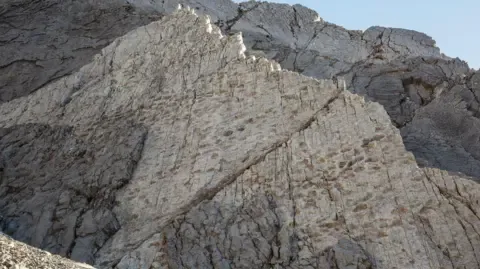 Photographer Elio Della Ferrera captured the first images of the footprints on the vertical mountain wall
The challenge now is studying a site that nature has made deliberately difficult to reach. The cliff is remote, inaccessible by conventional hiking paths, which is partly why it's remained undisturbed for so long. Researchers will rely on drones and remote sensing technology to map and analyse the trackways without disturbing the rock face itself.
The timing carries a symbolic weight. Stelvio sits near the venue for the 2026 Winter Olympics, and Italy's Ministry of Culture has framed the discovery as a bridge between past and present — nature's ancient record meeting modern sport. It's a reminder that even in places we think we know well, the ground beneath our feet holds stories waiting to be read.