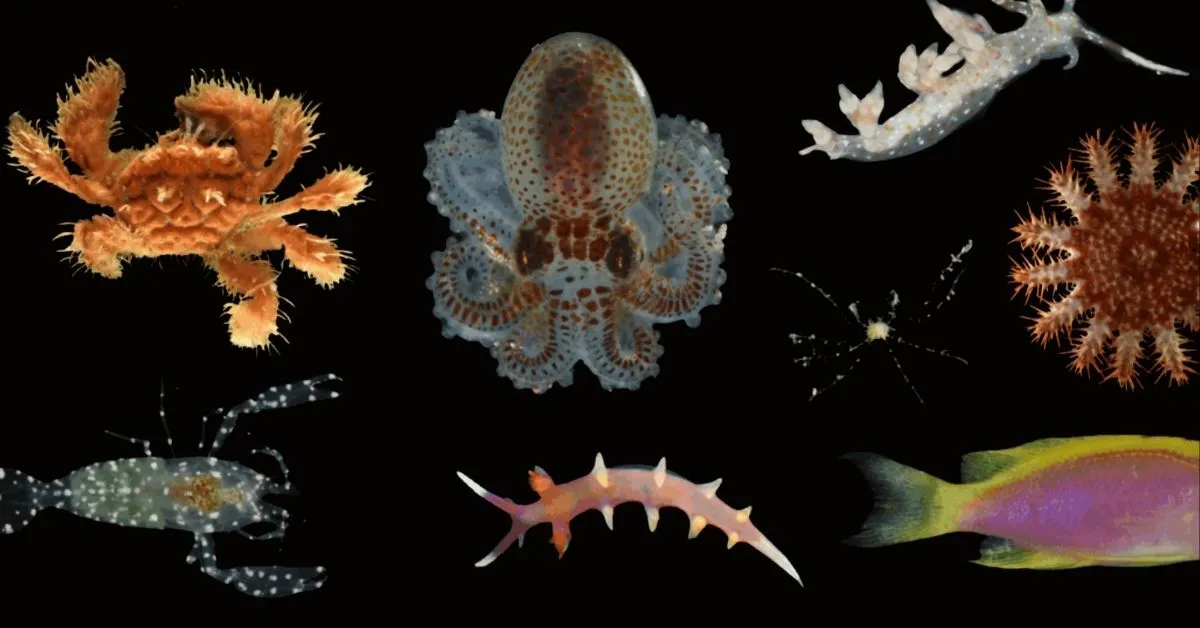
At 200 feet below the surface, where sunlight fades to blue-gray gloom, Luiz Rocha found a polka-dotted baby octopus. It was one of 20 species never recorded by science before—pulled from the "twilight zone," the least explored part of the ocean that sits between the sunlit shallows and the crushing deep.
Rocha, an ichthyologist at the California Academy of Sciences, led a team to Guam to retrieve underwater monitoring devices called ARMS—essentially apartment buildings for reef creatures. Over two years, these devices had collected over 2,000 specimens. When the team analyzed what was living there, they found not just abundance but novelty: a goby fish with a visible skeleton, a yellow-dotted sea slug, an orange cardinalfish. A hundred more species had never been recorded in the region at all.
This matters more than it might first seem. The twilight zone—roughly 180 to 330 feet deep—covers an area larger than all the world's continents combined. We know more about the moon than we do about these waters. Yet they're warming, acidifying, and facing industrial fishing pressure. Understanding what lives there, how it all connects, and what it needs to survive has become urgent.
We're a new kind of news feed.
Regular news is designed to drain you. We're a non-profit built to restore you. Every story we publish is scored for impact, progress, and hope.
Start Your News Detox"Understanding twilight zone ecology, connectivity, and vulnerability is essential for effective conservation planning in a rapidly changing ocean," Rocha said. Robert Lasley Jr., a curator at the University of Guam, added that the findings "highlight the complexity and richness of mesophotic ecosystems and underscore their need for protection."
What's striking about this work isn't just the novelty. It's the method. The ARMS devices sit on the reef for months, collecting data continuously. They're like time-lapse cameras for biodiversity. This long-term approach reveals patterns that single expeditions miss—which species are thriving, which are vulnerable, how the ecosystem breathes.
Rocha's team has 76 more devices to retrieve over the next two years. Each one might hold dozens of species waiting to be named, studied, understood. The work is patient, methodical, and fundamentally optimistic: we can still discover the world we live in. We can still map it, protect it, save it—if we pay attention.