Industrial chemical separations consume 10 to 15 percent of the world's total energy—more than aviation and shipping combined. Almost all of it goes to heat: boiling off unwanted materials to isolate the compounds we actually need. It's a massive, invisible energy drain that most of us never think about.
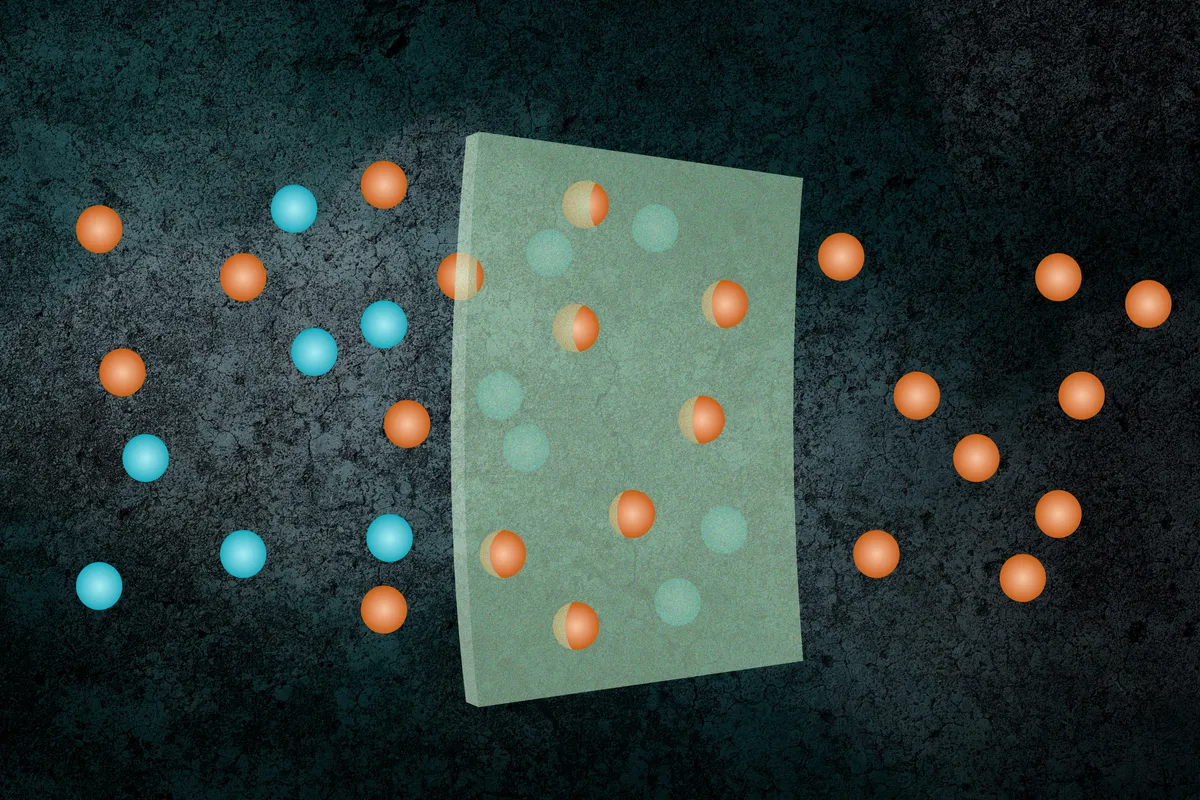
Osmoses, an MIT spinout founded by former postdoc Francesco Maria Benedetti and colleagues, is quietly dismantling that problem. The company has developed polymer membranes that can filter gases with unprecedented precision—without the heat.
How a lab discovery became a company
The story starts in 2017 when Benedetti joined Zachary Smith's lab at MIT's Department of Chemical Engineering. Katherine Mizrahi Rodriguez joined a year later, and the pair began investigating membrane materials for gas separations. By 2020, their work—done alongside chemist Holden Lai at Stanford and others—had broken records for selectivity using three-dimensional polymers whose structure could be fine-tuned for different applications. Science published the results in 2022.
We're a new kind of news feed.
Regular news is designed to drain you. We're a non-profit built to restore you. Every story we publish is scored for impact, progress, and hope.
Start Your News DetoxBut the researchers faced a choice: publish and hope someone else would commercialize it, or build the company themselves. "We'd spent years describing the huge energy footprint of thermal separations and the potential of membranes to solve that," Benedetti recalls. "We thought rather than wait for somebody to pick up the paper, we wanted to lead the effort."
They went through the NSF's I-Corps Program, a startup accelerator that pushes researchers to talk to real customers. Over 100 interviews confirmed what they suspected: this technology could reshape how entire industries operate.
What makes these membranes different
Osmoses' membranes are made from hydrocarbon ladder polymers—molecules with tunable structures that can selectively filter specific gases at scale. The system is smaller than traditional heat-based separators, which means lower upfront costs and easier installation in existing facilities. For industrial customers, that means less energy, more production, and a smaller footprint.
The company is already moving into the real world. Its first pilot project is upgrading biogas at a Canadian landfill operated by a major utility. Another pilot is launching at a dairy farm in the same region. Landfill and agricultural waste make up over 80 percent of the biogas upgrading market—and represent a significant renewable energy opportunity if the gas can be efficiently captured and refined.
Osmoses is also working with the Department of Energy on helium recovery, one of the highest-value applications for selective gas separation.
What comes next
Benedetti sees the technology expanding far beyond biogas. Carbon capture, acid gas removal from natural gas, oxygen-nitrogen separation, refrigerant recycling—all of these could eventually run on Osmoses' membranes instead of thermal processes. The company's mission, as he frames it, is simple: "Separations should not be a bottleneck to innovation and progress anymore." If the pilot projects work as expected, that's exactly what will happen.