Ocean Vuong doesn't believe in finding your voice. He believes in building it.
The award-winning poet and novelist, whose debut "On Earth We're Briefly Gorgeous" has sold over a million copies in 40 languages since 2019, pushes back against the idea that writers should spend their early years hunting for a distinctive style. That hunt, he says, can actually stunt your growth.
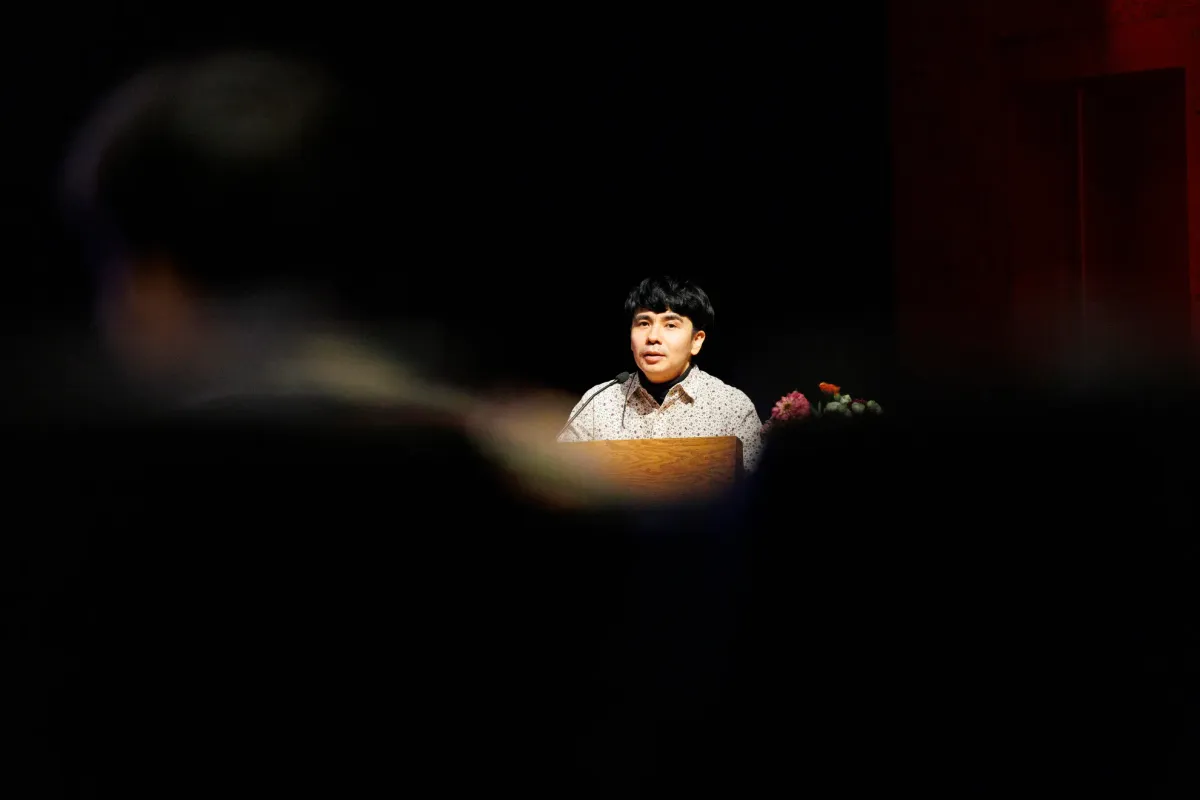
"It makes sense that in our culture of gain and scarcity that [finding a voice] should be a hunt or search or possession," Vuong said during Harvard's recent Eliot Memorial Reading. "But I don't think that's true. I don't think one finds a voice. I think one develops it throughout one's life. I'm still discovering mine."
This matters because the pressure to arrive fully formed—to have your thing figured out before you've really started—stops a lot of people before they begin. Vuong's point is gentler: your voice isn't a destination. It's a fingerprint that becomes clearer the more you use it.
We're a new kind of news feed.
Regular news is designed to drain you. We're a non-profit built to restore you. Every story we publish is scored for impact, progress, and hope.
Start Your News Detox"We all have a thumbprint; it's idiosyncratic to us," he explained. "Language syntax, how you arrange your words; that's the thumbprint of an inner life, and that could be replicated, shifted and grown inexhaustibly." In other words, there's no rush. The work itself is what shapes you.
What actually predicts success
If finding your voice isn't the first step, what is? Vuong's answer might disappoint people looking for a shortcut: endurance. Perseverance. The willingness to show up at your desk when everything outside it is conspiring against you.
"Talent is real, but a lot of times, talent can be a great hindrance," he said. "It's not a marker of a successful writer. It's really about endurance."
This runs counter to how we usually talk about writers—we celebrate the prodigies, the ones who seemed to arrive fully formed. But Vuong, who immigrated to the U.S. from Vietnam at age 2 and grew up in Hartford, Connecticut, suggests that early talent can actually be deceptive. It can make you complacent. It can make you think the hard work is optional.
What separates writers who last from those who burn out is something less glamorous: the ability to keep going when the work feels unglamorous. When the market doesn't immediately respond. When you're not sure if what you're making matters.
Vuong manages this partly through Buddhist practice, which he credits with helping him write from care rather than anger. "Anger is not useful for me because I destroy myself as I use it," he said. "It's a radioactive energy for me; it wounds as it's being wielded." Instead, he describes care as "the afterlife of anger"—the productive energy that emerges after you've felt the rage but chosen not to be consumed by it.
Hope, he says, is what sustains the work. Not naive hope, but the kind grounded in the belief that the act of writing itself—of arranging words into patterns that reflect your inner life—matters regardless of what happens next.
Vuong, a MacArthur Fellow, teaches modern poetry and poetics at NYU. But his real teaching might be this: if you're waiting to feel ready, to have arrived, to know exactly who you are as a writer, you'll wait forever. The voice comes from the doing.