Finnish-Estonian bikemaker Verge has been in the news often. Now, its spin-off, Donut Lab, is gaining attention. The company has been developing solid-state battery technology and is now seeing good results.
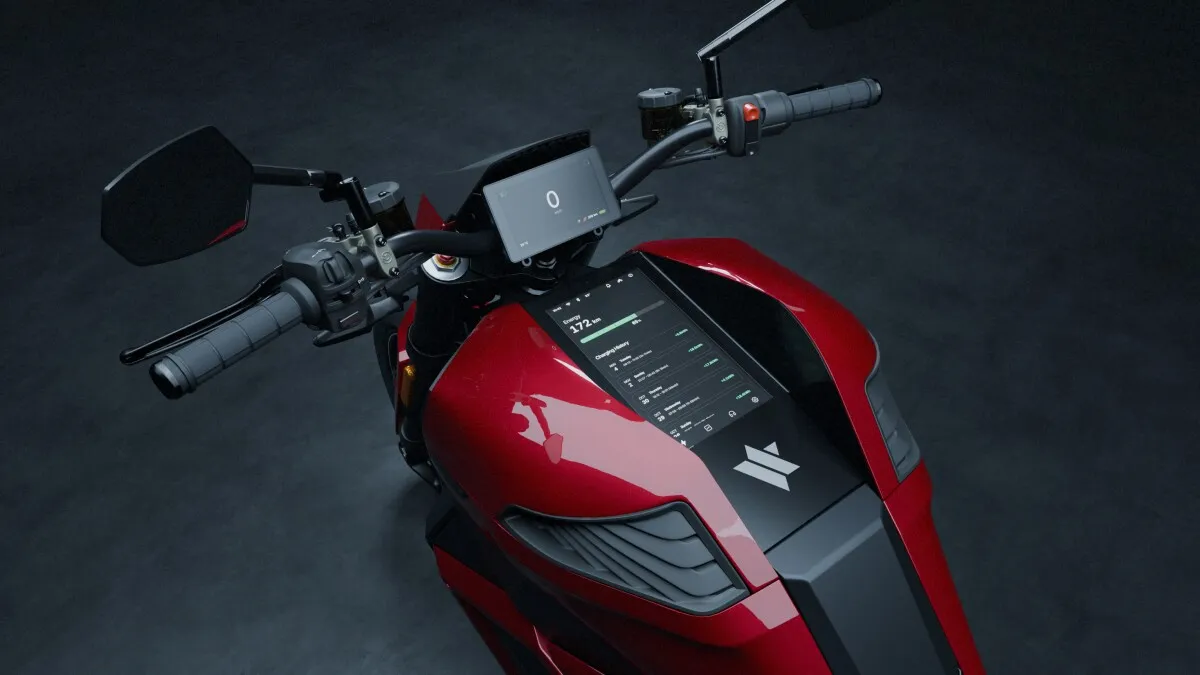
Donut Lab recently shared its first pack-level charging test results. This was its fourth battery test with Verge Motorcycles. The 18-kWh battery pack kept over 100 kW of charging power for five minutes. This happened at a 5C rate on the Verge TS Pro electric motorcycle.
These are some of the first real-world test numbers for Donut Lab's battery in an electric motorcycle. The company had shown a 400-Wh/kg solid-state cell at CES 2026. They claimed it would offer a 370-mile range, a 100,000-cycle life, and a five-minute charging time. They also said it would be cheaper to make than lithium-ion batteries.
We're a new kind of news feed.
Regular news is designed to drain you. We're a non-profit built to restore you. Every story we publish is scored for impact, progress, and hope.
Start Your News DetoxIt was time for Donut Lab to back up these claims with actual numbers.
Donut Lab announced in January that it was making a solid-state EV battery. They said deliveries would start by the end of the quarter. This would make the new Verge TS Pro the "world's first production vehicle with an all-solid-state battery." However, many people were doubtful.
Testing the Technology
Three important tests followed with Finland's VTT Technical Research Centre. The first test confirmed that the battery cells can indeed charge quickly. The second test showed that the battery cells could stay within a safe temperature range. This is possible with enough heat sinks.
The third test proved that the Donut Lab battery was not a supercapacitor. Many had suggested it was. Instead, it has a self-discharge rate similar to a real battery.
The fourth and perhaps most important test happened recently. Donut Lab connected a Verge TS Pro to a public fast-charger. It delivered 100–103 kW of electricity for five minutes.
In this test, the battery pack charged from 10% to 50% in five minutes. It reached 70% in just over nine minutes and 80% in 12 minutes. This was achieved using an air-cooled design, not liquid cooling. This is important because most electric car battery packs are about five times larger. They use liquid cooling systems to maintain similar charging rates without overheating.
These results make the system one of the fastest-charging electric motorcycles ever. Seeing this on a real motorcycle makes the test even more significant. Previous experiments focused on single cells in controlled lab settings.
Fast charging on a motorcycle is complex compared to cars. Smaller battery packs, tighter temperature limits, and fewer cells sharing the load usually limit charging speeds.
Ville Piippo, CTO at Donut Lab, explained that their battery's high energy density allows for flexible pack design and great performance. This is true even in challenging uses like motorcycles, where space is tight and simplicity is key. He added that they can offer vehicle makers packs with different energy capacities in the same physical size. Even the smallest packs have very high capacities.
Donut Lab's technology seems to maintain over 100 kW of charging power in a compact design. However, the company has not yet reached all its goals. This test only achieved about half of the peak charging rates (up to 200 kW) that the company had hinted at. It is unclear if this is due to system design, charger limits, or ongoing optimization.
Safety and Future Prospects
Donut Lab also published another test by VTT. This test checked the cell's ability to work safely after being damaged. A damaged cell underwent 50 fast-charge cycles and five regular charge cycles. There was no reported fire risk or temperature increases. The damaged Donut Battery failed "gracefully," meaning it kept working safely at a lower capacity.
More test results are expected soon, as shown on the company's "I Donut Believe" webpage.
While some might see this as a publicity move, it confirms something important. The company's technology can deliver significant performance gains on a real motorcycle, not just in a lab.
This suggests that a mass-market electric motorcycle with five-minute charging might not be far off.