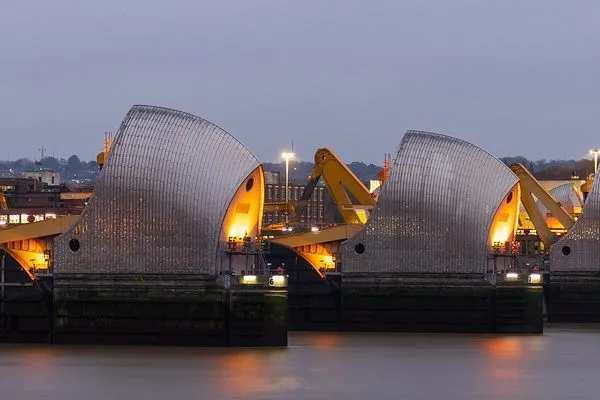
Samuel Pepys watched Whitehall disappear under water in 1663. In 1928, a single flood killed 14 Londoners and wrecked 2,000 homes. By 1953, another surge forced thousands from the East End with barely time to pack. For centuries, the Thames didn't just flow through London — it periodically swallowed it whole.
Then came a wall that could hold it back.
A Barrier Against the Tide
The Thames is a tidal estuary, meaning the ocean pushes water upriver twice daily. When a storm surge coincides with a high tide, the results have been catastrophic. After the 1953 disaster, the UK government knew something had to change. In the 1970s, they commissioned the Thames Barrier — a feat of engineering that seems almost too simple: a series of rotating steel gates that could rise from the riverbed and form a wall several stories tall.
Construction took a decade. When the barrier opened in 1983, it spanned 520 meters of river between Silvertown and Woolwich, east of central London. Most of the time, the gates stay down, invisible to the thousands of boats and commuters passing over and through daily. But when forecasters predict a dangerous surge, the gates rotate 90 degrees and lock into place.
We're a new kind of news feed.
Regular news is designed to drain you. We're a non-profit built to restore you. Every story we publish is scored for impact, progress, and hope.
Start Your News DetoxIn its first 40 years of operation, the Thames Barrier has closed more than 200 times. That's 200 times London didn't flood. During the brutal winter of 2013-2014 alone, it activated 50 times in 13 weeks — a pace that would have been unimaginable before the barrier existed.
The barrier has become so routine that most Londoners don't think about it. It's infrastructure that works, which is perhaps the highest compliment any defensive structure can receive. You notice a flood. You don't notice what stopped it.
But climate change is making the barrier's job harder. Rising sea levels mean higher baseline water levels, which means more frequent surges that would have been rare a generation ago. The barrier will need upgrades and eventually replacement. Engineers are already planning for a future Thames Barrier, one that can handle even higher tides.
For now, London remains protected by a wall that rises from the water only when needed — a quiet, persistent answer to a problem that once seemed inevitable.