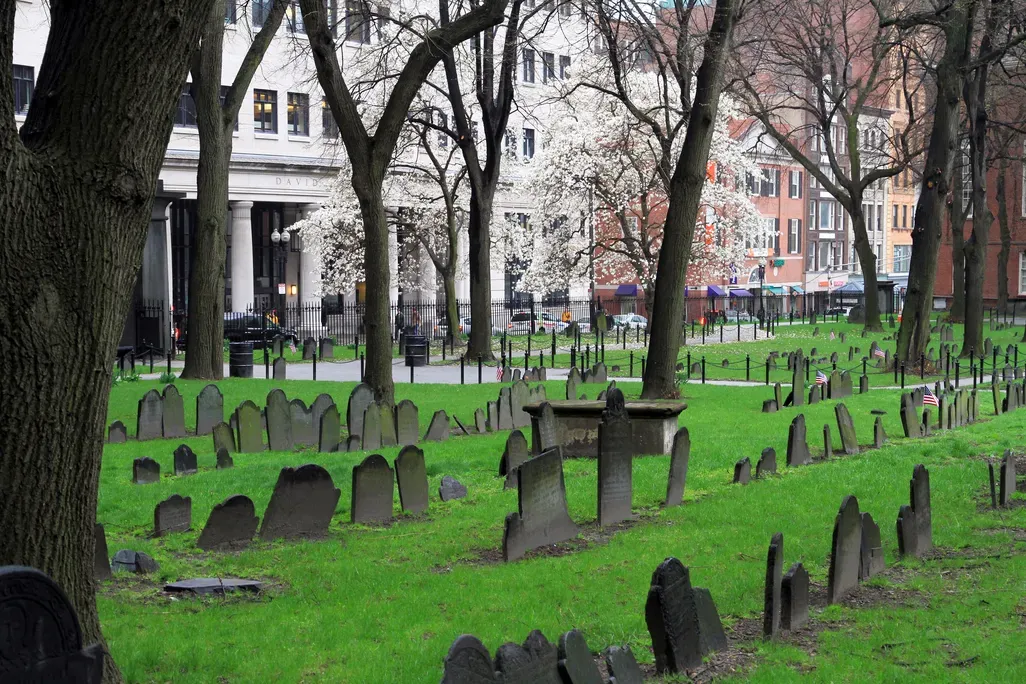
For hundreds of years, a simple headstone marked "Boston" lay unnoticed in Boston's Granary Burying Ground. It had fallen over and was covered in dirt. This cemetery, established in 1660, holds about 5,000 historic graves. Many famous figures like Samuel Adams, John Hancock, and Paul Revere are buried there.
Kelly Thomas, who directs historic burying grounds for Boston Parks and Recreation, noted that many of the old stones look similar. They are all grey and dirty, making it hard to spot unique ones.
Uncovering a Hidden History
Recently, restorers working in the cemetery noticed the small headstone. Its lack of a surname suggested the person buried there had once been enslaved. This sparked an effort to identify him through research.
We're a new kind of news feed.
Regular news is designed to drain you. We're a non-profit built to restore you. Every story we publish is scored for impact, progress, and hope.
Start Your News DetoxHistorians can now share the story of "Boston," also known as "Sebastian" or "Bastian." He was a formerly enslaved man who died free in 1729. Boston Mayor Michelle Wu called this discovery "likely one of the oldest gravestones of a free Black person in America." She added that the story was always there, waiting to be found.
The Life of Boston
Records show Boston was married to Jane Lake. Their daughter, also named Jane, was born around 1701. Samuel Sewall, a Boston merchant and judge, wrote in his diary that "Bastian holds her up" when their infant daughter was baptized in November 1701.
At that time, both Boston and Jane were enslaved. Boston, then called Sebastian, lived with merchant John Waite. Jane lived with widow Deborah Thayer. Historian Gloria McCahon Whiting noted that while their homes were close, there is no sign they lived together.
Boston gained his freedom between 1702, when Waite died, and 1708. His name appeared on a list of free Black people. Whiting's research shows Boston was known as a handyman. After his death in 1729, an obituary was even published in the New-England Weekly Journal.
Boston's gravestone features a "death's head," a common symbol of the era. The epitaph reads: "Here lies the / body of Boston / aged 70 years / deceased February the 28 / 1728." This death year was based on the Julian calendar. By today's Gregorian calendar, he died in 1729.
Mayor Wu believes that learning about people like Boston can inspire children in the city. She said, "Every kid growing up in our city should know what’s possible here."
Deep Dive & References
- Journal of American History - Gloria McCahon Whiting's research on Boston