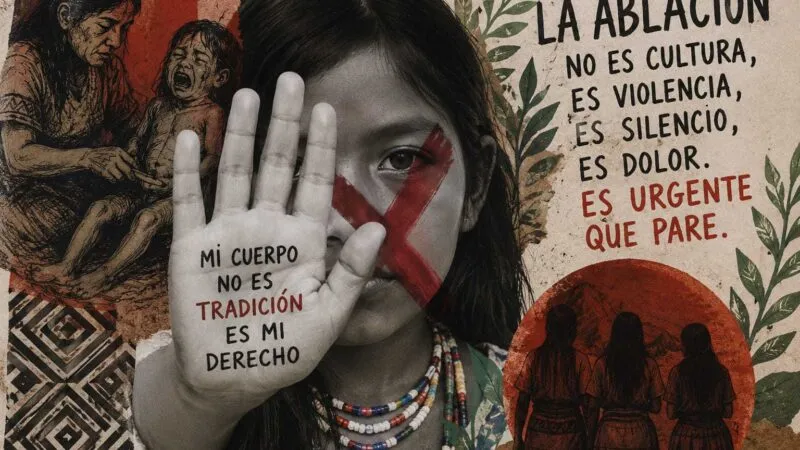
For years, the Emberá Chamí community in Colombia faced a silent tragedy: newborn girls dying from infections after female genital mutilation (FGM). Though documented cases began in 2007, the practice was quietly devastating lives long before that. Now, Colombia has stepped up, becoming the first Latin American country to ban FGM.
FGM, sometimes called a "healing" or "operation," is the non-medical removal of parts or all of external female genitalia. In Colombia, it's performed on girls from 17 days to 12 years old, with permanent consequences ranging from chronic infections and childbirth complications to psychological trauma and even death. The numbers, though incomplete, paint a stark picture: 91 cases reported in 2023, 54 in 2024, and 204 documented between 2020 and 2025 by the National Institute of Health. The vast majority of these — 177 cases — involved Indigenous girls.
A Law Forged by Survivors
This isn't just a legislative victory; it's a testament to the relentless efforts of Emberá women, many of them survivors themselves. They pushed for solutions within their communities, leading to years of talks that culminated in this groundbreaking law. Crucially, the law isn't about punishment. Criminalizing grandmothers or traditional birth attendants, the architects argued, would simply drive the practice further underground, leading to more deaths, not fewer.
We're a new kind of news feed.
Regular news is designed to drain you. We're a non-profit built to restore you. Every story we publish is scored for impact, progress, and hope.
Start Your News DetoxInstead, the new law establishes an interinstitutional committee involving government agencies, civil society, and community representatives. It focuses on creating care pathways, mandatory healthcare rules, better data collection, and an intercultural approach that acknowledges the practice's complexity without excusing inaction. Because, as Alejandrina Guasorna's story reveals, generations have suffered in silence.
Guasorna, at 74, only learned her clitoris was removed the day she was born after her sister confirmed a long-held rumor. A razor blade, a heated nail, a closed room, then silence. She grew up unaware, even becoming a midwife without knowing she might be delivering girls to the same fate. What haunts her most isn't the moment she can't remember, but the girls she does remember: the tiny bodies that didn't survive. "They brought dead girls all the time," she recalled. "We thought it was normal."
This wasn't ignorance; it was a community conditioned over generations not to see or speak. They buried their daughters and moved on. Guasorna challenges the idea that FGM is an ancient, unchanging tradition, highlighting that it's often a practice passed down in marginalized communities lacking education and state presence.
The Final Push
Passing the law was a political tightrope walk. The bill cleared two debates in the House of Representatives in 2025, then sailed through the Senate’s First Committee. But for weeks, the final debate — the last hurdle — languished on the legislative agenda, overshadowed by issues like school vouchers. The deadline was June 20, just a day before a presidential runoff election. Few politicians wanted to rock the boat.
Yet, despite the political climate, the vote happened. It was a victory born from years of pressure by women who had nothing to gain politically but everything to gain personally. FGM is practiced in at least 94 countries, affecting over 230 million girls and women globally. Only 59 of those countries have specific laws against it, mostly in Africa, Europe, and North America. Until now, Latin America had none.
As Leandra Becerra, Equality Now’s legal advisor for Latin America, noted, this achievement is the culmination of years of coordinated work by survivors, activists, and lawmakers. While President Gustavo Petro still needs to sign the legislation, the hardest part is done. Colombia has made its decision: female genital mutilation must end.