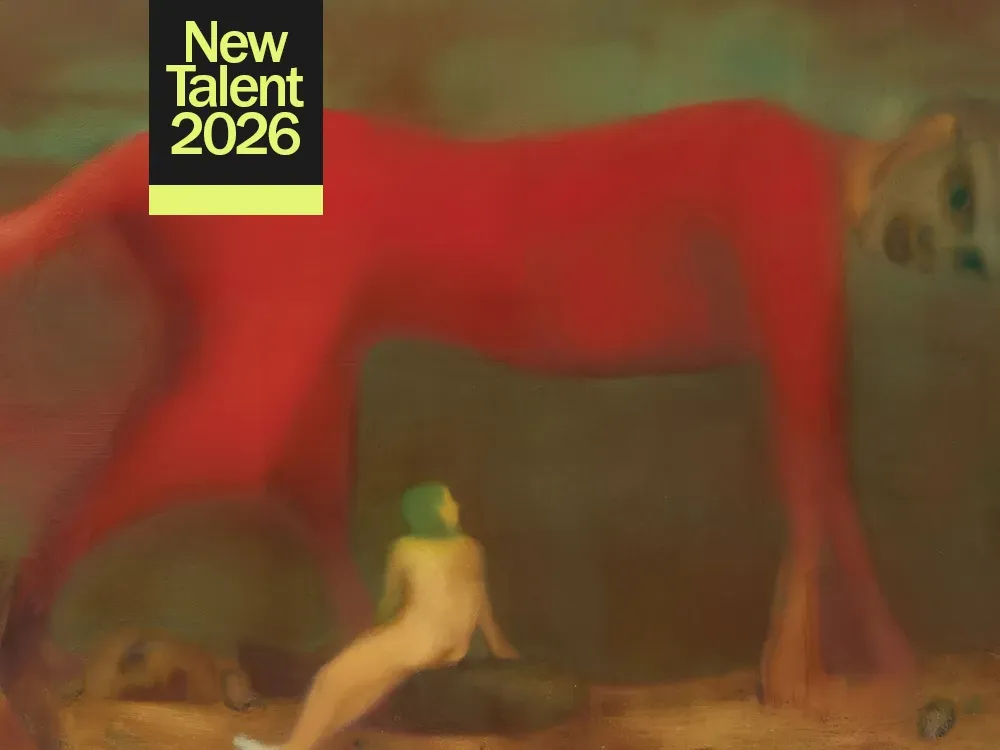
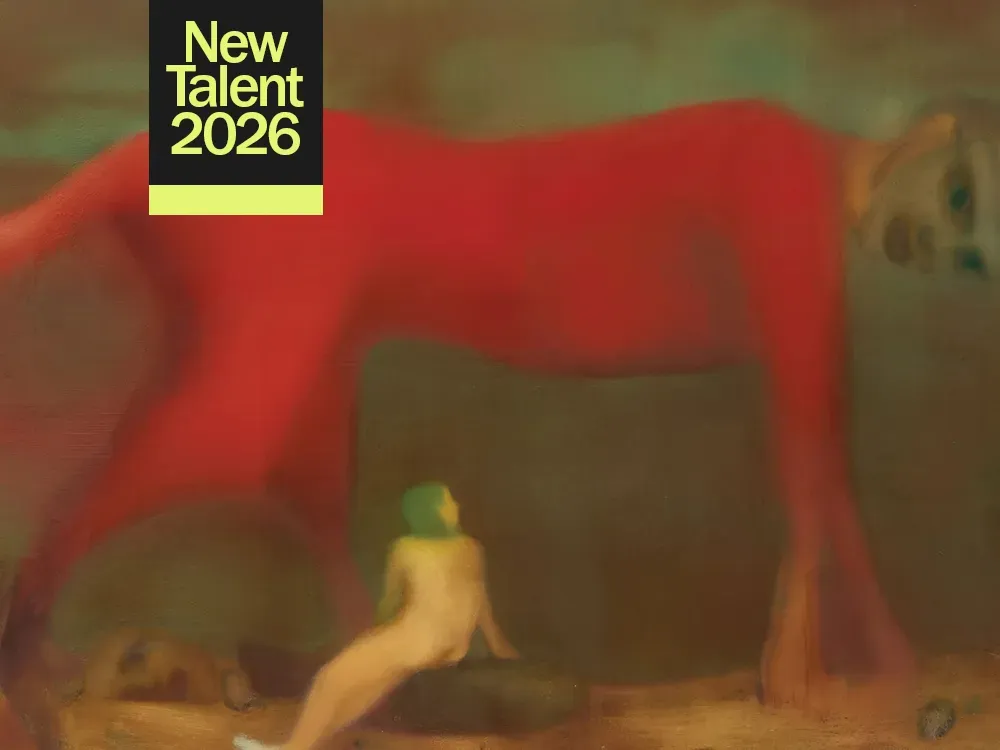
Ever feel like you're still figuring things out? Like your very essence is in flux? Artist Elizabeth Glaessner gets it. Her surreal paintings capture that exact, beautiful moment of becoming — where bodies, beasts, and entire environments are just… forming.
Imagine a human-like figure perched on a creature's back, but not quite separate. Its arms might be a shimmering, translucent green, blurring the lines between what's human, what's animal, and what's just… there. It's a glorious, undefined mess, and it lets your imagination run wild, which is exactly the point.
The Studio, The Spark, The Swirl
Fresh off a New York show, Glaessner is already plotting her next big exhibition for Perrotin Paris in early 2027. Her Brooklyn studio is a delightful explosion of inspiration: walls plastered with sketches, poems from Sylvia Plath, and reference images from artistic heavyweights like William Blake and Francisco de Goya. She’s even got taped sections marking out a massive new three-panel work that will feature at least ten figures and creatures. Because apparently, that's where we are now.
We're a new kind of news feed.
Regular news is designed to drain you. We're a non-profit built to restore you. Every story we publish is scored for impact, progress, and hope.
Start Your News DetoxHer process starts with charcoal, slowly coaxing compositions onto canvas. She says it “takes time for the figures to ‘catch,’” a wonderfully poetic way to describe the slow alchemy of creation. You can practically feel the tension in pieces like Hot Spring (2025) and Workhorse (2025), where a female figure on all fours has a smaller, hazy-limbed figure behind her, reaching, or maybe morphing, into a head. It’s like looking through a dream-fogged window.
The Art of the Undefined
Glaessner’s technique itself is a masterclass in controlled chaos. She uses surprisingly large brushes, even on smaller works, to keep things broad and sweeping. No fussy details here. She builds scenes with layers of oil paint over poured pigments, each one subtly shifting the forms. The final painting often bears little resemblance to the initial sketch, a testament to the happy accidents and small choices — a stray hair, a fleck of sediment — that become part of the canvas's very DNA. Because sometimes, the best art, like life, is about embracing the glorious, beautiful mess.