A stone's throw from where Germany's government meets, there's another parliament — this one made of trees, gravestones, and the stubborn vision of a single man.
Ben Wagin was born in West Prussia in 1930 and lived through World War II's devastation and the displacement that followed. By the 1960s, he was part of Berlin's anti-authoritarian art circles alongside figures like Joseph Beuys, already convinced that cities needed trees and artists needed to think ecologically. But Wagin didn't stay in the gallery world. In 1976, he founded the Tree Godfather Association and began planting thousands of ginkgos across Berlin — trees in front of the Kaiser Wilhelm Memorial Church, the Berliner Ensemble, the Neue Nationalgalerie. He had a gift for convincing politicians and sponsors to say yes.
The Wall Becomes a Garden
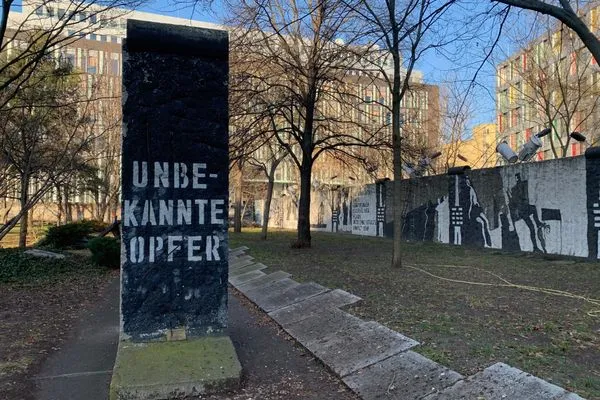
When the Berlin Wall fell in November 1989, Wagin saw an opening. While everyone else wanted the concrete gone, he occupied a section of the former Death Strip — the killing ground between East and West — and brought artists from both sides together to plant trees. He salvaged L-shaped wall segments, transformed them artistically, and placed gravestones in memory of those killed at the barrier and other victims of recent history.
We're a new kind of news feed.
Regular news is designed to drain you. We're a non-profit built to restore you. Every story we publish is scored for impact, progress, and hope.
Start Your News DetoxThe Parliament of Trees opened on November 9, 1990, exactly one year after the Wall's fall.
It's a strange, sometimes contradictory memorial. The aluminum plaques bearing names of artists and politicians aren't always clear about who was actually involved. Some of Wagin's choices feel eccentric, even questionable — he didn't remove the "r" from his birth name until 2012, at age 82. But the Parliament of Trees endured anyway, even as the government district expanded around it and threatened to swallow it whole.
Wagin fought relentlessly to preserve his work. In 2017, the site was officially designated a protected historical monument. He died in July 2021 at 91, leaving behind a place that turns a scar in the city into something growing — a parliament where trees speak for those who can't.
Since his death, the Berlin Wall Foundation has maintained the site, keeping Wagin's vision rooted in the city's most contested ground.