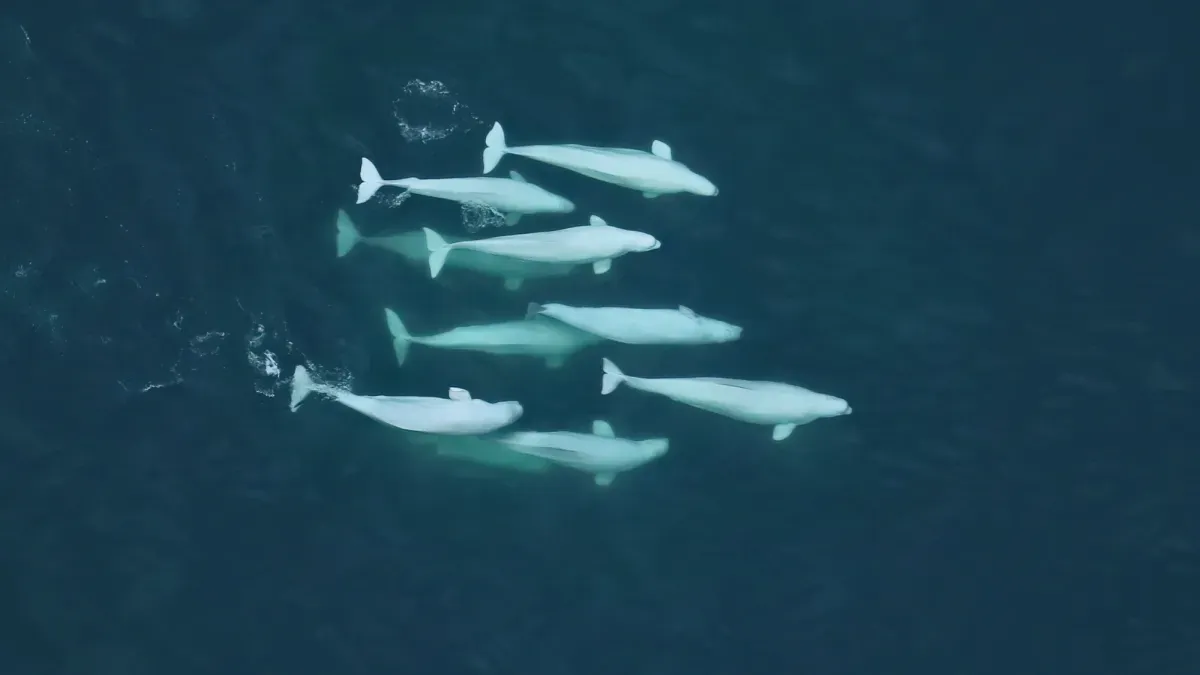
Bristol Bay's 2,000 beluga whales are doing something unexpected: both males and females mate with multiple partners across their lifetimes, a strategy that's quietly keeping the population genetically healthy.
Scientists studying this isolated population in southwest Alaska made the discovery by analyzing 13 years of genetic samples from 623 whales. What they found overturns decades of assumptions about how these whales breed. Rather than a few dominant males fathering most calves—the pattern researchers expected given that males are nearly twice the size of females—the whales have evolved something different. They're spreading reproductive opportunities across the group, creating half-siblings instead of full siblings, and mixing genes in ways that protect against inbreeding.
 Image: Greg O'Corry-Crowe and Cortney Watt, Arctic Whale Research Program – FAU/DFO.
We're a new kind of news feed.
Regular news is designed to drain you. We're a non-profit built to restore you. Every story we publish is scored for impact, progress, and hope.
Start Your News DetoxA long game
The key to understanding this pattern lies in how long belugas live. They can reach 100 years or more—far longer than most marine mammals. That longevity changes the math entirely. Rather than burning out in intense competition during a single breeding season, males appear to spread their reproductive efforts across decades. "It's a 'take your time, there's plenty of fish in the sea' strategy," says Greg O'Corry-Crowe, a biologist at Florida Atlantic University who led the research published in Frontiers in Marine Science.
Females are equally strategic. Instead of pairing with one male, they switch partners between breeding seasons. This flexibility lets them avoid low-quality mates and actively shape which genes get passed to the next generation. It's a form of choice that's often overlooked in discussions of animal reproduction, where male-male competition typically dominates the narrative.
Why this matters for survival
For a population of just 2,000 whales with little genetic flow from other Arctic groups, this mating system is essentially a built-in insurance policy. Small populations face a genuine threat: as gene pools shrink, inbreeding can weaken the entire group. But when both males and females have multiple partners and switch mates over time, genes stay mixed and healthy. The "effective population size"—the number that actually matters genetically—stays closer to the real headcount.
The Bristol Bay belugas live in one of the Arctic's most isolated ecosystems, making them a distinct population scientists can study in detail. That isolation also makes them vulnerable. Understanding how their mating system naturally maintains genetic diversity gives conservationists a clearer picture of what these whales need to survive as climate change and other pressures reshape their habitat.
Indigenous communities of Bristol Bay were central to this research, combining scientific sampling with traditional knowledge to protect the whales in a rapidly changing Arctic. As researchers continue monitoring the population, the message is cautiously hopeful: even small, isolated groups can have built-in resilience if we understand how they work.