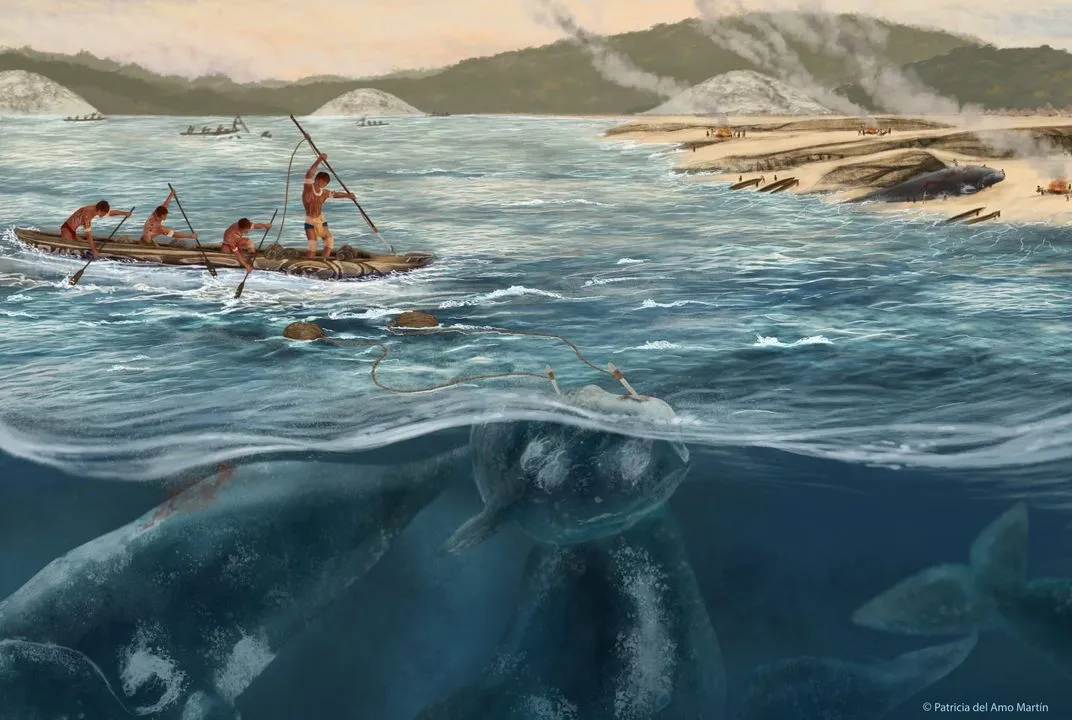
A dusty box in a Brazilian museum just rewrote what we know about ancient ocean hunting. Researchers examining artifacts stored away for decades have found evidence that people living along the coast 5,000 years ago weren't just collecting whales that washed ashore — they were actively hunting them, with harpoons made from whale bone.
The discovery, published in Nature Communications, pushes back the timeline of whale hunting in South America by roughly 1,000 years. It's a significant shift in how archaeologists understand these coastal communities.
How a museum visit changed everything
The story begins with an amateur archaeologist named Guilherme Tiburtius. Between the 1940s and 1960s, as developers dismantled large shell and bone mounds called sambaquis around Babitonga Bay in southern Brazil, Tiburtius rescued thousands of artifacts. Some 9,000 items eventually ended up in the local Museu Arqueológico de Sambaqui de Joinville, where they sat in storage.
We're a new kind of news feed.
Regular news is designed to drain you. We're a non-profit built to restore you. Every story we publish is scored for impact, progress, and hope.
Start Your News DetoxDecades later, researchers André Carlo Colonese, Krista McGrath, and Tatiane Andaluzia were hunting for evidence of prehistoric ocean fishing when they asked the museum curators to pull out whale bone artifacts. "The moment they took them out, I said, 'Guys, these are harpoons,'" Colonese recalls.
Lead author Krista McGrath analyzes one of the harpoons. Autonomous University of Barcelona
The team examined hundreds of marine bones and bone tools using zooarchaeology, typological analysis, and molecular techniques. They found evidence that hunters targeted southern right whales, humpback whales, blue whales, sei whales, sperm whales, and dolphins. The southern right whale was likely the primary target — these whales are slow swimmers and float after being struck, making them easier to retrieve from the ocean.
Harpoon socket pieces that came from southern right whales. Krista McGrath et al., Nature Communications, 2026
Why this matters beyond the museum
What makes this discovery culturally significant is where the harpoons were found. Some of the sambaquis were burial sites, and harpoons carved from whale bone were discovered next to human skeletons. This suggests whale hunting wasn't just a practical activity — it held deep cultural meaning. A single whale provided enormous resources: meat, blubber that could be rendered into oil for fuel and storage, bones for tools and possibly ceremonial objects.
"You can imagine a big feast where everyone eats a lot of meat and blubber, and at the same time they collect oil," Colonese explains. "A whale is very valuable."
The finding reshapes how archaeologists understand these coastal communities. Rather than viewing them primarily as shellfish collectors and fishers, researchers now recognize them as sophisticated whalers who managed dangerous hunts and processed massive marine resources. The research represents what Colonese calls a "paradigm shift" — evidence that these societies had the knowledge, tools, and social organization to pursue one of the ocean's largest animals.
The harpoons themselves tell a story of ingenuity: carefully crafted from bone, designed specifically for hunting cetaceans, and preserved in shell middens for 5,000 years. An amateur archaeologist's careful collecting, combined with modern molecular analysis, has brought that story back into view.