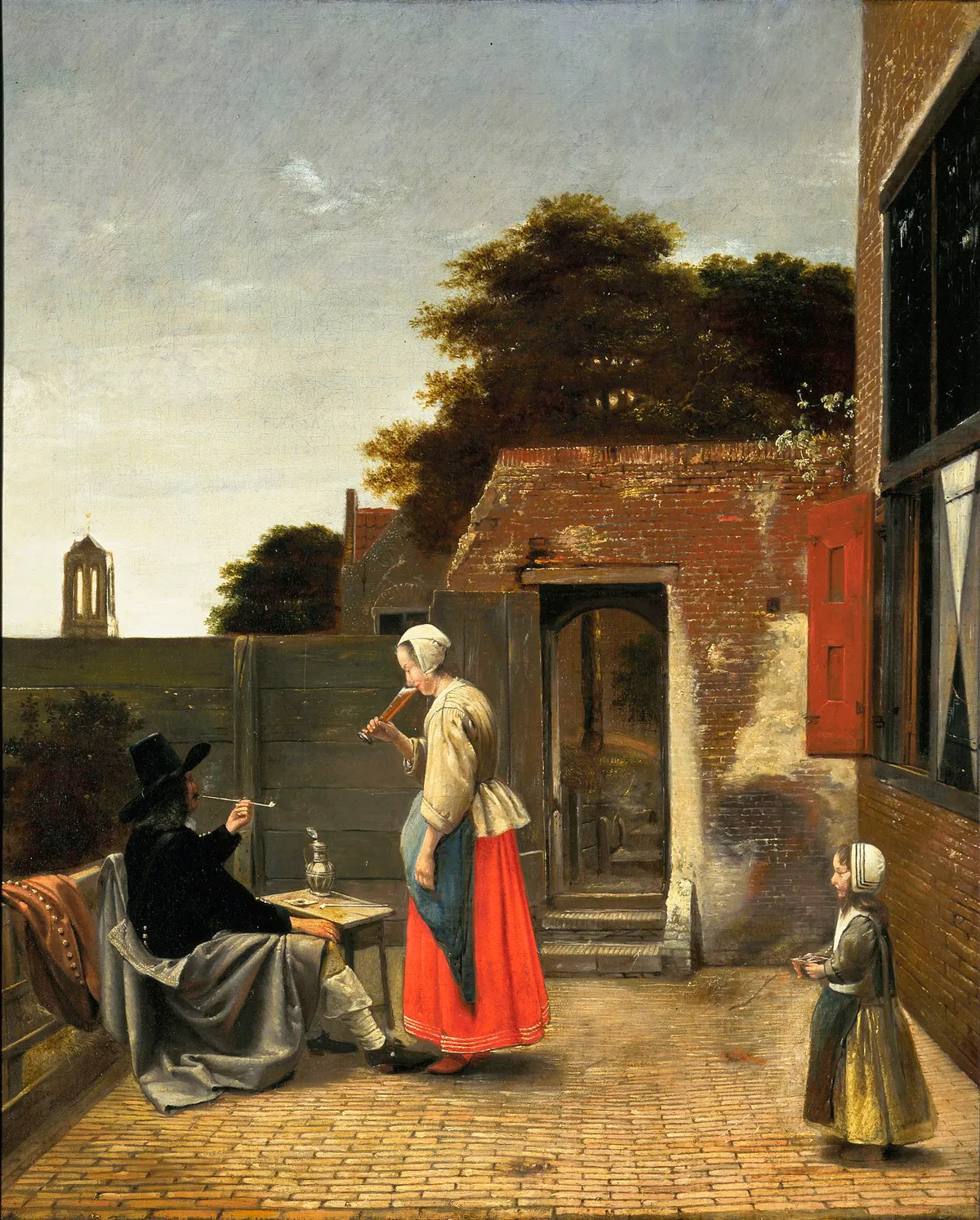
Hundreds of years ago, someone changed Pieter de Hooch's painting, A Man Smoking and a Woman Drinking in a Courtyard (1658-60). They painted over a soldier holding a beer, removing him from the scene.
Researchers have a few ideas why this happened. Maybe the goal was to make the painting unique and more valuable. Or perhaps it was to make the scene seem more modest. The original painting showed two men smoking and drinking with a woman taking a swig of beer. This suggested a lively, perhaps wild, atmosphere that de Hooch often included in his art.
Bringing Back the Soldier
The Mauritshuis art museum in the Netherlands recently restored de Hooch's original vision. Conservators painted the missing soldier back into the scene. The artwork is now called Figures in a Courtyard.
We're a new kind of news feed.
Regular news is designed to drain you. We're a non-profit built to restore you. Every story we publish is scored for impact, progress, and hope.
Start Your News DetoxJudith Niessen, head of collections and research at the Mauritshuis, told the Art Newspaper that the painting is "now much more moralistic," which was de Hooch's original intent.
Restorers had a clear guide for this work. De Hooch painted a second, almost identical version called A Dutch Courtyard. This painting, held at Washington, D.C.'s National Gallery of Art, still shows the soldier. Mauritshuis restorers Sabrina Meloni and Abbie Vandivere used it as a model.

Niessen explained that with only two people, the painting seemed more innocent. With the soldier back, it's clear they are playing a drinking game. The woman is drinking from a "pass-glass," while the two men are not.
The drinking game involved participants drinking down to a specific line on the glass. If they missed the line, they had to drink to the next ring. The glass was then passed to the next person.
The Soldier's Disappearance and De Hooch's Style
The soldier was likely removed from the painting sometime before 1822. In 1833, a catalog for the John Smith Gallery in London listed the painting without mentioning the soldier.
In the 1920s, art restorer Martin de Wild discovered the soldier had been painted over. He photographed his finding but only touched up the removal, leaving the soldier's beer tankard and pipe on the table. Later research using X-ray technology did not reveal who removed the soldier or why.
De Hooch's paintings often contained hidden meanings. For example, his A Musical Conversation (1674) was recently restored. Conservators found that a brighter appearance highlighted the painting's suggestive plot.

Catherine Whitney from the Honolulu Museum of Art noted that such "merry-company scenes" often hinted at "sensual and mischievous undercurrents." Symbols like a dog and a background painting of Venus, the goddess of sensual love, would have added to these implications.
Another de Hooch painting, A Woman Drinking With Two Men (1658), shows a similar scene with three figures drinking around a table. The National Gallery in London, which holds this painting, states that musical gatherings in art could represent innocent fun or something more suggestive. It's not always clear which meaning de Hooch intended.

Deep Dive & References
Raise a glass: long-hidden image of soldier returns to Pieter de Hooch painting - The Art Newspaper, 2026 Mysterious soldier returns to Pieter de Hooch painting after restoration - Codart Stories: Deep Cleaning Pieter de Hooch’s A Musical Conversation - Honolulu Museum of Art Pieter de Hooch: A Woman Drinking with Two Men - National Gallery, London