For decades, computer engineers just shrugged at waste heat, viewing it as a necessary evil in the digital world. But Hannah Earley, cofounder and CTO of Vaire Computing, thinks that's just poor design. She's building chips that don't just generate heat; they reuse the energy that would otherwise vanish.
Think of it this way: your computer chip is constantly hitting the delete key on temporary information, then burning more energy to keep going. Earley compares it to a car slamming the brakes and then flooring the gas, over and over. Her solution, called reversible computing, aims to keep that computational "momentum" going, making everything from data centers to your phone dramatically more efficient.

The Energy-Saving Pendulum
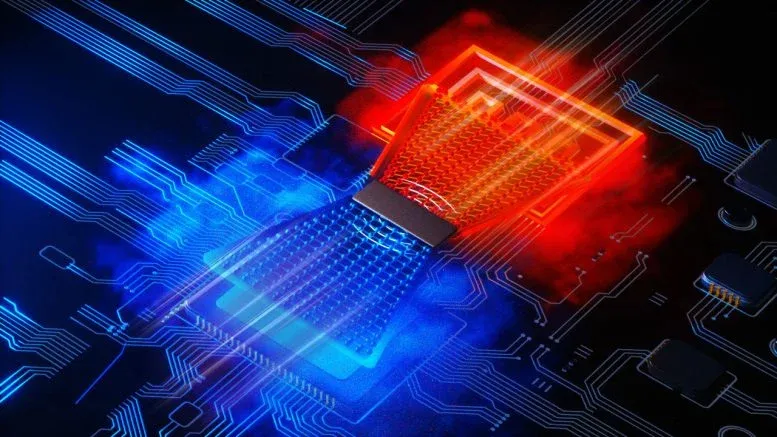
Reversible computing isn't exactly new; the theory has been floating around for half a century. The problem was making it work in the real world. Earley's genius was redesigning the actual hardware. She created a tiny chip component, a "resonator," that acts like a "glorified pendulum," storing recovered energy for later use.
We're a new kind of news feed.
Regular news is designed to drain you. We're a non-profit built to restore you. Every story we publish is scored for impact, progress, and hope.
Start Your News DetoxLast year, Vaire announced a genuine breakthrough: a chip with a resonator that actually recovered more energy than it lost. This wasn't just a theoretical win; it proved reversible computing could finally leap from academic papers to actual silicon. Igor Markov, an electronic design automation researcher, noted that Vaire "clearly has something interesting," though he added the usual caveat that the technology still needs more real-world demonstrations to woo the industry.
Earley, who started programming at the ripe old age of nine, kept digging deeper into computing until she hit the fundamental level of transistors. Then, during her PhD at Cambridge, she stumbled upon a 1999 thesis on reversible computing. Skeptical at first, she eventually realized that this connection between information, energy, and heat could fundamentally reshape computing.
That realization hijacked her entire PhD. She ended up building software to translate regular programs into reversible ones. Her work became so specialized, her advisor Gos Micklem eventually stopped putting his name on her papers. Which, if you think about it, is both impressive and slightly terrifying.
After finishing her degree in 2021, she teamed up with entrepreneur Rodolfo Rosini to cofound Vaire. They've since raised over $12 million and even brought the original reversible computing pioneer, Michael Frank, on board as a senior scientist. Because apparently that's where we are now: the future is so bright, it's bringing the OGs back into the lab.
Innovation, of course, isn't always a sudden lightning bolt. Earley spent weeks in an Iowa basement apartment, battling -40°F wind chills, filling whiteboards with circuit designs. The final design wasn't a sudden "aha!" moment but a slow, dawning relief. "I'm not completely out of my depth," she recalled thinking. Which, for the person literally trying to rebuild computers from scratch, is a pretty good feeling.
Now, the challenge is fitting this groundbreaking design into existing manufacturing. Earley believes the real future means rebuilding chips from the ground up, rethinking "every part of how computers are built" with reversibility in mind. Because why just compute when you can compute, and then some?