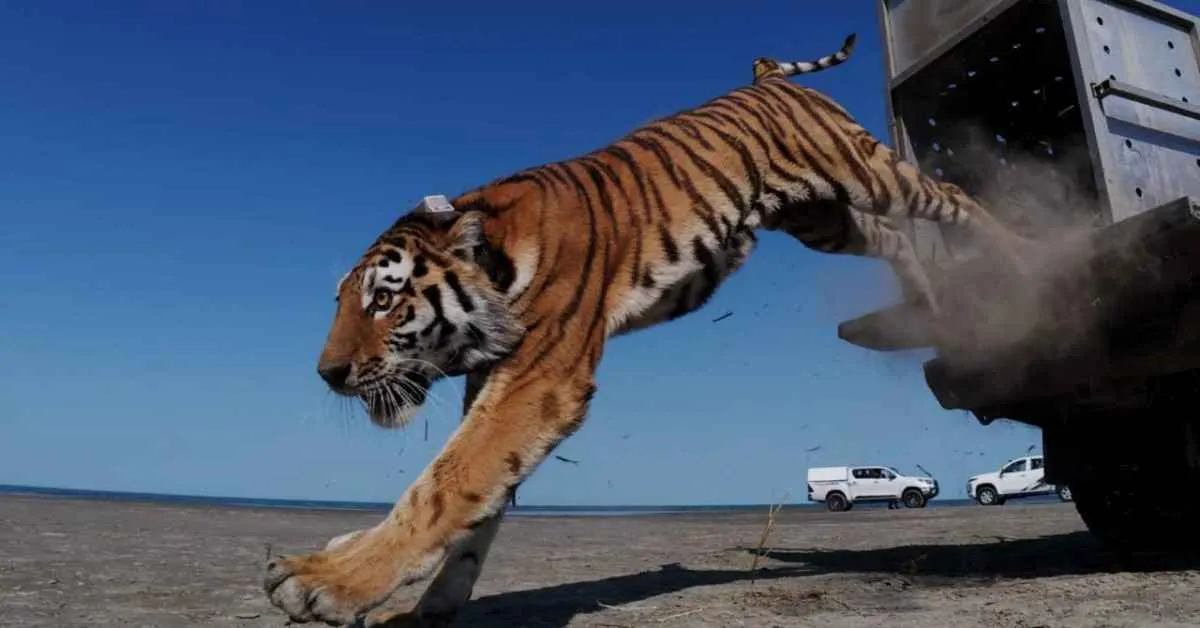
Kazakhstan has released its first tiger into the wild. This happened more than 70 years after the last tiger was seen in the country.
On July 31, 2026, an adult female Amur tiger named Umit was set free. Umit means "hope" in Kazakh. She jumped from her cage into the Ile-Balkhash State Nature Reserve. This reserve is 1.1 million acres in southeastern Kazakhstan.
The Kazakhstan government said on August 3 that Umit has a satellite tracking collar. This collar helps monitor her movements and behavior in real time.
We're a new kind of news feed.
Regular news is designed to drain you. We're a non-profit built to restore you. Every story we publish is scored for impact, progress, and hope.
Start Your News Detox"Today we are truly witnessing a historic event," said Yerlan Nyssanbayev. He is Kazakhstan's Ecology and Natural Resources Minister. "For the first time in over 70 years since tigers were wiped out in Kazakhstan, a tiger has been reintroduced to its historic range."
Bringing Tigers Back
The area where Umit was released was once home to the Caspian (Turian) tiger. The last time a Caspian tiger was confirmed there was in 1948. Umit is an Amur tiger. This type of tiger lives in the Russian Far East and northeastern China.
Amur and Caspian tigers were once thought to be different subspecies. However, in 2017, the IUCN recognized both as Panthera tigris tigris.
The Ministry of Ecology and Natural Resources said that preparing for the tigers' return took over 10 years. The Ile-Balkhash Reserve was created in 2018. Its goal was to make the area ready for tigers. This included increasing the number of prey animals. These include Bukhara deer (Cervus hanglu bactrianus) and kulan (Equus hemionus kulan).
The Kazakh government chose Amur tigers because their genes are very similar to Caspian tigers. Caspian tigers died out due to losing their habitat and being hunted.
More Tigers to Come
Umit is one of four Amur tigers given to Kazakhstan by Moscow. These tigers were captured in Russia's Khabarovsk Krai region. They were flown to Kazakhstan in May 2026.
The other adult tiger, Amur, and two cubs, Turan and Ussuri, are currently in special enclosures. They are in the Ile-Balkhash reserve.
Amur is undergoing behavioral tests. He will be released once experts confirm he can survive on his own. The two cubs will stay in their enclosures until they are at least 18 months old. After tests, a decision will be made about releasing them.