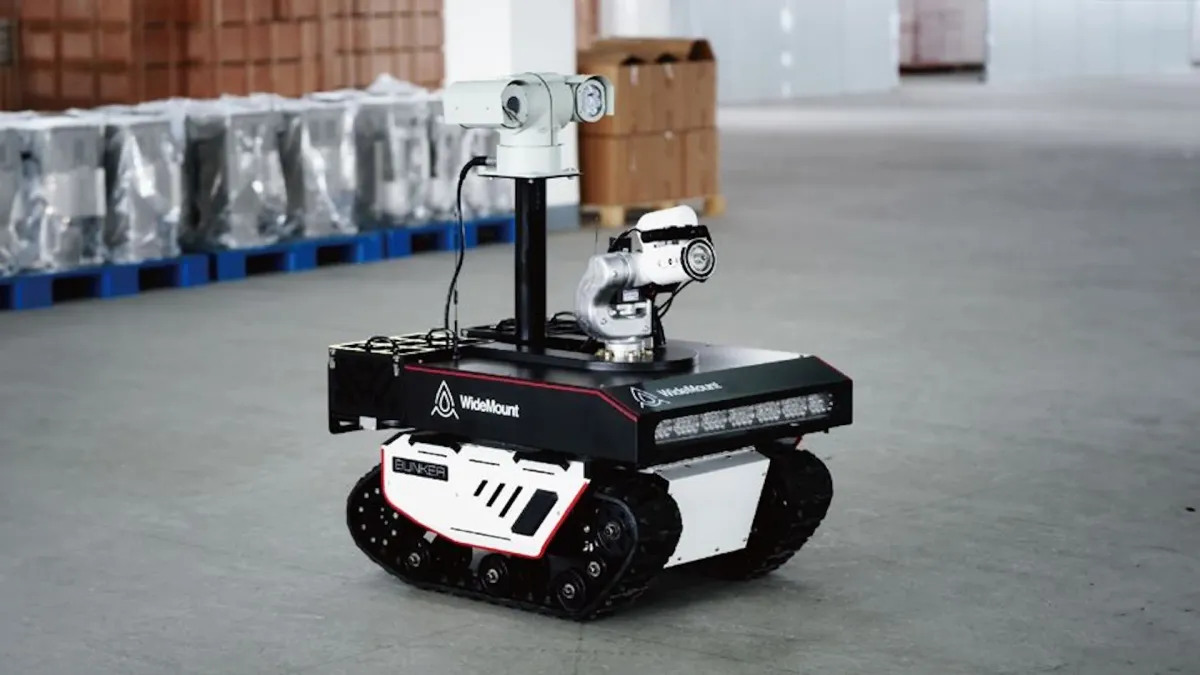
A tank-like robot developed at Hong Kong Polytechnic University can walk into a burning building, see through the smoke, and extinguish flames on its own. It just won the top innovation award at CES 2026 for its category—a recognition that reflects how far autonomous firefighting has come.
The robot's trick is its radar. Instead of relying on cameras (useless in thick smoke) or GPS (which doesn't work indoors), it uses millimeter-wave radar SLAM—essentially the same technology that lets self-driving cars "see" in fog. This radar builds a real-time map of the burning space as the robot moves through it, letting it navigate without any human guidance.
Once it locates a fire, the robot's deep-learning system identifies what's burning in real time. Different materials need different extinguishing agents—water works on some fires but makes others worse. The robot knows the difference. It selects the right suppressant, locks onto the flames with a closed-loop vision system, and puts them out. Onboard sensors measure the fire's intensity continuously, feeding live data back to command centers so human operators stay informed even as the robot works independently.
We're a new kind of news feed.
Regular news is designed to drain you. We're a non-profit built to restore you. Every story we publish is scored for impact, progress, and hope.
Start Your News DetoxWhy This Matters for Firefighting
Firefighting remains one of the most dangerous jobs. In 2023, the U.S. Fire Administration recorded over 100 firefighter deaths in the line of duty, many from smoke inhalation and structural collapse. A robot that can enter first—mapping the space, suppressing initial flames, and buying time for human crews—could reshape how fires get tackled.
The robot was developed by Professor Huang Xinyan and Wang Meng, a PhD student who founded the startup Widemount Dynamics Tech Limited to commercialize the technology. Their focus on smoke navigation was deliberate: most fire scenarios involve visibility near zero within seconds. A system that doesn't need to see the fire to find it solves a problem that has frustrated roboticists for years.
PolyU also won awards at CES for two healthcare innovations—a powered skateboard that helps stroke patients rehabilitate at home, and a 30-second fatty liver screening device. But the firefighting robot stands out for its combination of autonomy and real-world stakes. It's not a prototype anymore. It's being showcased at CES 2026 in Las Vegas, which means it's close to deployment.
The next phase is scaling: testing in real fire scenarios, refining the extinguishing agent selection, and building teams of robots that can coordinate in larger structures. But the core breakthrough is already proven. Smoke no longer blinds the machine.