When Harvard released its 2022 report on slavery, it had identified 79 people who'd been enslaved by university leaders and staff. Researchers knew that was just the beginning.
Now, working with American Ancestors, a genealogical nonprofit, they've named 1,314 formerly enslaved people connected to Harvard — and found 601 of their living descendants. The work started with mapping approximately 3,000 Harvard faculty, staff, and leaders who were present when slavery was legal in America. The harder part came next: figuring out who enslaved people, and recovering the names of those they enslaved.
Why the Records Don't Tell the Obvious Story
The challenge runs deep. Institutions kept meticulous records on free people but treated enslaved people as property — which is exactly how they appear in the archives. An enslaved person might show up in a will, a tax record, or a church baptism, but often with only a first name, sometimes a different name altogether, frequently just noted as someone's property.
We're a new kind of news feed.
Regular news is designed to drain you. We're a non-profit built to restore you. Every story we publish is scored for impact, progress, and hope.
Start Your News DetoxHarvard faculty members have accessible birth, marriage, and death records. They're searchable by full name in databases. Enslaved people? They're scattered across probate filings, church records, tax rolls, and court documents — if they appear at all. "The archives are created by the enslavers themselves for the most part," says Gabriel Raeburn, senior research project manager at American Ancestors. "They often didn't seem to believe it was worth recording the life events of those they enslaved."
Researchers have learned where to look. Probate records sometimes list enslaved people as bequeathed property. Church records in Massachusetts documented baptisms and civil marriages of enslaved people starting in 1705 — the First Church of Cambridge, for instance, recorded the 1729 baptism of "Titus, an Indian manservant of Pres. Wadsworth," one of four enslaved people at Harvard's Wadsworth House. Court filings, especially from the late 1700s onward, tracked enslaved people suing for freedom. Tax records captured them as taxable property.
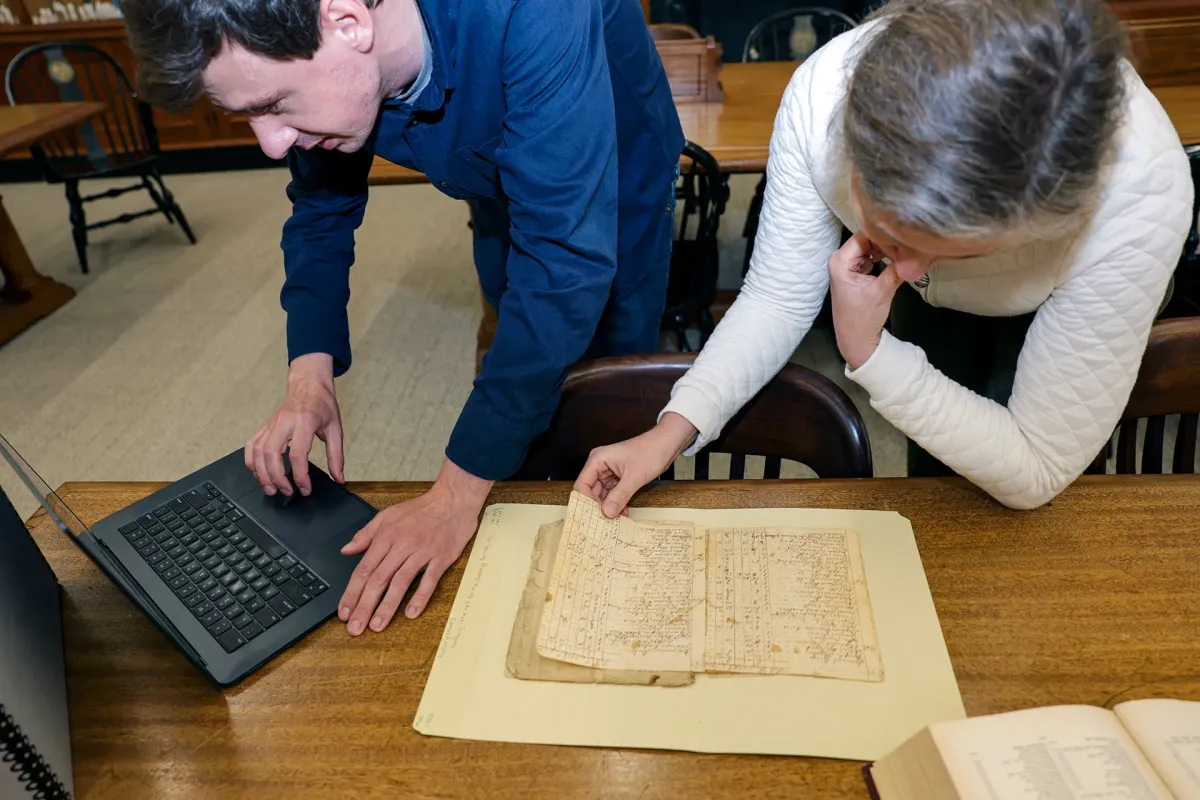
But even when researchers find a name, the work isn't finished. A probate file might mention someone in passing across hundreds of pages. The term "slave" rarely appears in official documents — instead, enslaved people are referred to as "servants" with a racial descriptor. Gabriel Raeburn recalled reading letters that mentioned both family members and enslaved people alongside each other. He only knew one man was enslaved because he'd previously seen his bill of sale.
Building a Shared Picture
Harvard's researchers aren't working alone. Universities across the country have begun collaborating through initiatives like the Universities Studying Slavery consortium and the Northeast Slavery Index. The Boston Task Force on Reparations, Medford's Royall House and Slave Quarters, local historical societies, and churches have all documented enslaved people in Massachusetts. Kirt von Daacke, managing director of the USS consortium, points out that you can't tell the history of slavery at one university without understanding the broader communities the institution was embedded in. "Standing on the shoulders of people who have done this before is really important," says Lindsay Fulton, American Ancestors' chief research officer, "because we're looking for records that are typically overlooked."
As the work deepens, researchers expect to identify many more. The fuller picture of Harvard's history — long obscured in the archives — is gradually coming into view.