When Sean Tevlin walked into The Group School in the 1970s, he was carrying the weight of a learning disability diagnosis, math anxiety, and a childhood that had offered him little reason to believe in himself. His parents' separation, his time in a Catholic orphanage, the office cleaning jobs he took instead of attending class — all of it had taught him to feel like an outsider. At TGS, something shifted.
Teachers there didn't just tolerate him. They engaged with him. They patiently tutored him. They rekindled a love of reading he thought he'd lost. "It opened me up mentally and emotionally," Tevlin reflects decades later, now living in Cambridge with Alison Harris, a founding student of the school who became his life partner.
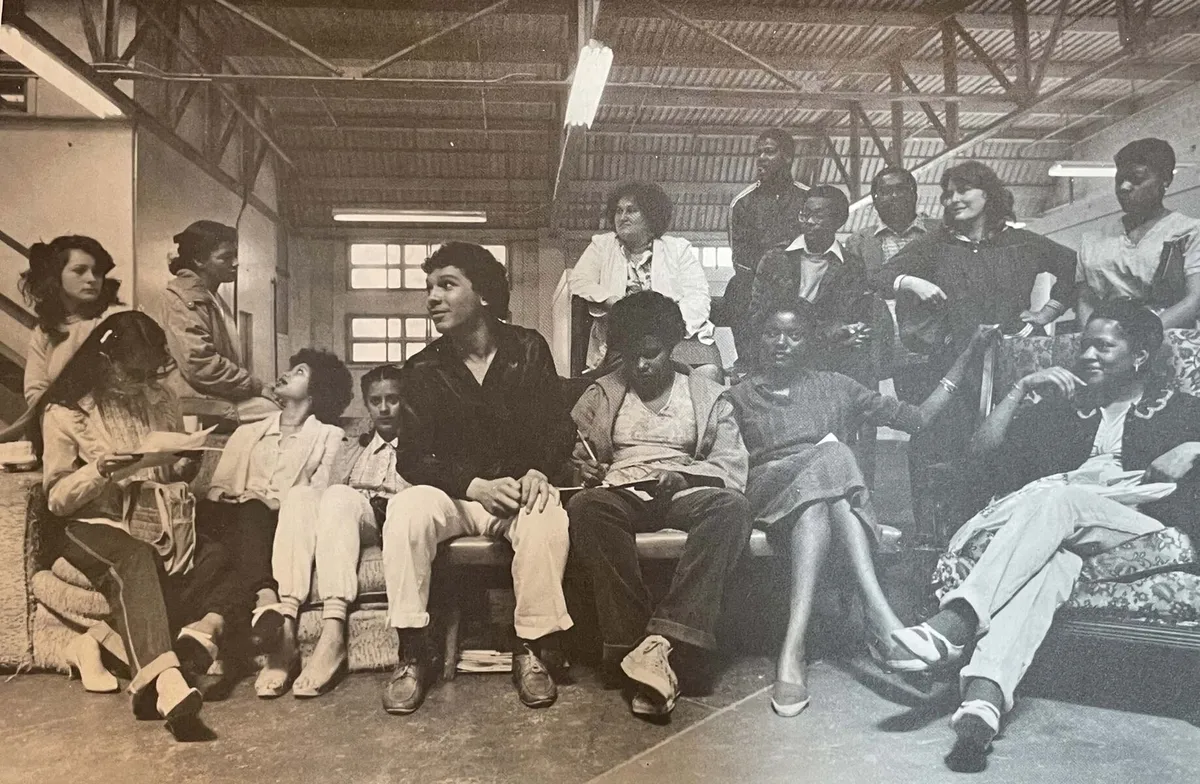
The Group School — "CHANGING LEARNING, CHANGING LIVES" spelled in giant letters on its white brick walls — operated between 1971 and 1982 from a converted industrial garage on Franklin Street. Over those eleven years, more than 600 students like Tevlin graduated from what was essentially an educational experiment: a place that combined radical democracy, intensive arts programming, and a philosophy that didn't ask working-class kids to shed their backgrounds to belong.
We're a new kind of news feed.
Regular news is designed to drain you. We're a non-profit built to restore you. Every story we publish is scored for impact, progress, and hope.
Start Your News DetoxHow a Conversation Became a School
The story began earlier, in the late 1960s, at a Teen Center behind a local Quaker school. A group of teenagers started asking questions about their own education. Why did school feel so disconnected from their lives? What was actually wrong with the system? People from Harvard's Graduate School of Education came to facilitate these conversations, ostensibly to keep kids engaged and out of trouble. But something more urgent was happening.
"It was a moment in history," says Adria Steinberg, a founding faculty member. "Many of us had been involved in social change movements — anti-war, civil rights — and we had a strong sense of the inequities in America. We were looking for an educational setting that acknowledged those inequities."
These weren't abstract concerns. They were lived experiences. The students asking these questions were the ones most failed by conventional schooling. Harris remembers the evolution clearly: "In the early stage, we were just a group of kids. Pretty soon the topic became what was wrong with our schools. Discussion started evolving around: Would we like a school? Could we start a school? And lo and behold, we actually did."
The Group School became a place where that question — what if education looked completely different? — got a real answer. For eleven years, it proved that another model was possible. For Tevlin and hundreds of others, it was the difference between a trajectory of struggle and one of possibility.