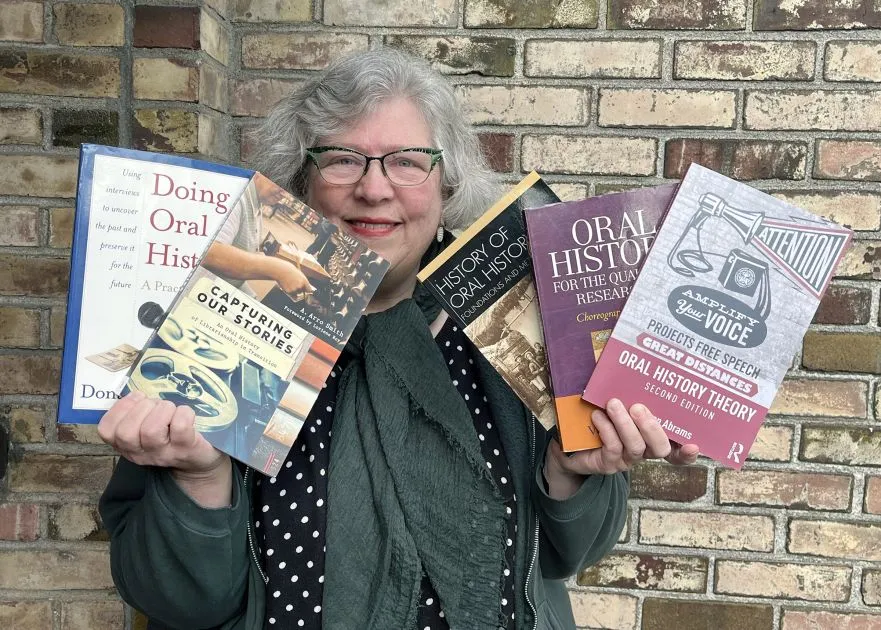
Ann Glusker didn't plan to become a librarian. As a public health epidemiologist in Seattle, she was solving problems for anyone who asked — helping families find the right hospital, giving school districts birth data for enrollment planning. Then came a dinner party where someone asked: When you get home after a movie, do you look up every fact mentioned in it?
"My answer was, of course, 'Doesn't everybody do that?'" Glusker recalled. "And they said, 'No, not everybody does that. You must be a librarian.'"
At 46, with two advanced degrees already in hand, she went to library school. Seven years later, she's at UC Berkeley, supporting sociology, demography, psychology, and social welfare research. But her most recent work isn't shelving books — it's preserving stories.
We're a new kind of news feed.
Regular news is designed to drain you. We're a non-profit built to restore you. Every story we publish is scored for impact, progress, and hope.
Start Your News DetoxGlusker has just released "Librarians Navigating Change," an oral history project interviewing 15 retired and current UC Berkeley librarians. Nearly 400 pages of transcripts capture four decades of adaptation, uncertainty, and the quiet work that keeps research institutions running.
What the interviews revealed
The librarians Glusker spoke with had lived through seismic shifts. Some started before the internet existed. They watched technology reshape how information moves, how libraries operate, and what their role could be. COVID-19 accelerated changes that were already underway — the shift to digital resources, the rethinking of physical space, the redefinition of what a librarian does.
But perhaps the biggest theme wasn't technological at all. When Glusker asked why people became librarians, not one said "because I love books." Instead, they spoke about service — about wanting to help, to think deeply, to matter. "The people I talked to all felt that Berkeley was an important place to be because of the kind of impact you could make," Glusker said. "If you're helping Berkeley students, you're helping people change the world."
There were practical realities too. Libraries that once had 12 librarians now operate with one or two. Job titles have doubled in length. No one arrived at Berkeley and kept the same role for a decade. The work got harder, more complex, more essential — and somehow, librarians kept showing up.
Some stories stuck with Glusker more than others. There was David Eifler, a retired Environmental Design Librarian, whose 3-year-old son encouraged him into the profession after a library visit. And Lily Castillo-Speed, head librarian at the Ethnic Studies Library, who quietly handed a graduate student a key during the 1990s student protests to save confiscated banners and posters from police disposal. The next day, the library had a collection of protest materials — preserved not by official policy, but by someone who understood that information, and history, matter.
Glusker remains hopeful about what comes next. "Librarians really understand how information is structured," she said. "I think that we're always going to be needed." As information becomes more fragmented and harder to navigate, the people trained to organize it, find it, and connect others to it may be more valuable than ever.