Turns out, where you swipe right on a dating app isn't the only thing your phone knows about your daily habits. It also has a pretty good idea if you're battling depression or, perhaps, enjoying a few too many happy hour specials.
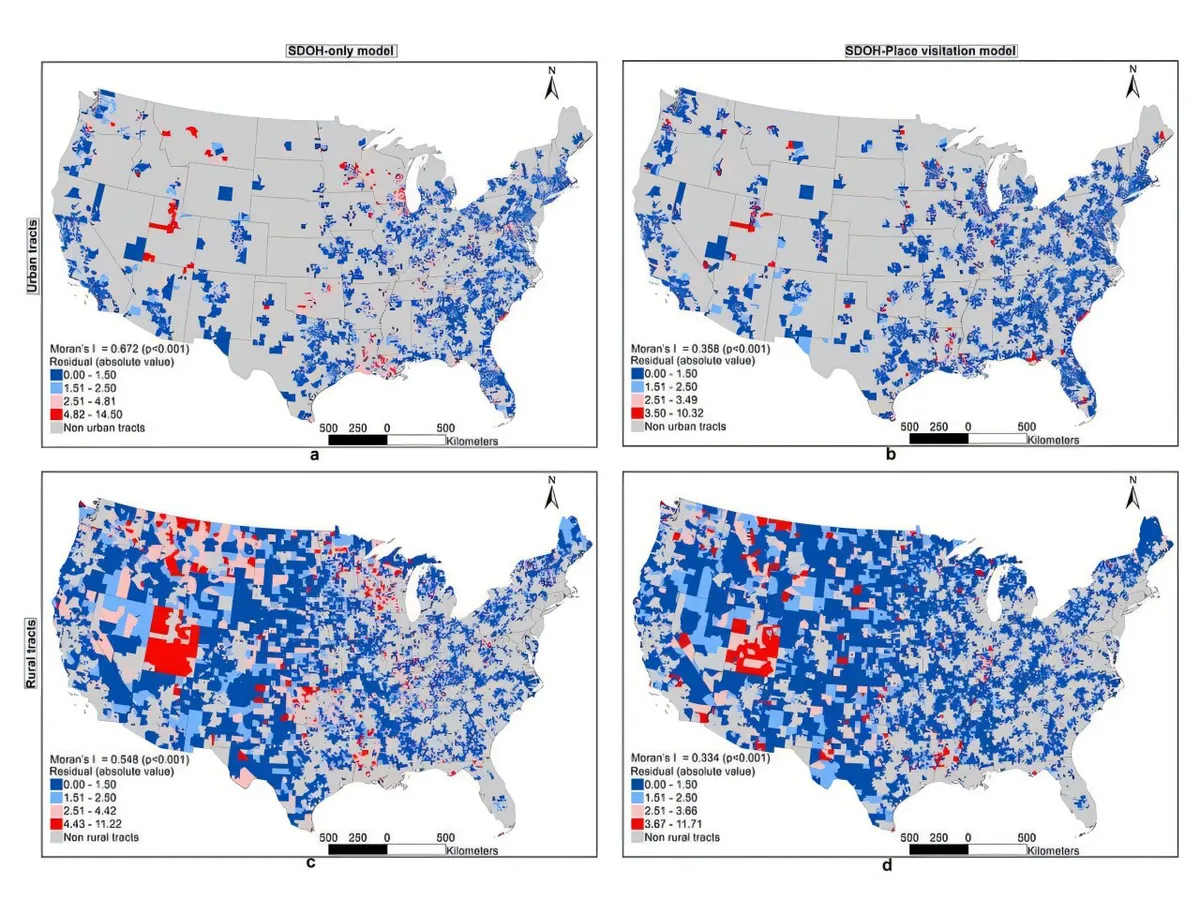
Researchers at Penn State just dropped a bombshell: adding anonymous cellphone location data to health models made those predictions 7.5% more accurate. Because apparently, where you go matters just as much as where you live when it comes to community health.
Your Daily Commute, Decoded
Traditionally, public health predictions have been about as exciting as a census form: age, race, income, education. But Zhenlong Li, a geography professor and lead author, realized we're all out there, living our lives, hitting up parks, gyms, and that one restaurant with the suspiciously good fries. These daily patterns, he figured, had to be telling us something.
We're a new kind of news feed.
Regular news is designed to drain you. We're a non-profit built to restore you. Every story we publish is scored for impact, progress, and hope.
Start Your News DetoxSo, they built a standard health model. Then, they layered on aggregated (and anonymous, thank goodness) cellphone data from 2019, tracking visits to roughly 7 million public places. Think: parks, restaurants, casinos (naturally), and even health clinics. This wasn't just a local experiment; they crunched data across 12,800 rural and 56,600 urban areas across the entire U.S.
And guess what? Their hypothesis was correct. As doctoral student Temitope Akinboyewa put it, daily activity patterns at a neighborhood level were better predictors of neighborhood health. The biggest bumps in prediction power? Binge drinking, depression, routine medical checkups, obesity, and asthma.
The Surprising Signals
The improvements were, frankly, a little wild. For urban areas, predicting binge drinking got a nearly 39% boost. In rural areas, depression predictions shot up by almost 49%. Let that satisfying number sink in.
So, what did they find? Frequent visits to places selling alcohol were, perhaps unsurprisingly, linked to higher rates of both binge drinking and depression. In cities, hitting up bowling centers and amusement parks correlated with more binge drinking. Less binge drinking? That was linked to religious organizations, limited-service restaurants, and malls. Because nothing says 'self-control' like a trip to the food court.
For rural folks, casinos and convenience stores saw a link to more binge drinking. Less? General stores, limited-service restaurants, and gas stations. Which, if you think about it, is both impressive and slightly terrifying.
Depression had its own quirky links. Urban dwellers hitting casinos and jewelry stores (retail therapy gone wrong?) showed higher rates. Lower rates were linked to caterers, art dealers, and child day care services. In rural areas, more depression tracked with limited-service restaurants and casinos, while convenience stores, hotels, and child day care services were linked to lower rates.
Before you start judging your local convenience store for its mental health impact, Li stressed that this study shows associations, not direct causes. But it's a fascinating peek into how our daily movements, tracked by the very device we can't live without, could offer a surprisingly sharp lens into community well-being. And if that's not enough, he thinks data from smart wearables could push these predictions even further. Your Fitbit might just know more about your mood than you do.