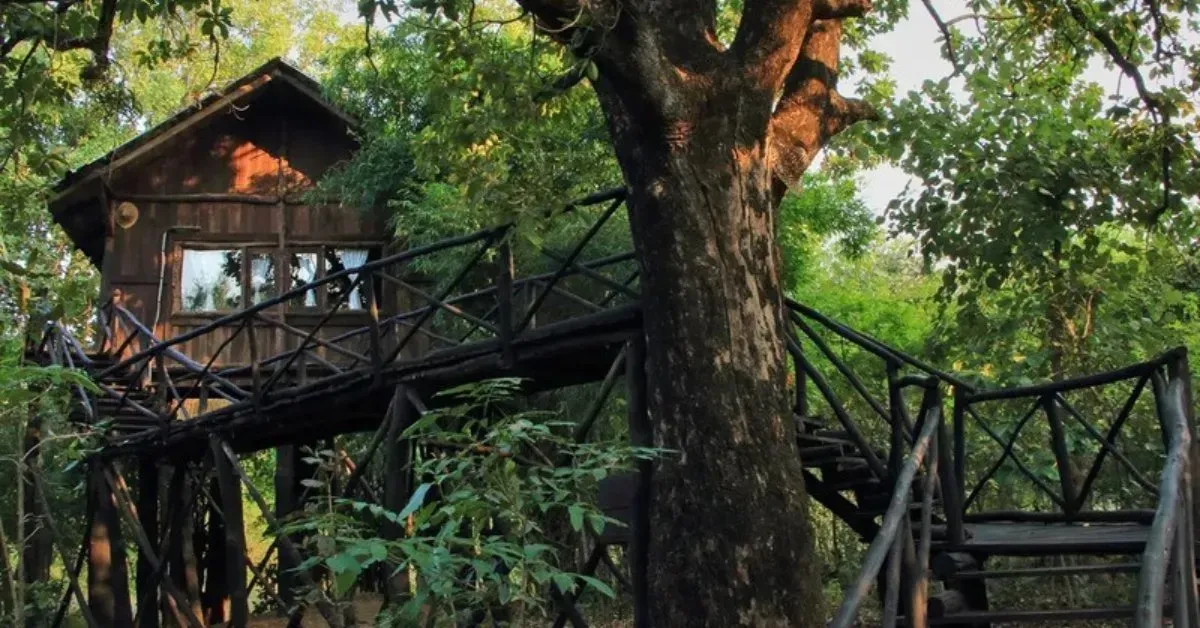
India's treehouse stays have quietly shifted from gimmick to genuine alternative. These aren't Instagram backdrops pretending at sustainability — they're places where staying high in the canopy means leaving a lighter footprint on the ground.
The appeal is straightforward: wake 30 to 45 feet above the forest floor with nothing between you and the canopy but air. At The Machan in Lonavala, each treehouse sits on a full acre of untouched greenery. Couples drift off under open skies in the Starlight Machan; families find cosy lofts in the Forest Machan. It's the kind of seclusion that used to require flying somewhere expensive. Now it's three hours from Mumbai.
 Image: Vythiri resort
In Wayanad's rainforest, Vythiri Resort has five treehouses built from bamboo and thatched roofs that disappear into the canopy. Four sit at 90 feet — genuinely remote. The family treehouse sits lower, closer to the restaurant, a practical nod to how people actually travel. Each one opens to a balcony where the view is just endless green.
We're a new kind of news feed.
Regular news is designed to drain you. We're a non-profit built to restore you. Every story we publish is scored for impact, progress, and hope.
Start Your News DetoxNear Athirapally Falls in Kerala, the Rainforest Resort built its signature treehouse around a living tree. The structure wraps around it; nature isn't decoration, it's the architecture. A private deck faces the falls — you hear the roar day and night. A net-canopied bed keeps insects out while keeping the forest in.
 Image: Rainforest
Pench Tree Lodge sits on 40 acres deep in Madhya Pradesh. Six treehouses rise from ancient Mahua trees with floor-to-ceiling windows that blur the line between inside and out. You get birdsong as your alarm, rustling leaves as your soundtrack. There's AC and a four-poster bed — comfort without pretending you're roughing it. As dusk falls, soft lanterns light the trail back to your treehouse glowing in the deepening green.
 Image: Pench Tree
Some go minimal. The Mudhouse near Munnar in Kerala is hand-built from mud, coconut thatch, and local timber. One treehouse. A simple bedroom. An open-sky bathroom. A balcony staring into the valley. No frills. A shared kitchen, a communal table, maybe a barbecue under stars if the weather cooperates. It's the opposite of resort comfort, and that's exactly the point.
 Image: Instagram
Arjun's Treehouse at Ahilya by the Sea in Goa is 100 square feet of cosy magic nested in a banyan tree. A queen bed, an ensuite, AC, Wi-Fi if you need it — but with views of Dolphin Bay, you probably won't. It's the kind of hideaway that feels like finding something the world forgot about.
 Image: Ahilya
Scale matters. Tree House Resort in Rajasthan spreads across 300 acres with 20 treehouses cradled in kikar trees, each named after the birds that live here. Air conditioning, Wi-Fi, room service, even a bathtub overlooking the Aravalli Hills. The resort unfolds into a full ecosystem — a nature-view gym, pool, restaurant, courts for golf and tennis. It's what happens when treehouse living meets resort infrastructure.
 Image: Instagram
Treehouse Hideaway near Bandhavgarh in Madhya Pradesh sits within 21 acres. Six hideaways built around native Mahua and Banyan trees. You might be reading on your balcony when the forest stirs — a langur overhead, a deer call in the distance. Inside: AC, a mini bar, warm wooden charm. Outside: the jungle breathing around you.
 Image: Treehouse Hideaway
In Jibhi, a wooden treehouse in the mountains runs on solar lights and rainwater. No plastic. Hosts who know your name. Sometimes a flying squirrel swoops past at dusk like a secret only the forest keeps.
 Image: Agoda
At Tranquil Resort in Wayanad, you wake 35 feet up on a 400-acre estate with coffee plantations stretching below. Two treehouses: one wraps around a jackfruit tree with a verandah for squirrel spotting. The other sits in a Gulmohar with a wall library and a tree-trunk bathroom.
 Image: Tranquil Resort
What ties these places together isn't the height or the amenities — it's the fundamental shift in what luxury means. Less footprint. More forest. Fewer rooms, more solitude. It's the difference between staying in a place and belonging to one, even briefly. For 2025, that distinction might matter more than ever.