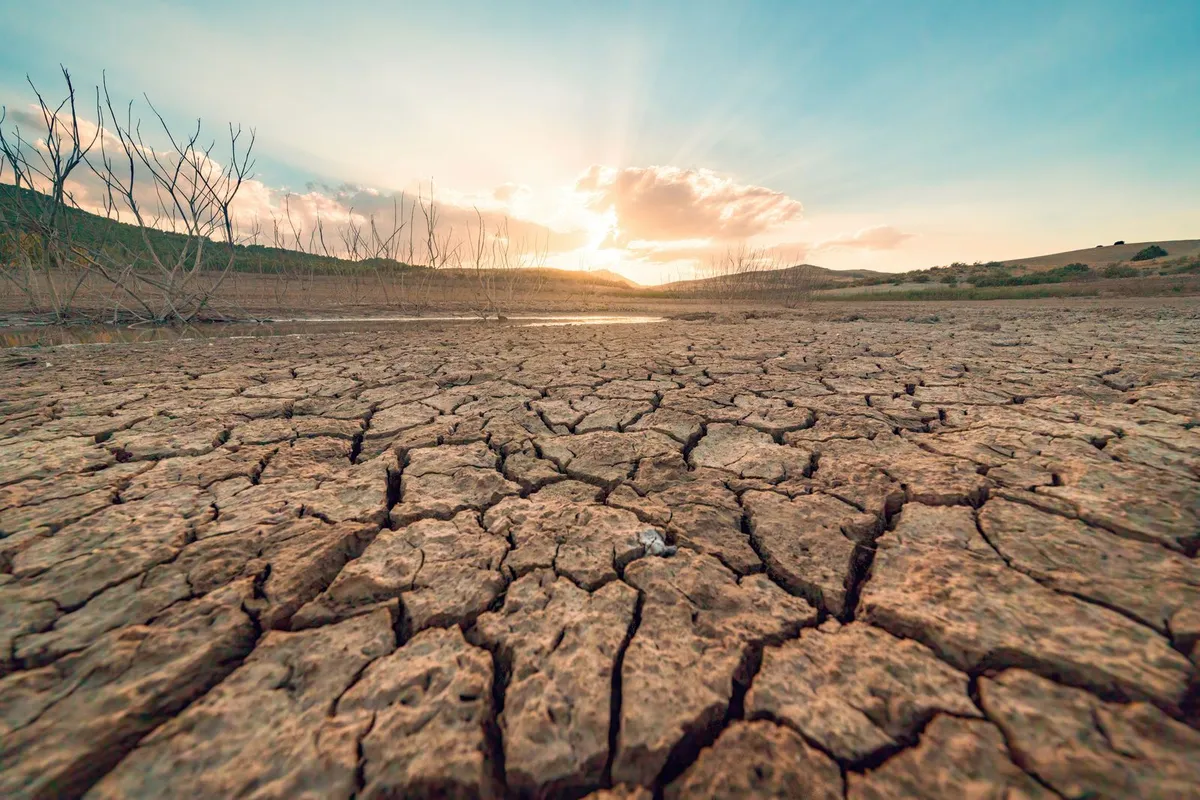
The United Nations has a new term for what's happening to the world's water systems: bankruptcy. Not a metaphor. A formal scientific definition describing regions that have exhausted their renewable water supplies and face irreversible depletion.
In 2022 and 2023 alone, more than 1.8 billion people lived under drought conditions. Four billion more face severe water scarcity for at least one month each year. Nearly three-quarters of the global population now lives in countries where water security is either unstable or critically threatened.
The language matters. "Water crisis" suggests something temporary, a shock that passes. Bankruptcy suggests something deeper: a system that has spent not just its annual water income from rivers and snowmelt, but also emptied its savings accounts of groundwater and aquifers. "Many critical water systems are already bankrupt," says Kaveh Madani, lead author of the UN report released in January and director of the UN University's Institute for Water, Environment and Health. "The bitter reality is that they are facing both insolvency and irreversibility."
We're a new kind of news feed.
Regular news is designed to drain you. We're a non-profit built to restore you. Every story we publish is scored for impact, progress, and hope.
Start Your News DetoxWhere the System Is Breaking
The crisis isn't evenly distributed. The Middle East and North Africa sit at the intersection of extreme water stress and climate vulnerability. Tehran, Iran's capital, recently came within striking distance of running out of water entirely. South Asia's groundwater tables are collapsing under the weight of agriculture and rapid urbanization, threatening both regional food production and global supply chains. In the American Southwest, the Colorado River's flow has dropped roughly 20 percent since 2000 compared to the previous century—a decline that has sparked interstate conflict over how to manage what little remains.
The human cost ripples outward. When water disappears, jobs disappear with it. Agricultural communities collapse. People migrate. The instability in Iran today offers a preview of what water bankruptcy looks like in practice: not just drought, but the social fracture that follows.
What Comes Next
The UN report suggests that current approaches—improving drinking water access, upgrading sanitation, marginal efficiency gains—are no longer enough. The world needs to formally acknowledge water bankruptcy as a distinct crisis and elevate it in negotiations around climate, biodiversity, development finance, and peacebuilding.
That means transforming agriculture through crop shifts and irrigation reforms. It means building better water monitoring systems. It means, as Madani puts it, "honesty, courage and political will." Some losses are permanent: vanished glaciers won't return, compacted aquifers won't reinflate. But preventing further depletion is still possible. Redesigning institutions to live within new hydrological limits is still possible.
The question now is whether governments will act before more regions cross from scarcity into irreversible collapse.