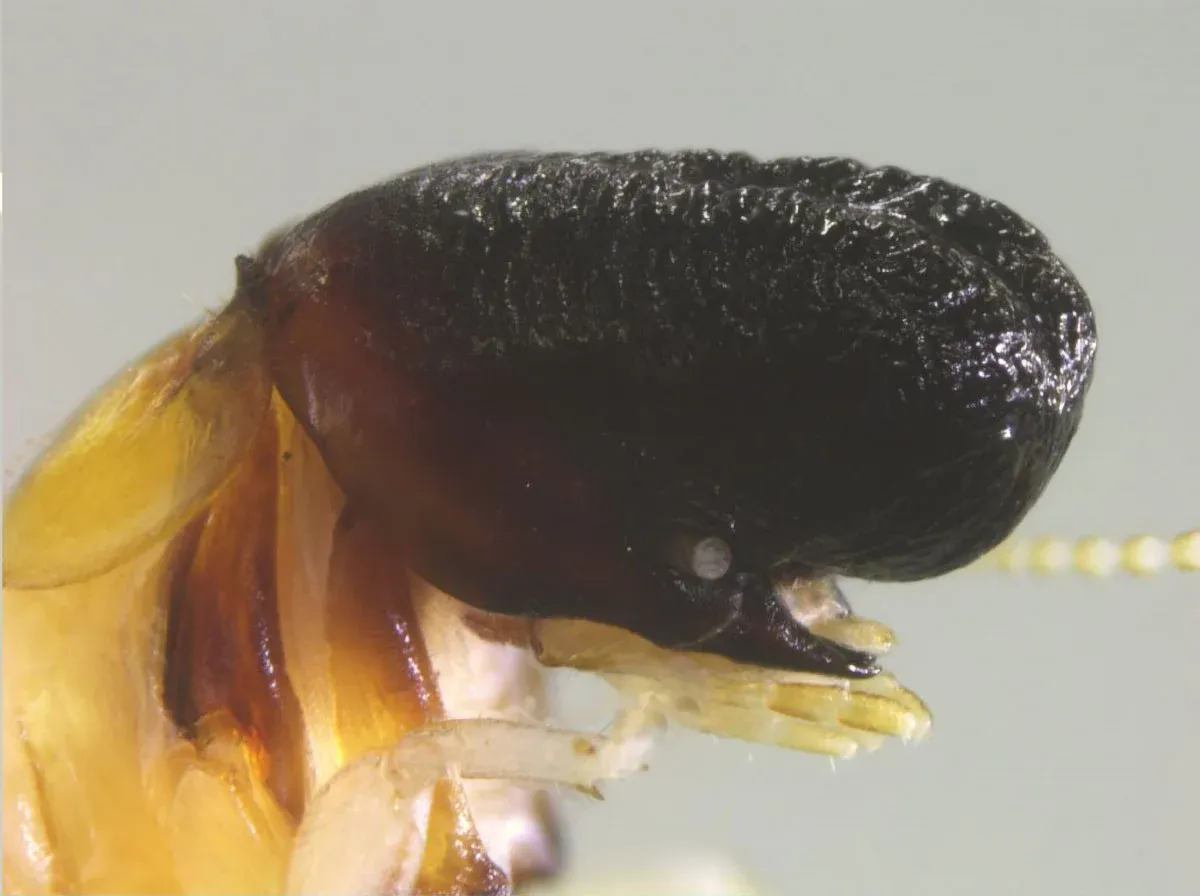
Deep in a South American rainforest, researchers found something so visually odd that they initially thought it was an entirely new type of termite. It wasn't. But it was weird enough to name after a fictional whale.
Cryptotermes mobydicki — a soldier termite discovered in French Guiana — has an elongated head and hidden mandibles that genuinely resemble a sperm whale's profile. The resemblance is so striking that Rudolf Scheffrahn, an entomologist at the University of Florida leading the research team, couldn't unsee it once he noticed it. "The lateral view of the soldier's frontal prominence and elongated head resembles the head of a sperm whale," he explained, "and in both organisms, the mandibles are eclipsed by the head."
The team found the colony living in a dead tree about eight meters up the forest floor. Under closer inspection, they realized this wasn't a new genus entirely — it was a new species within the Cryptotermes genus, bringing the South American count to 16 known species in that group. Genetic analysis shows it's closely related to termites already found in Colombia, Trinidad, and the Dominican Republic, offering clues about how this globally distributed termite family evolved.
We're a new kind of news feed.
Regular news is designed to drain you. We're a non-profit built to restore you. Every story we publish is scored for impact, progress, and hope.
Start Your News DetoxWhy This Matters
The discovery sounds like a fun footnote, but it points to something bigger: we still don't know what's living in tropical rainforests. There are roughly 3,000 termite species worldwide, which sounds like a lot until you realize how many insects exist. Every new species found — especially one this distinctive — fills in gaps in our understanding of how life diversifies and adapts.
Scheffrahn noted that "the discovery of this distinctive new termite species underscores the vast number of unnamed organisms yet to be discovered on our planet." Translation: we're still finding surprising forms of life in places we've already studied.
Here's the practical part: unlike invasive termite species that cause serious damage to homes in the southeastern United States, Cryptotermes mobydicki stays put in its rainforest home. It poses zero threat to property or trade. The whale-headed termite is content being weird in the canopy, far from your house.
The name itself — borrowed from Moby Dick — reflects a scientific tradition of playful naming. It sits alongside other whimsical species like the ghost orchid and the Dumbo octopus. As ecosystems shrink and species disappear before we even find them, discovering something this visually distinctive feels like a small win. We got to meet this termite before we lost it.