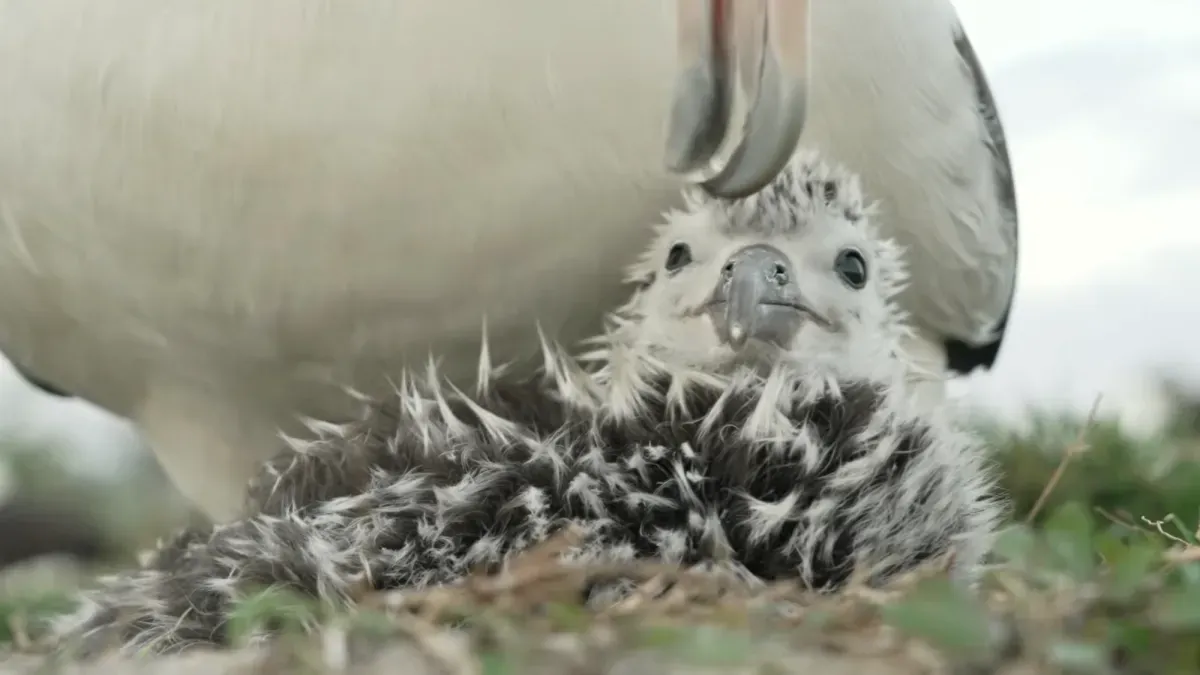
A parent albatross leans over its newly hatched chick and begins an intricate grooming ritual, using its beak with such precision that it applies only the pressure needed to clean fragile downy feathers. This moment—captured in a video by Friends of Midway Atoll—reveals something easy to miss in wildlife footage: the tenderness that keeps these birds alive.
Every year, thousands of Laysan and Black-footed albatrosses return to Midway Atoll in the Hawaiian Archipelago to breed. They reunite with their mates, lay a single egg, and begin months of careful parenting. The chicks emerge helpless, fed a nutrient-dense mix of partially digested squid and fish eggs regurgitated by their parents. That beak—a survival tool honed by millions of years of ocean life—becomes an instrument of care.
A Population That's Holding Steady
Volunteers at the wildlife refuge conduct an annual census to track how many birds return. The 2025/2026 count revealed 617,869 nests across the atoll: 589,623 Laysan albatrosses and 28,246 Black-footed albatrosses. For context, these numbers represent a population that was nearly wiped out in the early 1900s when feather hunters killed hundreds of thousands of birds. The recovery, though incomplete, shows what protection and time can achieve.
We're a new kind of news feed.
Regular news is designed to drain you. We're a non-profit built to restore you. Every story we publish is scored for impact, progress, and hope.
Start Your News DetoxAmong the returning birds is Wisdom, a Laysan albatross estimated at 75 years old. She was first banded in 1956—when the Korean War was still ongoing—and has since laid 50 to 60 eggs in her lifetime, with roughly 30 chicks successfully fledging. In 2024, at 74, she became the world's oldest known wild bird to successfully lay an egg. She was spotted on the atoll again in November 2025, though whether she's nested this season remains unclear.
Wisdom's presence matters beyond the record books. She's a living counter to the narrative that wildlife populations only move in one direction. Yes, albatrosses face real threats—ocean plastic, fishing nets, climate change affecting food availability. But here's what's also true: a bird that hatched during the Eisenhower administration is still returning to the same atoll, still raising chicks, still surviving.
If you want to watch the nesting unfold, Friends of Midway Atoll runs a 24/7 livestream from the island. You won't get the close-up detail of that careful beak preen, but you'll see the rhythm of a population that, against odds, keeps coming back.