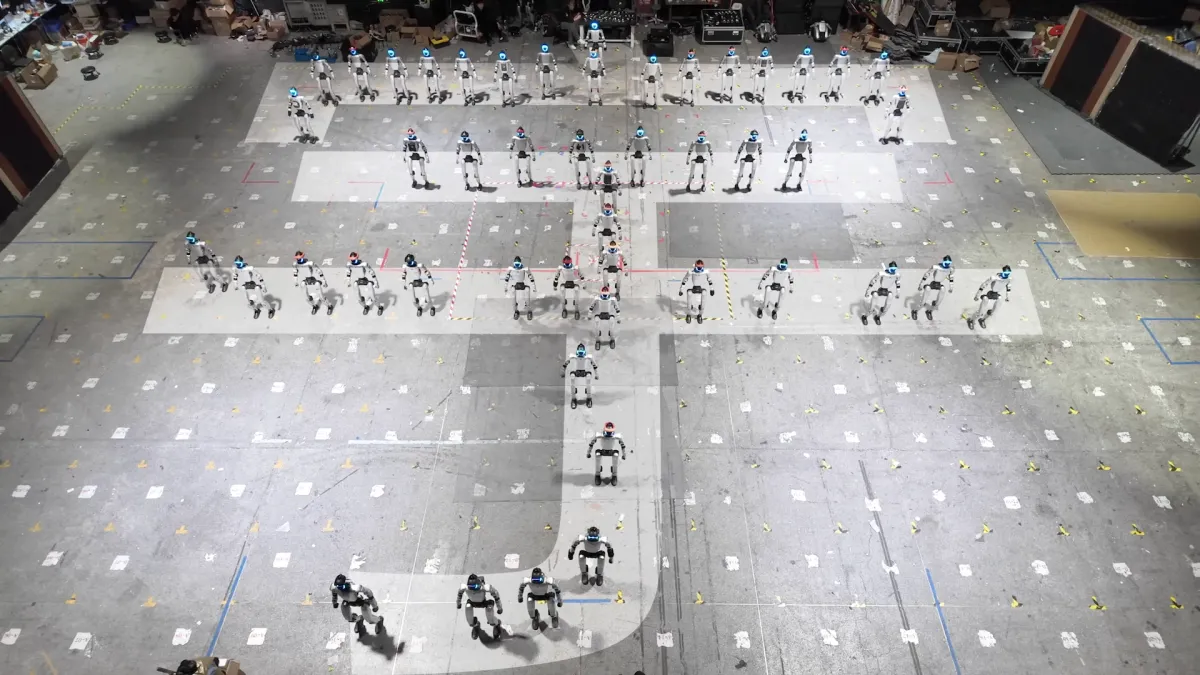
More than 40 of Unitree's G1 robots moved in perfect synchronization this week, executing a routine designed to spell out a New Year's greeting when viewed from above. No human operators guided them mid-performance. No wireless signals adjusted their movements on the fly. They simply ran the sequence they were programmed for, landing synchronized somersaults that reached 3 meters into the air and maintaining a running speed of 4 meters per second across the entire routine.
It's the kind of moment that catches people's attention—not because robots can move, but because they can move together with that level of precision. The performance, released during China's Lunar New Year celebrations (which run through late February), represents a step up from Unitree's 2025 appearance at the Spring Festival Gala, when their humanoid robots performed martial arts routines. This year, the company pushed toward something harder: coordinated group choreography.
The scaling question
What makes the performance more than just a novelty is what it suggests about manufacturing capacity. Unitree's leadership has announced plans to ship roughly 20,000 humanoid robots in 2026—nearly four times the 5,500 units the company delivered in 2025. That's the kind of production ramp that signals a company betting serious money on demand existing beyond the viral video stage.
We're a new kind of news feed.
Regular news is designed to drain you. We're a non-profit built to restore you. Every story we publish is scored for impact, progress, and hope.
Start Your News DetoxThe robots used a system Unitree calls "Cluster Cooperative Rapid Scheduling," the same framework that powered their kung fu performance last year. It's designed to coordinate multiple units without centralized real-time control—a technical challenge that matters more as production scales. If you're shipping thousands of robots annually, you need them to work reliably whether they're operating alone or in groups.
This acceleration is happening against a backdrop of intensifying competition. Elon Musk has repeatedly claimed that Chinese robotics companies will pose Tesla's biggest challenge as the automaker pivots toward its own humanoid robot, Optimus. But Musk's track record on Optimus timelines has invited skepticism—he admitted in Tesla's Q4 2025 earnings call that no Optimus units were doing useful work in the company's factories yet.
Unitree's approach looks different: quieter about timelines, more focused on visible demonstrations of what their robots can actually do. A synchronized performance of 40 units executing complex movements without human intervention is harder to dismiss than a promise.
The real test comes next. Whether these robots move into factories, warehouses, or homes depends on whether the cost-per-unit keeps dropping and the reliability keeps climbing. A viral video proves the technology works. Shipping 20,000 units proves there's a business underneath it.