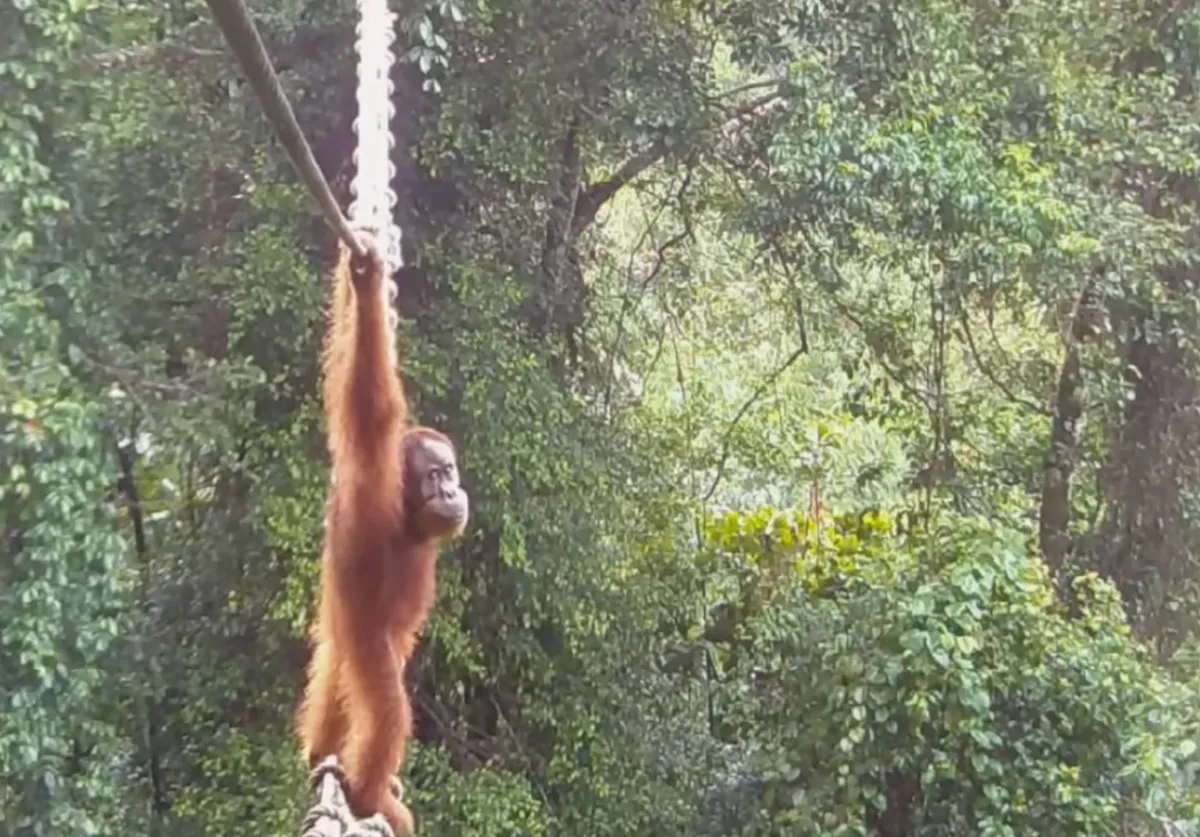
A Sumatran orangutan has been filmed using a human-made wildlife bridge for the first time. This video shows that these critically endangered animals will use artificial structures to cross fragmented habitats.
Screenshot from SOS social media video
Helen Buckland, CEO of the Sumatran Orangutan Society (SOS), shared her team's excitement with the Guardian. The young male orangutan was filmed crossing the bridge in North Sumatra. He paused briefly before continuing his journey across the ropes.
SOS noted in their social media post that they had waited two years for an orangutan to use one of these canopy bridges.
We're a new kind of news feed.
Regular news is designed to drain you. We're a non-profit built to restore you. Every story we publish is scored for impact, progress, and hope.
Start Your News DetoxBridging Fragmented Forests
The treetop bridge spans the Lagan-Pagindar road in Indonesia. This road cuts through the habitat of about 350 wild orangutans. It separates the Siranggas Wildlife Reserve from the Sikulaping Protection Forest. Habitat fragmentation can lead to inbreeding and poor health for the animals.
The road is important for local communities. It connects isolated villages to essential services like healthcare and schools. Erwin Alamsyah Siregar, executive director of Tangguh Hutan Khatulistiwa (TaHuKah), told the Associated Press that development was necessary for people. However, without intervention, orangutans would be trapped.
In 2024, road upgrades widened the gap in the forest canopy. This made it impossible for tree-dwelling animals to cross.
A Simple Solution
TaHuKah, SOS, and government agencies proposed building rope bridges to reconnect the trees. Experts studied orangutan nests, animal movements, and forest cover. They then built five wildlife bridges, each with a camera trap.
Other primates, such as gibbons, langurs, and macaques, have been seen using these rope structures. Now, conservationists know that orangutans, the world's largest tree-dwelling mammals, will also use them.
Sumatran orangutans are one of three orangutan species. They spend almost their entire lives in trees. Females rarely touch the ground, and males only occasionally travel on the forest floor. The International Union for Conservation of Nature lists them as "critically endangered." Their population is estimated to be fewer than 14,000 and is decreasing.
Most wild orangutans live in northern Sumatra. Experts are also reintroducing orangutans confiscated as illegal pets. Over 260 individuals have been released near Bukit Tigapuluh National Park and Jantho Pine Forest Nature Reserve.
Habitat fragmentation is a major threat to orangutans. Siregar told Agence France-Presse that it is one of the biggest challenges in modern conservation.
Buckland noted that these canopy bridges show that human development and wildlife can coexist. She believes that sometimes, the simplest solutions are the most effective.
Deep Dive & References
Sumatran Orangutan Society social media video First footage of endangered Sumatran orangutan using canopy bridge to cross road offers hope for species - The Guardian, 2026 Orangutan uses Indonesia canopy bridge in world first: NGO - Associated Press, 2026 World First! Sumatran Orangutan Uses Canopy Bridge to Overcome Forest Fragmentation - Sumatran Orangutan Society, 2026 Orangutan - Smithsonian's National Zoo & Conservation Biology Institute Sumatran Orangutan - World Wildlife Fund Orangutans - New England Primate Conservancy Pongo abelii - IUCN Red List of Threatened Species